Edmonton is one of the fastest-growing cities in Canada. Its transit system is no longer keeping pace.
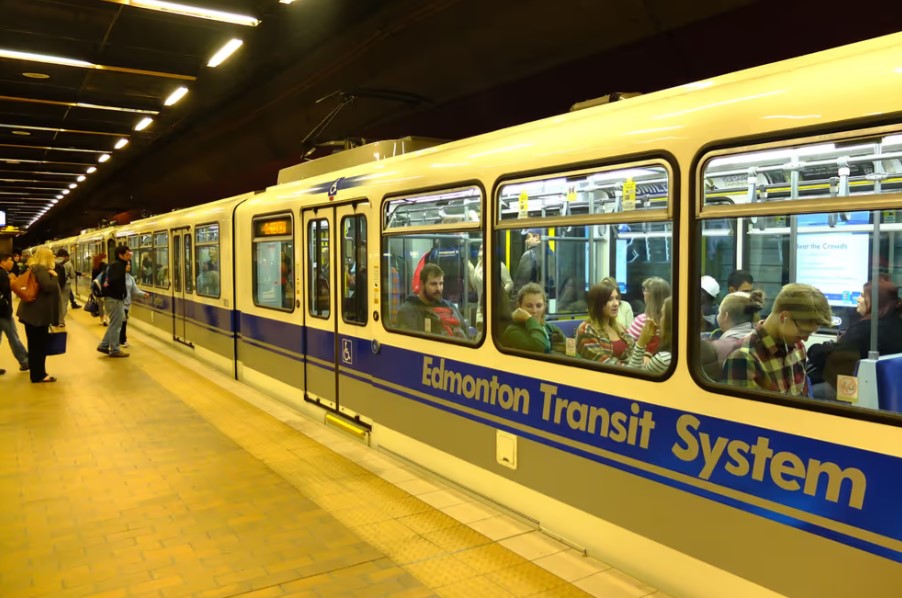
Edmonton Transit Service (ETS) carried 1.8 million fewer passengers in the last three months of 2025 compared to the same period in 2024, according to ETSAB Branch Highlights Reports the city's own official monthly transit data. It's a sharp reversal after years of recovery, and it comes as Edmonton's population grows faster than almost anywhere else in the country.
Statistics Canada data shows Edmonton's metro area grew 3% between July 2024 and July 2025 the fastest of any census metropolitan area in Canada. ETS ridership briefly outpaced that growth, hitting a record 101 million trips in 2024. By fall 2025, the momentum had flipped.
Month by Month: How the Numbers Fell
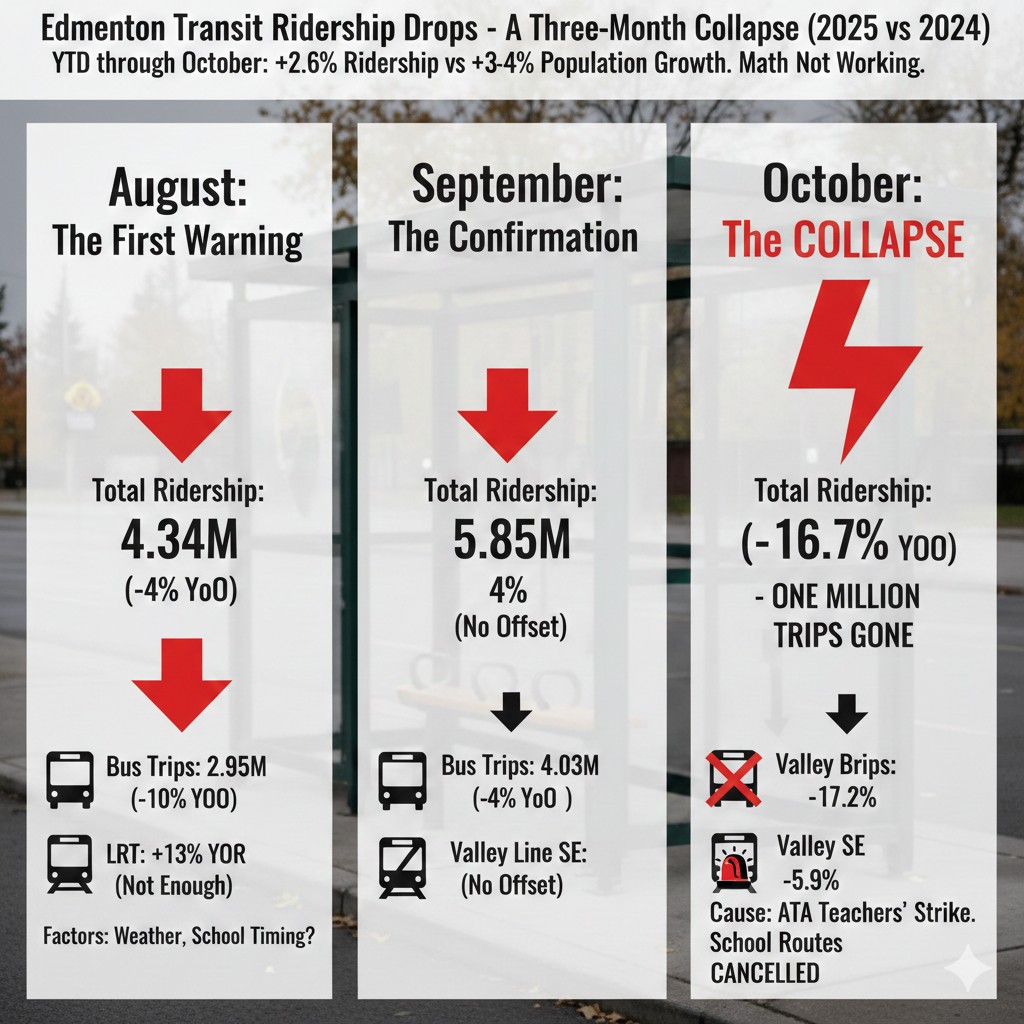
August was the first warning. Total ridership dropped 4% year-over-year to 4.34 million, with bus trips falling a sharper 10% from 3.29 million down to 2.95 million. ETS said it was analyzing factors including weather and school year timing. The LRT side held up with a 13% increase on the Capital and Metro Lines, but buses carry the bulk of the system, and they were already sliding before fall arrived.
September confirmed it. Ridership hit 5.85 million, another 4% drop from 2024. Buses fell again, from 4.20 million to 4.03 million. The Valley Line Southeast crept up slightly to 288,000 riders, but not enough to offset anything.
Then October broke open. Total ridership collapsed 16.7% from 6.45 million in October 2024 down to 5.37 million. That's over one million trips gone in a single month. The Alberta Teachers' Association strike wiped out student ridership overnight. Bus trips fell 17.2%, weekday boardings dropped 18%, and ETS cancelled most of its 600-series school special routes outright. Even the Valley Line Southeast slipped 5.9%.
Year-to-date through October, ridership was up just 2.6% while the city's population was growing at 3-4%. The math isn't working.
Construction That Never Seems to End
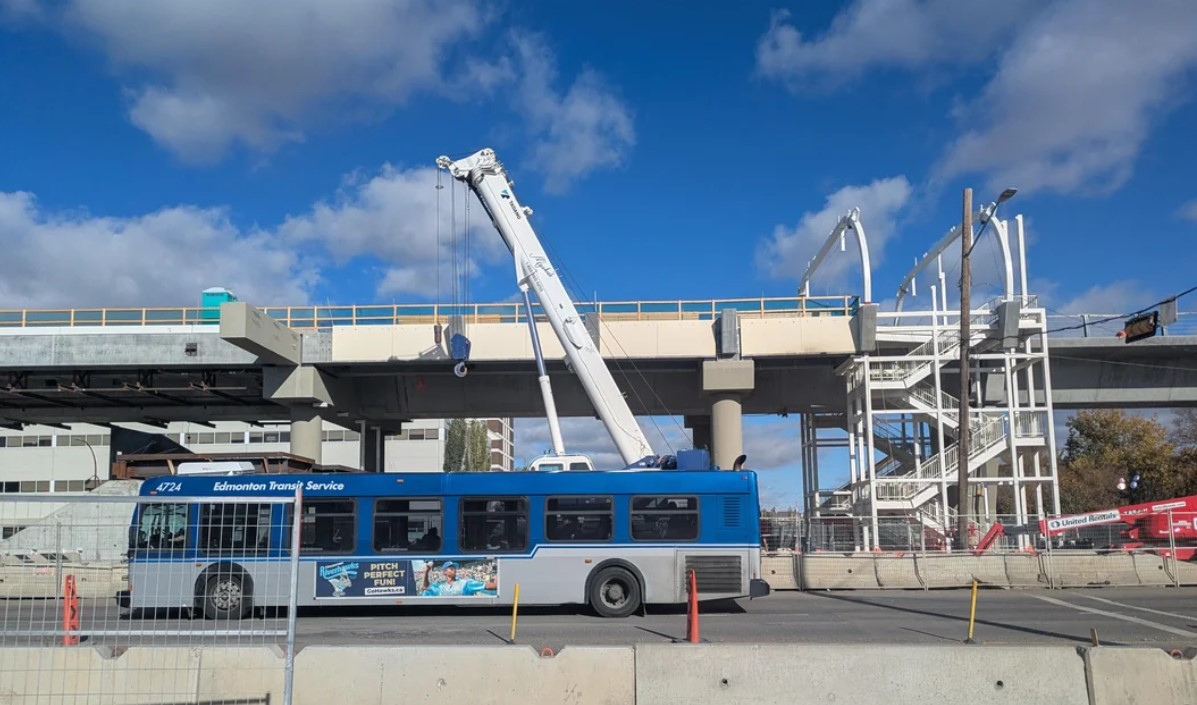
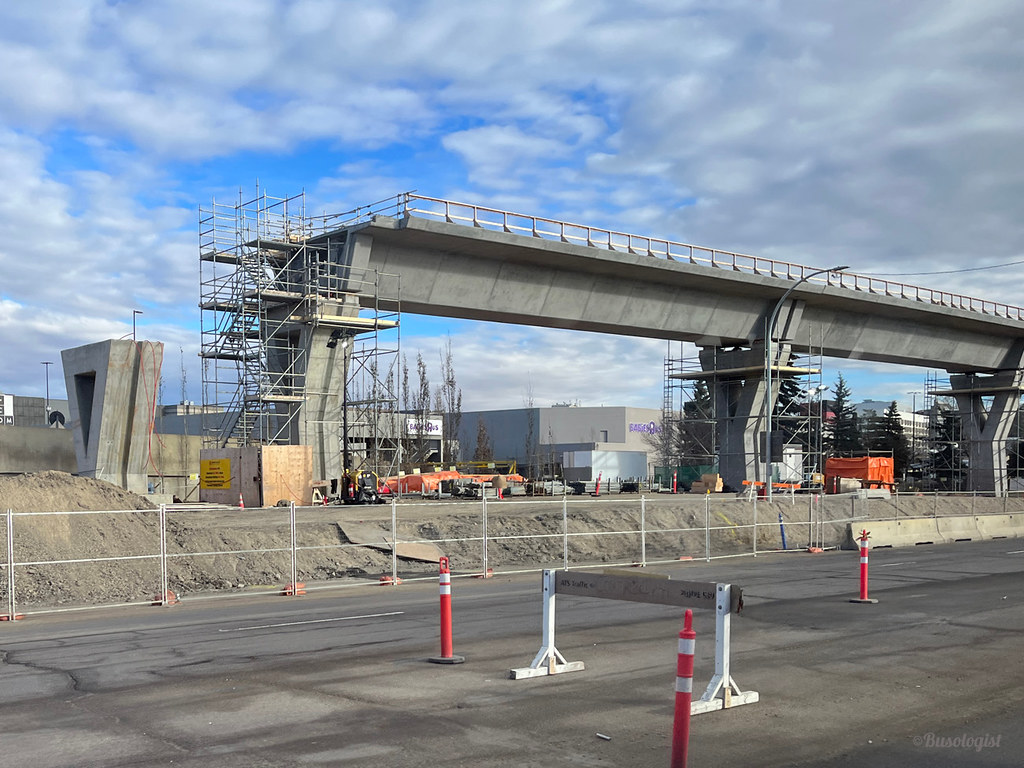
Long before the teachers' strike, riders were already dealing with disruption. Rerouted bus lines, closed stops, extended commutes construction has been a persistent friction point all year. In September alone, the entire Valley Line Southeast shut down for a full day of maintenance, and the Coliseum Station southbound track was out of service for months over the summer for bridge and track repairs. For a system trying to win over car-dependent Edmontonians, predictability is everything. Construction chips away at that trust month by month.
The Safety Problem Nobody Wants to Ignore
Beyond strikes and fare hikes, there's a harder conversation the numbers point toward: safety.
A 13-year-old boy was fatally stabbed at MacEwan Station in February 2025. Before that: a woman beaten into a coma at Coliseum Station in 2023, stabbings at Belvedere Station, and a machete attack at Southgate Transit Centre. A poll found 17% of Edmontonians are now avoiding transit entirely due to safety concerns with many more refusing to ride at night or alone.
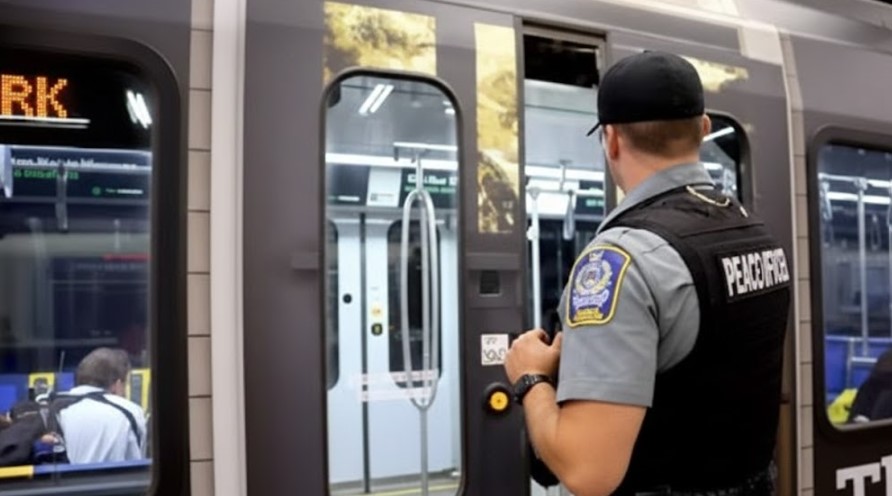
The city has rolled out an Enhanced Transit Safety Plan, hired more Transit Peace Officers, and secured millions in provincial funding for cameras and security upgrades. But the ETSAB's own 2025 report acknowledged the uncomfortable truth: high-profile violent incidents shape how safe people feel, regardless of what the crime statistics say. Perception is its own kind of reality when someone is deciding whether to get on the bus.
What the City Was Hoping For
As recently as June 2024, ETS Director of Transit Planning Sarah Feldman put it plainly: "We want ridership to grow as the city grows and even better if it outpaces growth."
For most of 2024, that was happening. The reversal in fall 2025, against a backdrop of a city adding tens of thousands of new residents every year, is a clear signal that population growth alone doesn't build a transit city. Investment, reliability, and safety do.
The December 2025 ETSAB report has not yet been published the full Q4 picture is still incomplete.
Sources: ETSAB Branch Highlights Reports August, September, October and November 2025, City of Edmonton. Statistics Canada subprovincial population estimates, January 2026.









Comments
Conversation