Alberta tabled its 2026 budget Thursday, and for Medicine Hat residents the news cuts both ways. The city scored some major long-term wins, but it comes alongside a tax picture that's been quietly frustrating Hat homeowners for two years running.
The Big Win: Highway 3 Twinning Is Finally Happening
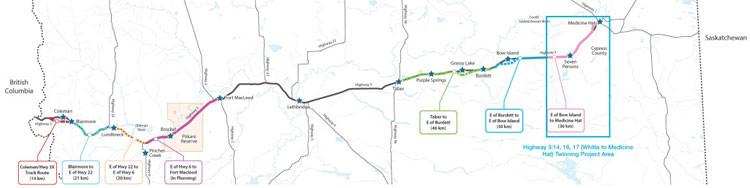
This one has been a long time coming. The province has committed $152 million over three years to twin Highway 3 from Seven Persons into Medicine Hat $72 million in 2026-27, $20 million the year after, and another $60 million in 2028-29. For anyone who drives that stretch regularly, this is significant. Highway 3 has been flagged as a safety concern for years, with a mix of commercial trucks and local traffic sharing a two-lane road. It's the largest direct capital investment in Medicine Hat named anywhere in the budget documents.
Medicine Hat College Gets Provincial Money
Medicine Hat College is receiving $2 million in 2026-27 toward its Centre for Community Wellness. It's modest compared to the highway investment, but it's confirmed capital funding for a project that expands student health and community programming on campus.

The Part That Stings: Your Tax Bill Is Going Up Again
Here's where it gets complicated for Hat homeowners. Medicine Hat city council already approved back-to-back 5.6% municipal property tax increases for 2025 and 2026 about $10 more per month for the average $315,000 home. That was the city's decision.
But there's a second layer most people don't think about: roughly 30% of your property tax bill doesn't stay in Medicine Hat it goes straight to the province as an education requisition. Medicine Hat's share of that provincial education tax jumped 12% in 2025, adding $3.1 million more to what the city collects on the province's behalf. Budget 2026 shows that education property tax revenue is being pushed from $3.12 billion this year to $3.59 billion in 2026-27 provincially another roughly 15% increase on top of last year's hike.
The president of Alberta Municipalities put it plainly last December: "About 30 per cent of property taxes in Alberta actually go to the province instead of municipalities, but many residents don't realize that. This year the province increased its property taxes by 14 per cent, and next year it's planning another 10."
So when your tax bill arrives this spring, the increases you see aren't entirely your city council's doing.
The Utility Advantage For Now
One thing that has historically offset Medicine Hat's cost of living is the city's unique position as the only municipality in Alberta that owns and operates its own natural gas and electricity utility. Residents paid an average of $688 less than their counterparts in Calgary, Edmonton, Lethbridge and other major Alberta cities in the first half of 2025.
That advantage isn't going away, but it's been a point of tension locally. In 2023, the power plant produced a record $134 million dividend for the city leading to public accusations of profiteering off residents. That prompted rebates and a pricing overhaul. By 2024, as energy markets cooled, dividends collapsed to just $12 million. City council voted in July 2025 to pause discussions about creating an arm's-length corporation to run the utility a move that would have brought Medicine Hat in line with how Calgary's Enmax and Edmonton's EPCOR operate.
For now, residents still benefit from lower rates than almost anywhere else in the province. Whether that continues long-term is a conversation Medicine Hat hasn't finished having.
The Bottom Line
Medicine Hat gets $152 million toward Highway 3 twinning, $2 million for Medicine Hat College, and draws from provincial pools for municipal infrastructure. In return, homeowners are absorbing another year of compounding property tax increases some from city hall, and some from a provincial education requisition that's risen sharply two years in a row with no signs of slowing.
Sources: Alberta Budget 2026 Capital Plan Tables, Government of Alberta




Comments
Conversation