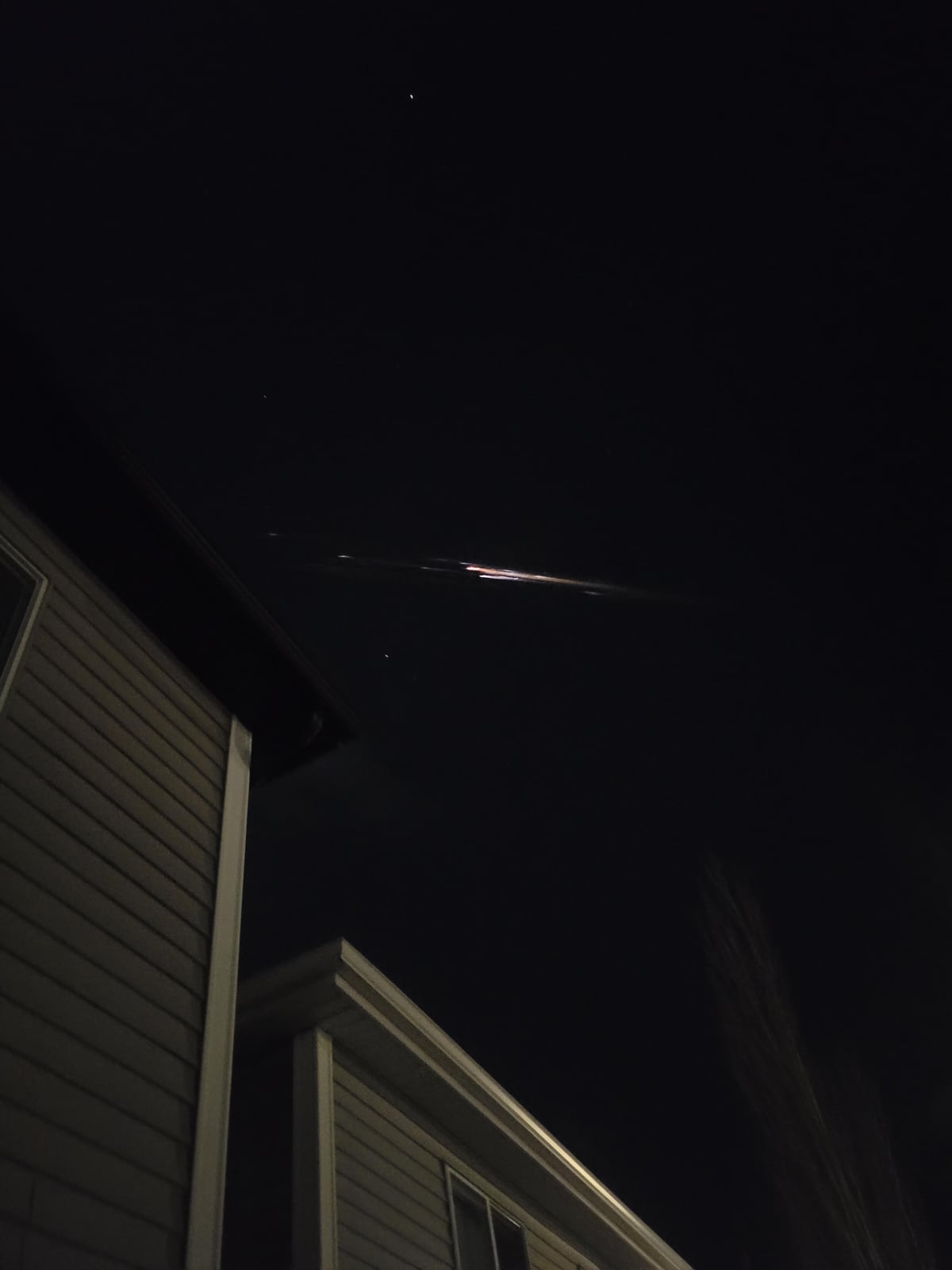
Around 7:54 p.m. Thursday, phones started lighting up across Calgary. People were outside, looking up, pulling out their cameras. A brilliant streak of light was breaking apart across the sky multiple glowing fireballs trailing through the dark above the city.
The immediate guesses were predictable. Meteor. Aliens. Missile. One look at social media and you'd find all three.
The real answer: it was a SpaceX Starlink satellite, launched back in 2020, finally burning up on its way back to Earth. Astronomer Jonathan McDowell the Harvard-Smithsonian researcher who has become the go-to expert for identifying exactly what just fell out of the sky confirmed the reentry of Starlink-1723 matched the time and trajectory over Calgary.
No danger. No debris expected to reach the ground. Just a five-year-old satellite doing what it was designed to do at the end of its life.
This Is Becoming Normal
Here's the thing: this wasn't a freak event. It wasn't even unusual.
By early 2026, SpaceX has over 9,000 Starlink satellites in orbit. They're designed with a lifespan of roughly five years, after which they're slowly lowered out of orbit to burn up in the atmosphere. Right now, one to two Starlink satellites are falling back to Earth every single day most of them going completely unnoticed because they burn up over oceans or uninhabited areas in the middle of the night.

When one happens to pass over a major city at dusk, you get exactly what Calgary saw Thursday.
It's not the first time this has happened in the prairies. In September 2025, Saskatoon residents captured video of a Starlink reentry lighting up the sky just after midnight also initially mistaken for something far more dramatic. That same year, a 2.5-kilogram fragment of a Starlink satellite was found on a farm in Saskatchewan, a reminder that "designed to fully burn up" and "actually fully burns up" aren't always the same thing.
The Bigger Picture
The fireballs are spectacular. The science underneath them is getting complicated.
As more satellites burn up in the upper atmosphere, they release vaporized metals primarily aluminum oxide that settle into the stratosphere, where the ozone layer lives. NASA sampling flights over Alaska in 2023 found that roughly 10 per cent of stratospheric particles at altitude already contained metals traceable to spacecraft reentries. Scientists at institutions including the University of British Columbia have flagged this as a problem that's being outpaced by the rate of launches.
The regulations governing satellite reentry risk were written for an era when a few dozen objects came down per year. SpaceX alone is now on track for hundreds annually, with filings for global megaconstellations totaling over 70,000 spacecraft on the books.
Thursday night over Calgary was a good show. The question scientists are starting to ask is what 70,000 of those shows does to the atmosphere over time.
For now, the sky is clear, nobody got hurt, and Calgary got a story to tell.
Source: Alberta Substance Use Surveillance System alberta.ca/substance-use-surveillance-data; Jonathan McDowell, Harvard-Smithsonian Center for Astrophysics; NASA atmospheric sampling data









Comments
Conversation