Looking for the next payment? See the 2026 AISH payment dates and the AISH calculator.
If you are living with a permanent disability in Alberta and trying to figure out your options, you have probably heard of both AISH and CPP Disability. On the surface they sound similar monthly payments for people who cannot work. But the two programs operate completely differently, and applying for the wrong one first can cost you time, money, and income.
Here is how they compare.
What Is AISH?
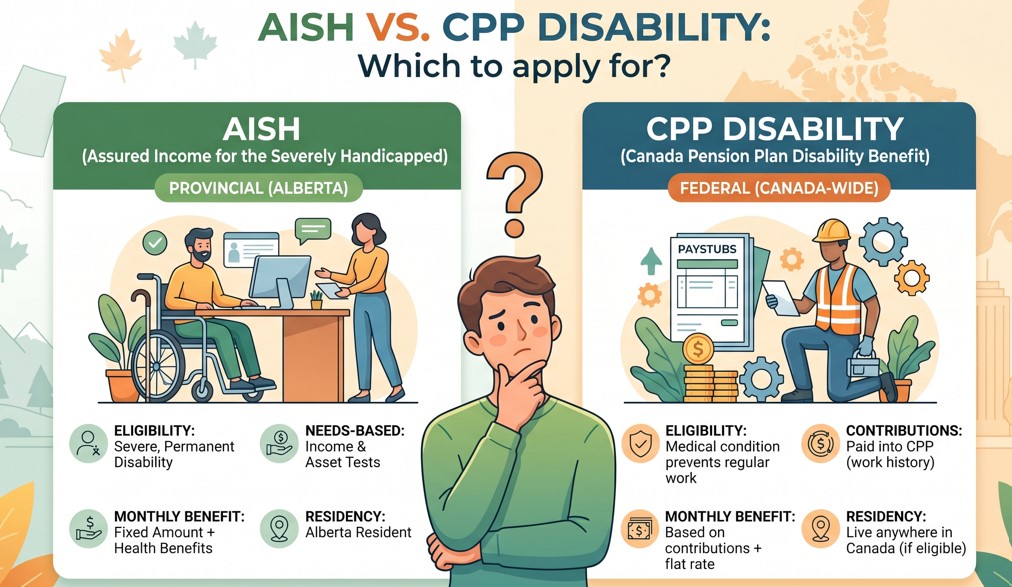
AISH Assured Income for the Severely Handicapped is a provincial program providing financial and health benefits to eligible Albertans with a permanent medical condition that prevents them from earning a living. It is administered by the Government of Alberta and designed as a floor-level income support program.
The current monthly living allowance is $1,940 for a single person who rents or owns a home. On top of that, recipients receive health benefits covering prescription drugs, dental, optical, and ambulance services.
To qualify, your condition must be the primary reason you cannot earn a living not education level, not circumstances. AISH also looks at whether medical treatment, therapy, or rehabilitation exists that could help you improve your ability to work. If something is available that could help you earn a living, AISH factors that in. The standard is high.
Financially, you and your spouse or partner must apply for all other income you may be eligible for, including CPP Disability, Employment Insurance, and Workers' Compensation benefits. AISH is explicitly designed as a last resort after other sources are tapped. Non-exempt income is clawed back dollar-for-dollar from your monthly allowance. Non-exempt assets cannot exceed $100,000. Your primary home and main vehicle are generally exempt.

What Is CPP Disability?
CPP-D is a monthly taxable benefit for working-age Canadians who are unable to work due to a severe and prolonged disability. Unlike AISH, it is available to anyone who has made sufficient CPP contributions regardless of province, employer, or occupation.
The key word is contributions. To qualify, you must have made valid CPP contributions in at least four of the last six years. If you have not worked enough and paid into the Canada Pension Plan, CPP-D is simply not available to you.
The monthly basic amount is $598.49, plus an amount based on your lifetime CPP contributions. The maximum monthly payment in 2025 is $1,673.24. The average paid out in 2025 was $1,538.67. Most people land somewhere between the floor and the ceiling depending on their work history.
Unlike AISH, CPP-D is taxable income and is not tied to your assets or your partner's income.
The Core Difference
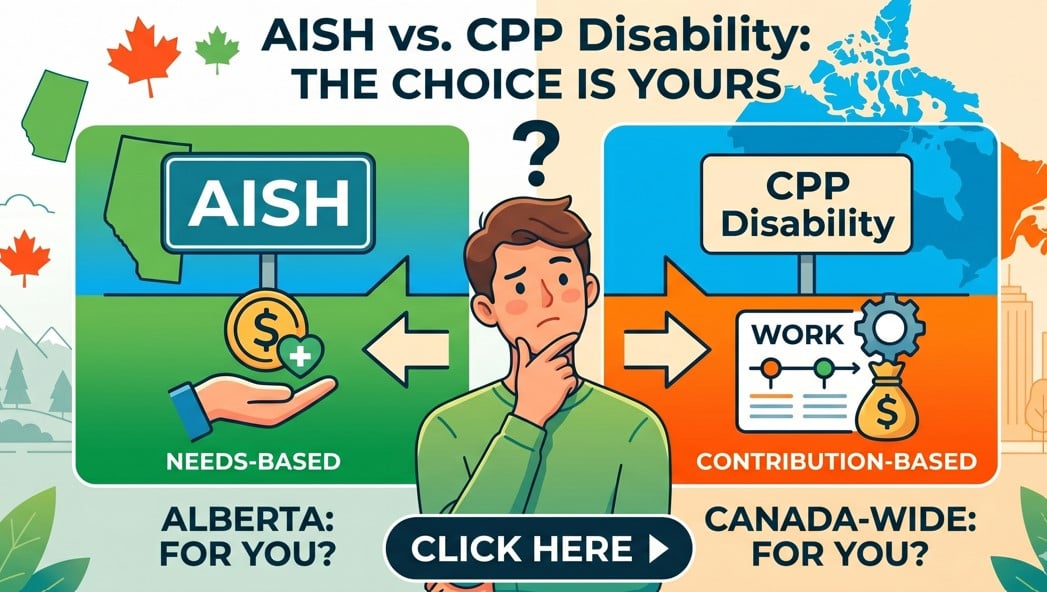
AISH is needs-based. CPP-D is contribution-based.
If you have never worked or worked informally without CPP deductions CPP-D is likely off the table. AISH is the program built for you. If you have a strong work history with CPP contributions, you may qualify for CPP-D regardless of your financial situation or asset level.
The disability definitions differ too. AISH requires a permanent medical condition that substantially limits your ability to earn a living. CPP-D uses a federal standard the disability must be both severe and prolonged. You must be incapable of regularly pursuing any substantially gainful occupation, not just your previous job, and the condition must be long-term or indefinite.
Can You Collect Both?
Technically yes, but there is a catch. AISH offsets CPP Disability benefits dollar-for-dollar. If you receive CPP-D, that amount is subtracted from your AISH monthly allowance. Getting both does not double your income.
That said, there are real reasons to pursue CPP-D even if you are already on AISH. When you are not working due to a disability, CPP records your income as zero, which would otherwise drag down your retirement pension average later in life. Applying for CPP-D triggers a disability dropout provision that removes those zero-income years from the retirement calculation. That can meaningfully increase your CPP retirement pension down the road.
Apply for both if you qualify. The monthly income gain while on AISH may be modest, but the long-term retirement protection is real.
Applying for AISH
Apply directly through the Alberta government online or at an Alberta Supports Centre. You will need medical documentation, financial records, and details on your household income and assets. Processing times vary. Applicants receiving palliative care or with a terminal diagnosis are prioritized.
Applying for CPP-D
Apply through Service Canada online, with a consent form submitted by mail. A decision can take up to 120 days from the date a complete application is received. Initial denial rates are high, but approved applicants receive a retroactive lump-sum payment covering up to 12 months. If denied, you can request a reconsideration and appeal to the Social Security Tribunal.
A Major Change Coming This July
Albertans on AISH should know the program is changing. Starting July 1, 2026, all current AISH clients will be transitioned to the new Alberta Disability Assistance Program (ADAP). The ADAP benefit is $1,740 per month $200 less than the current AISH rate.
Those assessed as completely unable to work will be able to reapply for AISH and undergo a new medical assessment. Those who do not re-qualify remain on ADAP at the lower amount. A transition benefit will keep payments the same until the end of 2027 for those affected. The change has drawn strong criticism from disability advocates, physicians, and several Alberta city councils, including Calgary, Edmonton, Red Deer, and Lethbridge.
If you are currently on AISH, watch for communication from the province before July 1 about your specific path forward.
Which Should You Apply For First?
If you have a solid work history with CPP contributions, start with CPP-D. The benefit is not income-tested, there is no asset limit, and it protects your future retirement pension.
If you have not worked enough to qualify for CPP-D, or if your CPP-D amount would be low, AISH is your primary program. Apply immediately processing takes time.
If you qualify for both, file both applications. The income offset is real, but so is the retirement protection.
Alberta Supports Centres can help with AISH applications. For CPP-D appeals, legal representation significantly improves approval odds.
Sources:
Government of Alberta (alberta.ca), Government of Canada (canada.ca), Inclusion Alberta (inclusionalberta.org), Alberta Doctors' Digest








Comments
Conversation