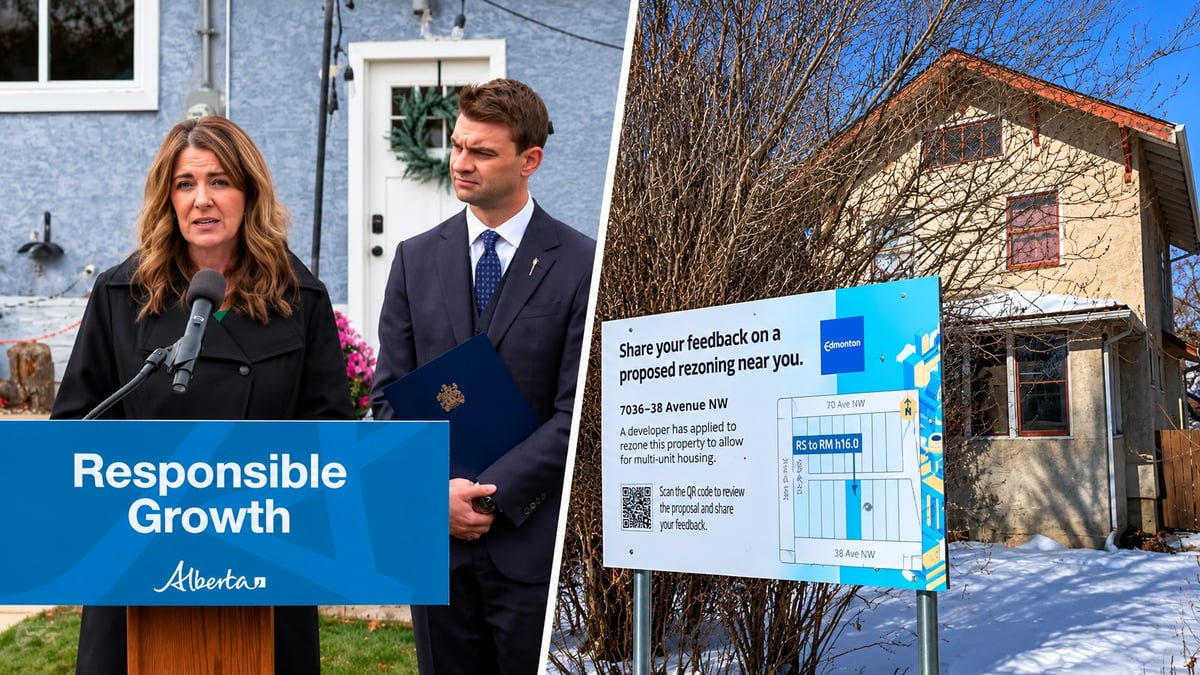
Edmonton spent years making it easier to build more homes in established neighbourhoods. Now the Alberta government is ordering it to reverse course.
Premier Danielle Smith and Municipal Affairs Minister Dan Williams announced on Thursday, Oct. 8, that Edmonton must go back to the rules it had before 2024 for housing types, density and building height.
The city also has to bring back minimum parking requirements, which it dropped in 2020.
Edmonton has three months to comply, until about Jan. 8, 2027.
"Whether it's your first home or your forever home, Albertans want neighbourhoods where they have room to live, a place to park and a community they can be part of," Smith said. "We've heard from Albertans who feel the pace and scale of some high-density infill is changing that."
What changes in Edmonton
Edmonton's current zoning bylaw took effect on Jan. 1, 2024. It cut the city's residential zones from 16 to six, and made it easier to replace a single house with duplexes, rowhouses and small apartment buildings.
The province is ordering Edmonton to:
Go back to its pre-2024 rules for what types of homes can be built on a lot, how many, and how tall.
Restore minimum parking requirements from before 2020.
Review its land use rules over the next 18 months, with public consultation.
None of this changes Edmonton's zoning overnight. Council first has to amend the bylaw.
Parking is coming back
In 2020, Edmonton became the first major Canadian city to drop minimum parking requirements entirely. Since July 2 of that year, builders have decided how much parking a project needs, instead of the city setting a number.
The City argued the old minimums made housing more expensive. Its own estimate puts the cost of one parking stall at anywhere from $7,000 to $60,000, depending on the type, and that cost ends up in home prices and rents.
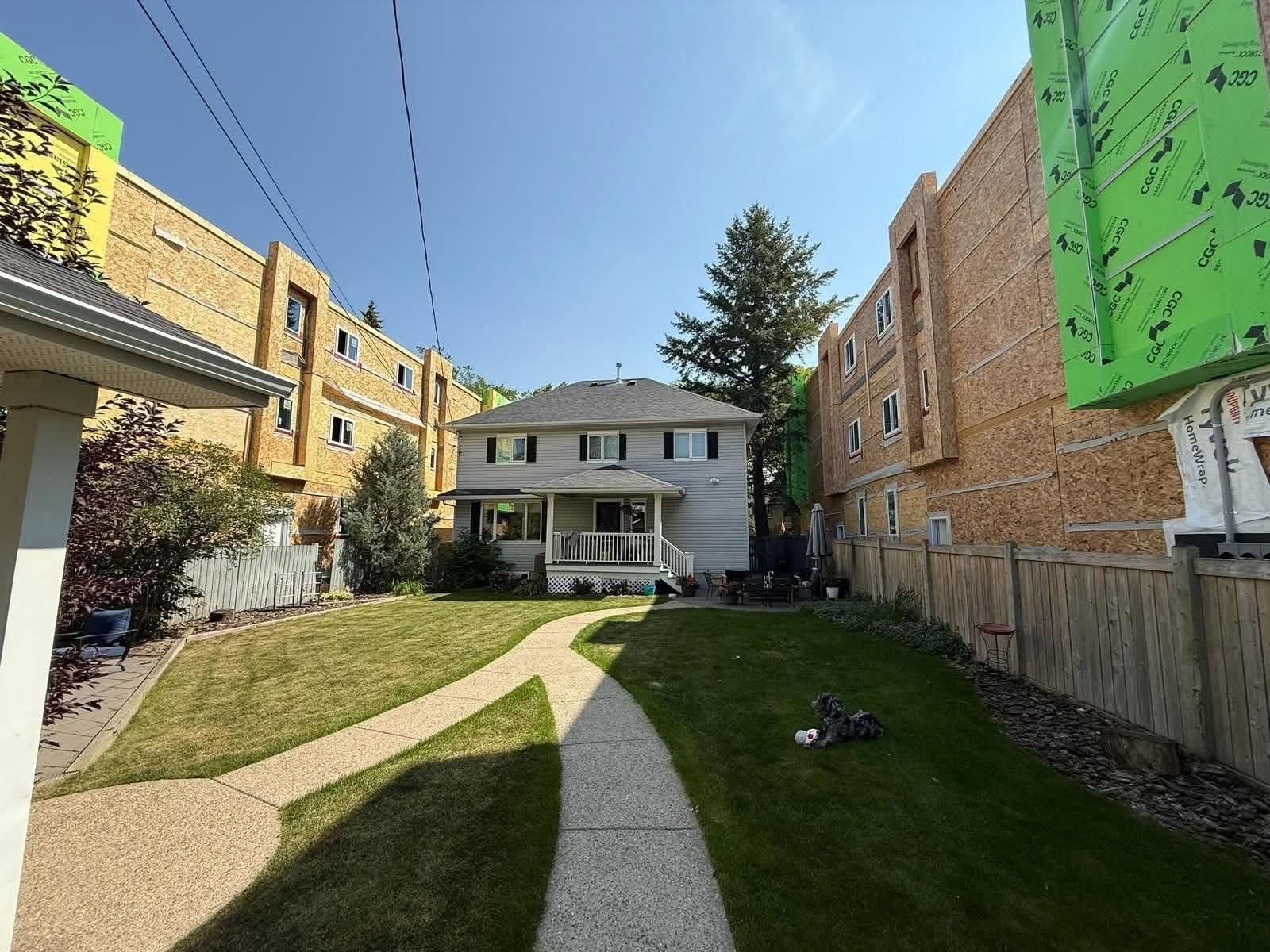
Neighbours of new infill have complained about the result: multiplexes with few parking spots, and cars lining the street.
Bringing minimums back means new developments will likely have to include more on-site parking. How many spots will depend on the rules Edmonton writes. Existing homes won't have to add parking.
Why Smith says it's needed
Smith laid out her case in a post on X on Thursday morning.
She said she'd heard from "endless Albertans" with the same story. "They saved for years to buy a single family home on a quiet street," she wrote. "Then one morning the house next door came down, with no notice, and later a 16 unit complex went up in its place, with nowhere for anyone to park and no consideration for the neighbourhood."
"Those are not complaints," she wrote. "They are people describing the place they built a life in with their family."
She also pushed back on the idea that the move will slow down home building. "Alberta needs more homes. We are building more of them than almost anywhere in Canada," she wrote. "But a home is more than a house, and a neighbourhood is more than a supply of lots."
Smith also raised concerns about water and utility capacity, and said the current rules are hurting some homeowners' property values.
What the rules actually allow
Smith didn't say where her 16-unit example came from.
Under Edmonton's current Small Scale Residential Zone, which covers much of the city's residential land, the most homes allowed on an interior lot is eight, generally in buildings up to three storeys. Larger buildings are allowed in other zones, like those set aside for medium-scale housing.
So a 16-unit building isn't automatically allowed on a typical residential lot. It depends on how that lot is zoned.
A split reaction
Smith's post drew tens of thousands of views and hundreds of replies within hours. Some replies described multiplexes going up on people's own streets with little parking. Others, including self-described lifelong conservatives, called it provincial overreach into a city decision, and some asked where Alberta's growing population is supposed to live.
What about projects already approved?
That's still unclear.
Builders may already have permits, applications in progress, or projects under construction. The province hasn't said how those will be handled, and the City will need to explain how it plans to deal with them as it rewrites the rules. Thursday's announcement didn't cancel any approved projects.
Why Edmonton changed its rules
Edmonton's 2024 overhaul was meant to solve a different problem: where to put a fast-growing population without the city spreading farther out.
City planners argued that adding homes in established neighbourhoods, close to schools, transit and existing pipes and roads, is cheaper than building new suburbs. Supporters say limiting most streets to detached houses makes it harder for young families and first-time buyers to get in.
Council has already tweaked the rules several times in response to complaints, including lowering height limits in small-scale residential zones and tightening setbacks for new builds.
The bigger plan behind it
The 2024 zoning changes came out of Edmonton's City Plan, the long-term growth plan council adopted in 2020.
The City Plan aims for half of all new homes to be built through infill, in neighbourhoods that already exist, rather than new suburbs on the city's edge. It also calls for "15-minute districts," where most daily needs, like groceries, schools, parks and services, are within about 15 minutes by walking, biking or transit.
Allowing more homes on residential lots was one of the main ways the city planned to get there.
The idea of "15-minute" communities has drawn false claims online that it means restricting where people can go. Edmonton's plan doesn't limit travel. It's about having more of what people need close to home.
The province's order doesn't cancel the City Plan. But it removes one of the main tools Edmonton was using to meet it, and the 18-month review will decide what replaces it.
What about Calgary?
Calgary council voted on April 8 to repeal its 2024 blanket rezoning, which had allowed rowhouses and similar homes on most residential lots. The repeal took effect Aug. 4.
About 99 per cent of the affected properties were expected to go back to their old zoning, according to the City. Some properties with qualifying applications or approvals were exempted.
The province is ordering Calgary to keep that in place, and to create an overlay, a map layer marking the land returned to low-density zoning. Calgary's broader land use review is set to finish in 2027.
Williams credited Calgary council for listening to residents.
What about Edmonton's $202 million in federal money?
Edmonton has a $202-million deal with Ottawa through the Housing Accelerator Fund, which pays cities to remove barriers to building housing. It started at about $175 million in 2024, and grew from there.
The money funds 16 projects, including zoning changes, faster permitting, affordable housing and building near transit. The City says it's meant to help create more than 6,000 extra homes.
Edmonton has already received three of its four payments. To get the full amount, it has to hit housing permit targets by November 2026. As of July 2026, the City said it had finished 10 of its 16 projects and was on track.
Calgary's own Housing Accelerator Fund deal is worth $228 million.
The province didn't say what its order means for Edmonton's final payment, and Ottawa hasn't said whether it will affect the city's agreement.
Sources
Government of Alberta, news release, October 8, 2026
Danielle Smith, post on X, October 8, 2026
Small Scale Residential Zone, City of Edmonton
Open Option Parking, City of Edmonton
Housing Accelerator Fund, City of Edmonton
Repeal of citywide rezoning, City of Calgary








Comments
Conversation