
A Tale of Two Economies
February was a rough month for Canada's job market. Then again, it depends on where you live.
Nationally, the numbers were bad enough that economists reached for words like "gut punch" and "decidedly weak." Tens of thousands of jobs disappeared across Quebec, British Columbia, Saskatchewan and Manitoba. The unemployment rate climbed. The mood was grim.
Nobody told Alberta.
What Happened to the Rest of Canada
Canada shed 84,000 jobs in February, pushing the national unemployment rate to 6.7 per cent. Quebec took the hardest hit 57,000 jobs gone, the province's worst monthly loss in over four years. BC lost 20,000. Saskatchewan and Manitoba both fell too.
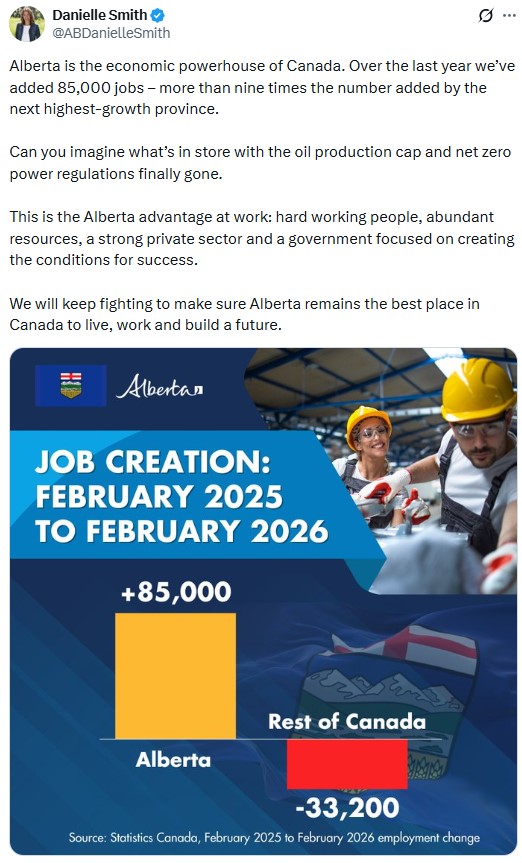
After a strong hiring run to close out 2025, back-to-back losses to open 2026 mean the entire country has added just 80,000 net positions over the last six months. For context, Alberta alone added more than that in a year.
Prime Minister Carney, speaking from Norway, pointed to U.S. tariff pressure as the culprit. Fair enough. But tariffs don't fully explain why one province is moving in the opposite direction from everyone else.
Alberta's Numbers
Alberta's unemployment rate sat at 6.3 per cent in February down from the month before, down from the year before, and below the national average. Roughly 2.65 million Albertans were employed.
Year over year, the province added about 86,400 jobs a 3.4 per cent jump. Premier Danielle Smith rounded that to 85,000 in a social media post Friday, adding that it was more than nine times the job growth of the next closest province. She called Alberta "the economic powerhouse of Canada."
That's a political line. It also happens to be backed by data.
What's Driving It
Healthcare and social assistance grew more than 10 per cent year-over-year. Construction kept pace, powered by 54,858 housing starts across the province in 2025 most of them in Edmonton and Calgary. New energy projects are coming online. Oil prices, pushed higher by Middle East tensions, have kept the sector in hiring mode.
Alberta's economy has been quietly diversifying for years. The headline still says oil, but the actual job growth is spread across healthcare, construction, and services. That mix is proving more resilient than most expected heading into a year defined by trade uncertainty.

How Long Does It Last
Smith's broader argument is that Alberta was being held back by federal production caps, net zero regulations, carbon pricing and that the province is only now running at something closer to its real capacity. "Can you imagine what's in store," she wrote.
It's impossible to fully separate the economics from the politics there. But the gap between Alberta and the rest of Canada right now is wide enough that it demands an explanation beyond talking points.
The risk is real though. A prolonged trade war with the United States will find Alberta eventually energy demand softens, investment gets cautious, and hiring slows. February's numbers are a snapshot, not a guarantee. For now, they're a good one.

Source:
Statistics Canada Labour Force Survey, February 2026 / Premier Danielle Smith / Government of Alberta







Comments
Conversation