
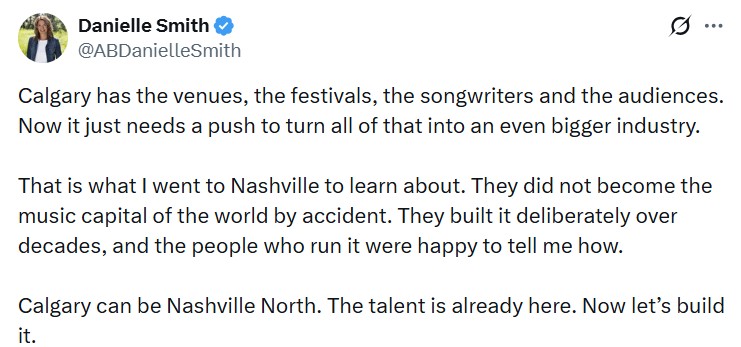
"Calgary can be Nashville North," Premier Danielle Smith wrote in a column published Saturday. "The talent is already here. Now let's build it."
She was in Nashville this week on what her office described as a personal trip, taking time to meet with the head of the city's chamber of commerce, Tennessee tourism commissioner Mark Ezell, and the chief executive of a Nashville tourism marketing agency.
"They did not become the music capital of the world by accident," Smith wrote. "They built it deliberately over decades, and the people who run it were happy to tell me how."
The two numbers
Smith cited both figures herself.
Calgary's music industry: roughly $2.3 billion in value.
Nashville's: $28.3 billion.
Nashville's industry is about twelve times the size.
Smith said the Tennessee capital made the changes that got it there about 25 years ago, and that she wanted to find out what those were.
"I want to find out a little bit about what that is and see if we can develop some excellent partnerships with the music industry so that we can do a transfer of talent," she said before the trip.
What Smith says Calgary already has
Her argument is that the raw material exists.
"Calgary has the venues, the festivals, the songwriters and the audiences," she wrote. "Now it just needs a push to turn all of that into an even bigger industry."
That's not an unreasonable read. Calgary has the Stampede, the Calgary Folk Music Festival, Sled Island, a country music infrastructure that runs year-round, and a venue base from small rooms up to the Saddledome.
The Stampede agrees
Joel Cowley, chief executive of the Calgary Stampede, said Smith's vision aligns with the organization's 20-year master plan for Stampede Park.
"If you were looking for inspiration for Calgary's Culture and Entertainment District, there's no better inspiration than Nashville," Cowley said.
He also named the current problem. "Right now, Stampede Park is event driven. You don't come here unless there's an event."
That's the difference between the two cities in one sentence. Broadway in Nashville is busy on a Tuesday in February. Stampede Park is busy when something is happening on it.
What Nashville actually did
Smith says the changes happened about 25 years ago. Here's roughly what that looked like.
Nashville's music economy was already a century old by then, built on the Grand Ole Opry, the recording studios of Music Row and the publishing industry that grew up around them. What changed at the turn of the century was the city deciding to sell it.
The convention centre, the arena, the hotel capacity and the entertainment district on Broadway were built to convert an existing industry into a tourism economy.
The music business itself, the labels, publishers, studios and session players, was already there. The buildings came after.
Calgary's position is closer to the reverse. The venues are going up now. The business layer around them is thinner.
That's not an argument against Smith's proposition. It's the specific work it would require.
Calgary is building the venues right now
Whatever anyone makes of the framing, the construction is real.
Scotia Place, the new arena, opens in fall 2027, seating 18,400 for hockey and up to 20,000 for concerts. Our construction coverage is here.
The Werklund Centre, formerly Arts Commons, is adding a 1,000-seat theatre and a 200-seat studio theatre, completing in the 2028-29 season. Calgary Municipal Land Corporation calls it the largest arts-focused infrastructure project currently underway in Canada. Our coverage is here.
Olympic Plaza is being rebuilt in a $70-million project finishing alongside it in 2028.
The BMO Centre expansion is complete.
And the City is spending $875,000 studying what replaces McMahon Stadium. That story is here.
Four major venue projects in various stages, in a city of 1.6 million.
The trade war timing
Smith was asked before the trip whether travelling to the United States sends the wrong message, given that trade negotiations broke down last month and Canada's counter-tariffs take effect September 8.
She rejected the suggestion.
"I hope no one's surprised to hear that I believe it's my job to continue reaching out at all levels to various influencers in the United States and get our message across that we have an incredible partnership," Smith said. "It's an incredible economic partnership, trade partnership, defence partnership, and we want it to continue."
She has been consistent on this, publicly urging Ottawa to return to negotiations before the counter-tariffs land.
The counterpoint worth noting
If the argument is that cultural industries need deliberate, sustained public investment, there's a recent Alberta decision that cuts against it.
The province's Film and Television Tax Credit was set at $60 million in Budget 2026, a reduction of $35 million from the previous allocation. That drew attention from an industry that had built around the earlier commitment, in a year when productions including Door Kicker, The Magnificent Seven and Heartland are shooting across the province.
Nashville's transformation, by Smith's own account, took decades of deliberate building.
What's next
Nothing announced yet.
Smith hasn't outlined a specific policy proposal, and her column reads as a statement of intent rather than a plan. Whether it becomes provincial policy, a funding commitment, or a partnership agreement with Tennessee remains to be seen.
Sources
Danielle Smith, column published in the Calgary Sun, September 5, 2026 Danielle Smith, public statement on X
Comments from Smith at a Calgary news conference and from Calgary Stampede CEO Joel Cowley as reported by CBC News and Postmedia. Music industry valuation figures as cited by Smith.








Comments
Conversation