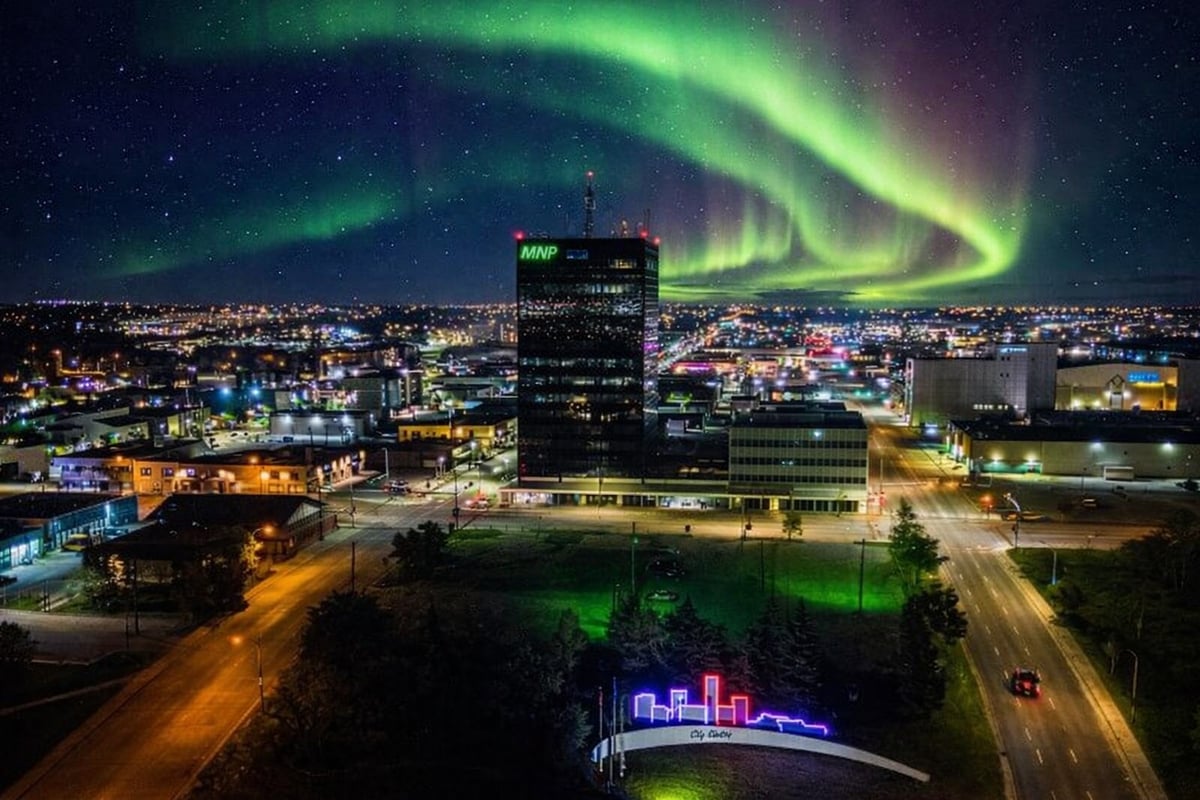
Grande Prairie doesn't get credit for a lot of things. But for aurora hunting, it's one of the best-positioned cities in Canada, and most people who live there have no idea how good they have it.
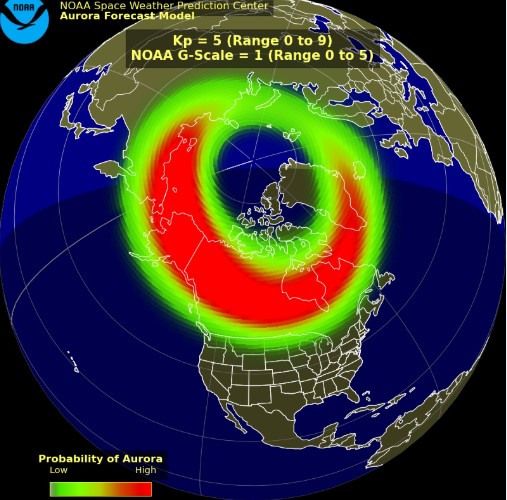
The city sits at roughly 55 degrees north latitude right inside what scientists call the auroral oval, the ring-shaped zone around Earth's magnetic pole where the northern lights are most active. According to NOAA's Space Weather Prediction Center, the aurora is visible from locations within this oval on more than half the nights of any given year when space weather is active. Edmonton, by comparison, sits about 3.5 degrees further south. That might not sound like much, but in aurora terms it matters the further north you are, the less you need a strong geomagnetic storm to see a display.
The Peace Country's flat terrain and distance from major light pollution make it even better. You can drive 10 minutes outside the city in almost any direction and be looking at a genuinely dark sky.
What Actually Causes the Northern Lights
The aurora happens when charged particles from the sun mostly electrons slam into oxygen and nitrogen atoms in Earth's upper atmosphere, between 80 and 500 kilometres above the surface. The collision excites those atoms, and when they settle back down they release that energy as light. Green is the most common colour, produced by oxygen at lower altitudes. Red aurora, which shows up higher in the atmosphere, is rarer and usually only visible during stronger storms. Purple and blue come from nitrogen.
None of that requires anything special from you. What it does require is darkness, a clear sky, and reasonable timing.
When to Go
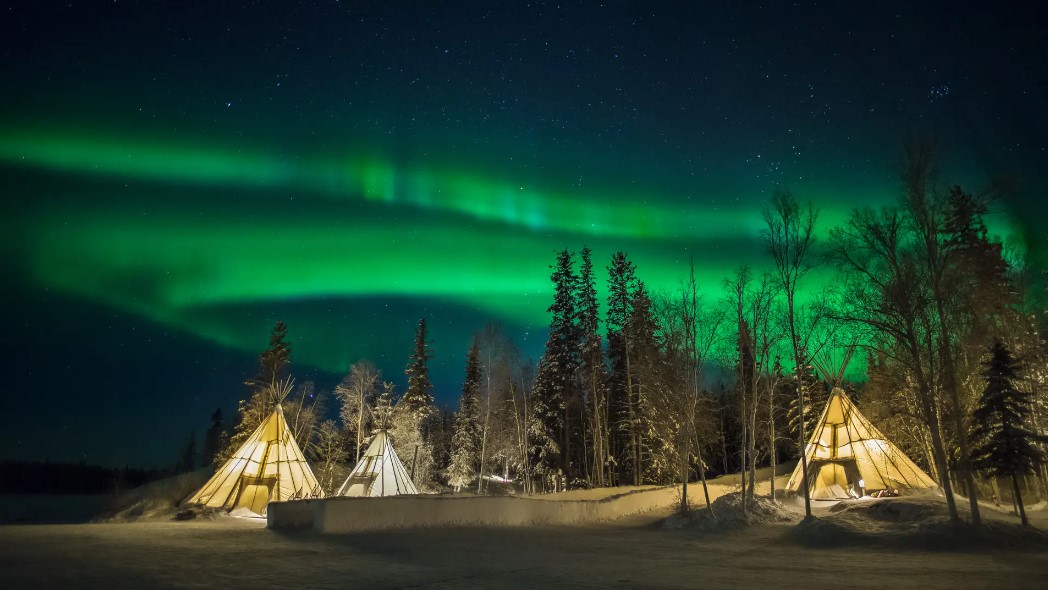
The two best windows of the year are September through early November, and late February through April. These are the equinox seasons, and for reasons tied to how Earth's magnetic field is oriented relative to the sun, geomagnetic activity tends to spike around both equinoxes. Winter December and January is dark enough but often overcast in the Peace Country, and the extreme cold makes standing outside for two hours genuinely unpleasant. Summer is dark enough late at night but the nights themselves are too short to be worth chasing.
You also need to check the Kp index before you go anywhere. The Kp index, developed by German scientist Julius Bartels in 1938, runs from 0 to 9 and measures disturbance in Earth's magnetic field in three-hour intervals. A Kp of 0 or 1 is calm the aurora is there, but it's sitting right over the magnetic pole and you won't see it from Grande Prairie. A Kp of 3 or 4 means a decent chance of activity at your latitude. A Kp of 5 or higher is a geomagnetic storm, and at that point the auroral oval expands significantly southward those are the nights when the sky can go completely green.
NOAA's Space Weather Prediction Center updates the Kp index every three minutes at swpc.noaa.gov. Bookmark it. Checking it takes 10 seconds.
Where to Go Near Grande Prairie
You don't need to drive far, but you do need to get away from the city's glow. A few reliable options:
Saskatoon Lake about 25 kilometres west of the city on Highway 672. The lake itself provides a natural reflection surface when conditions are calm, and the surrounding area is flat and open. Almost no light pollution in the northern sky.
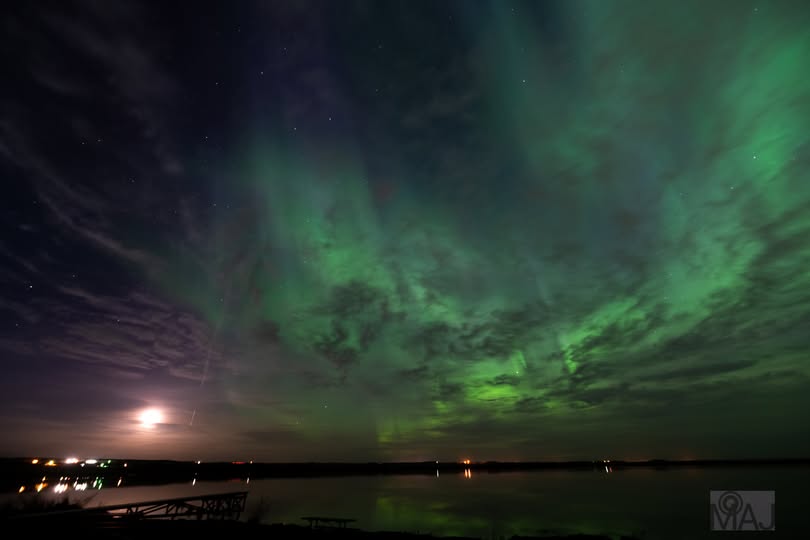
Pipestone Creek Park southeast of the city near Wembley. Known locally for its hadrosaur bone beds, but on a clear March night with a Kp of 4, it's also one of the darker accessible spots in the immediate area.
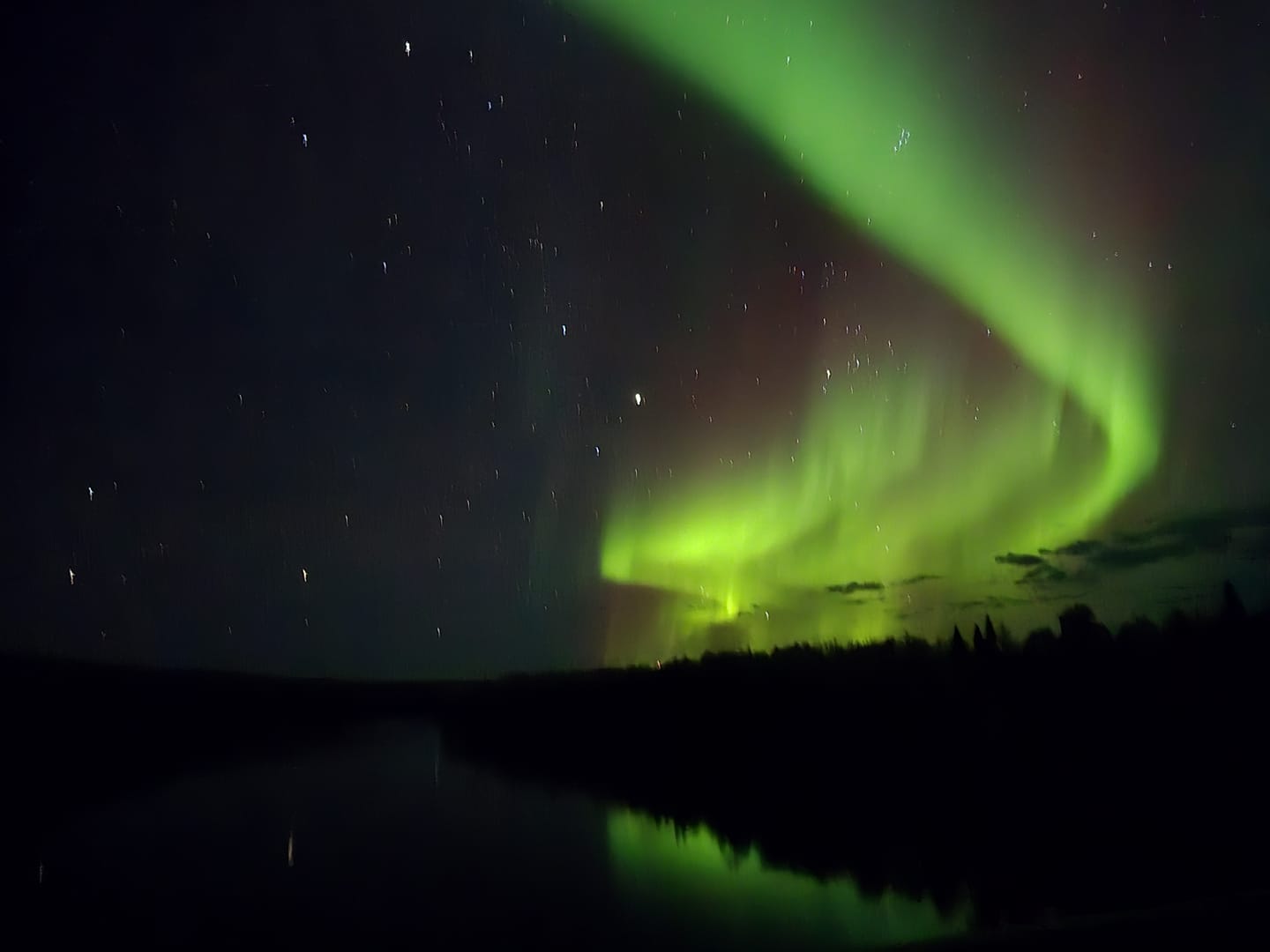
Kleskun Hill Natural Area 18 kilometres east on Highway 43. Elevated position gives you an unobstructed northern horizon, which matters more than most people realize. The aurora always appears in the north first, low on the horizon, before it expands upward.
Any gravel road heading north or east out of the city will also work. The key is getting the city lights behind you, not to your north.
What to Actually Do When You Get There
Let your eyes adjust for at least 15 minutes before deciding there's nothing to see. The human eye's rod cells the ones responsible for low-light vision take time to reach full sensitivity, and a faint aurora that looked like nothing in the first five minutes often reveals itself as a full curtain once your eyes settle in.
Dress for at least two hours in the cold. March in northern Alberta means real temperatures, and wind chill on an open field will end your night fast. Hand warmers in your pockets, an extra layer you didn't think you needed, and a blanket to lie on if you want to look straight up.
For photos, any modern smartphone with a night mode or pro mode will capture aurora that your eyes might have missed. Set exposure to 3–5 seconds, ISO between 800 and 1600, and brace your phone on something solid. The aurora moves, so longer exposures blur it. Shorter is better once the display gets bright.
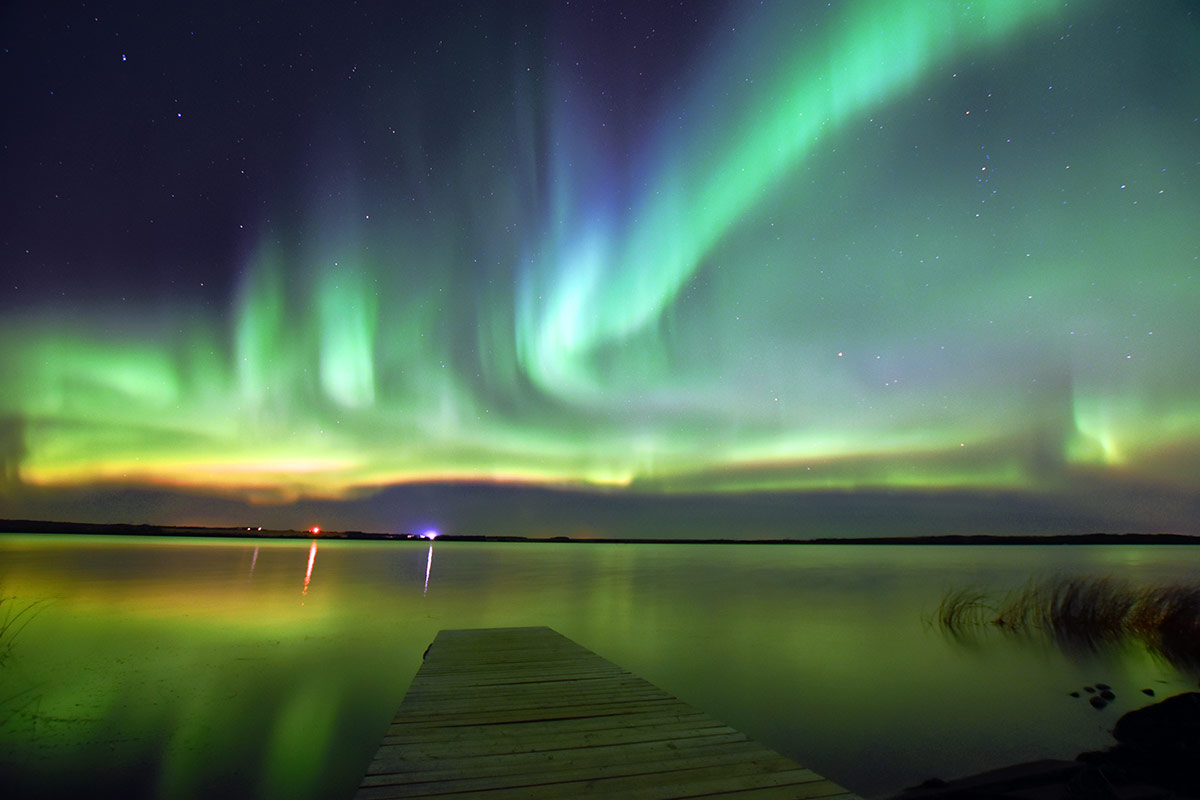
How to Know Tonight Is Worth It
Three things need to line up: clear skies, darkness, and a Kp of at least 3.
Kp index: swpc.noaa.gov updates every three minutes
Cloud cover forecast: Environment Canada at weather.gc.ca check the hourly forecast for Grande Prairie and surrounding areas
Aurora alerts: The free SpaceWeatherLive app sends push notifications when Kp crosses a threshold you set
Set a Kp alert for 3 or higher. When your phone goes off on a clear night, go.
Sources:
NOAA Space Weather Prediction Center: Aurora
NOAA Space Weather Prediction Center: Planetary K-index
Environment and Climate Change Canada: weather.gc.ca






Comments
Conversation