On Sunday, Nov. 1, daylight saving time ends for most of Canada. Millions of Canadians will turn their clocks back an hour and get an extra hour of sleep.
Most of Western Canada won’t.
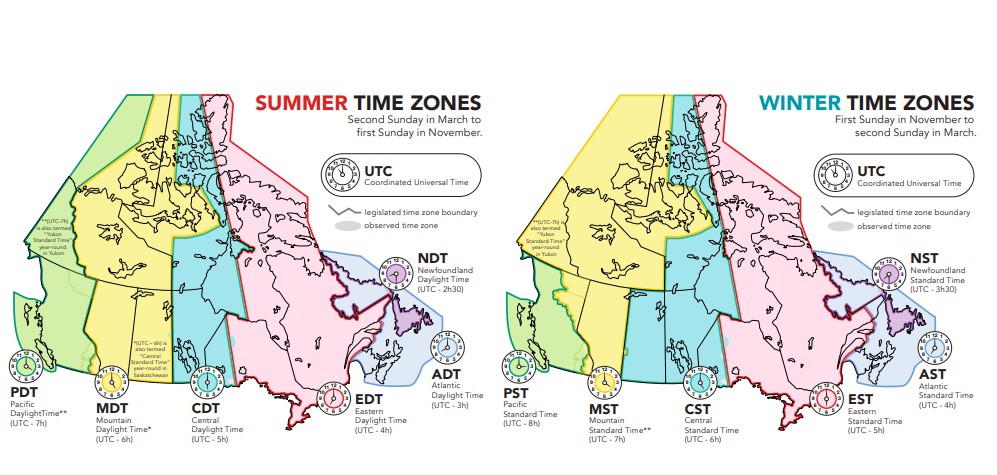
For the first time, Alberta, British Columbia and Manitoba are all keeping their clocks where they are this fall. So is the Northwest Territories. And Saskatchewan, which hasn’t changed its clocks in decades, rewrote its time law this year because of it.
That means darker winter mornings and brighter evenings from Victoria to Winnipeg.
Now the debate is moving east. In Newfoundland and Labrador, a petition is calling on the province to stop changing its clocks too.
Which provinces won’t change their clocks on Nov. 1?
Not changing clocks:
British Columbia: Made its last clock change in March and is now on permanent Pacific Time
Alberta: Now on permanent Alberta Time, the old Mountain Daylight Time
Northwest Territories: Following Alberta onto permanent daylight time
Saskatchewan: Most of the province stays on Central Standard Time year-round, as it has for decades
Manitoba: Announced in September it’s staying on daylight time permanently
Yukon: Stopped changing its clocks in 2020
Still turning clocks back an hour:
Ontario (most of it)
Quebec (most of it)
New Brunswick, Nova Scotia and P.E.I.
Newfoundland and Labrador
In those provinces, clocks go back one hour at 2 a.m. on Sunday, Nov. 1.
Alberta: sunrise near 10 a.m.
Alberta made the switch official with Bill 31 this spring. Read how Bill 31 ended Alberta’s clock changes.
The province is now on Alberta Time, or UTC-6, all year. That makes winter mornings an hour darker than Albertans are used to.
By the shortest day of the year, Dec. 21, sunrise will be:
| City | Sunrise, Dec. 21 |
|---|---|
| Lethbridge | 9:26 a.m. |
| Calgary | 9:37 a.m. |
| Red Deer | 9:42 a.m. |
| Edmonton | 9:48 a.m. |
| Fort McMurray | 10:00 a.m. |
| Grande Prairie | 10:19 a.m. |
That means school drop-offs in the dark, commutes before sunrise and outdoor jobs that start in darkness.
The payoff comes at the end of the day. In Edmonton, the sun sets around 5:16 p.m. on Dec. 21, an hour later than under the old winter clock.
There isn’t any more daylight. It’s just been moved an hour later.
See when the sun will rise in your Alberta city this winter.
Not every Albertan asked for this. In a 2021 referendum, 50.2% voted against permanent daylight time. The province went ahead anyway. Premier Danielle Smith has said Albertans should live with it for a year before judging it.
B.C.: an hour ahead of Seattle
B.C. made its final clock change in March and is now on permanent Pacific Time, or UTC-7.
In Vancouver, the December sunrise moves to after 9 a.m., and sunset to after 5 p.m.
There’s a twist for anyone who crosses the border. Washington, Oregon and California still turn their clocks back on Nov. 1, so B.C. will be one hour ahead of Seattle all winter, until the U.S. springs forward in March.
Cross-border shoppers, and anyone with meetings in Seattle: check your times.
Saskatchewan: “Welcome to Central Standard Time”
Saskatchewan isn’t changing its clocks. Its neighbours are changing around it.
Most of the province has stayed on Central Standard Time, UTC-6, all year since its Time Act passed in 1966. That used to put Regina an hour ahead of Edmonton every winter.
Not anymore. Alberta’s new time is the same as Saskatchewan’s. The two provinces now share a clock all year.
Saskatchewan noticed. On April 30, it announced it would replace its 60-year-old Time Act with a new one. The province’s news release was titled “Saskatchewan replaces The Time Act, welcomes Alberta to Central Standard Time.”
The new law keeps Central Standard Time and lets the province set special rules for border communities that follow a neighbour’s clock.
The biggest of those is Lloydminster. The border city has always run on Alberta time on both sides of the boundary. That used to put it out of step with the rest of Saskatchewan every winter. Now Lloydminster, Regina and Saskatoon share the same time all year.
“We welcome an updated Time Act that reflects how our border community functions day-to-day,” said Lloydminster Mayor Gerald Aalbers.
“Straddling the border comes with its own unique set of challenges,” said Lloydminster MLA Colleen Young.
Regina’s December sunrise stays where it’s always been: 8:56 a.m. on Dec. 21.
Manitoba: on Toronto time
Manitoba announced on Sept. 17 that it’s staying on daylight time year-round.
For Manitobans, the big change is in the east. Winnipeg will be on the same time as Toronto all winter. It used to be an hour behind.
Winnipeg’s December sunrise will now come after 9 a.m.
Northwest Territories: following Alberta
The N.W.T. shares a time zone with Alberta, so it’s following.
“We will follow Alberta’s lead in ditching twice-a-year clock changes,” Premier R.J. Simpson said in April. He’d said for years the territory would only switch if Alberta did.
Newfoundland: a petition pushes for the change
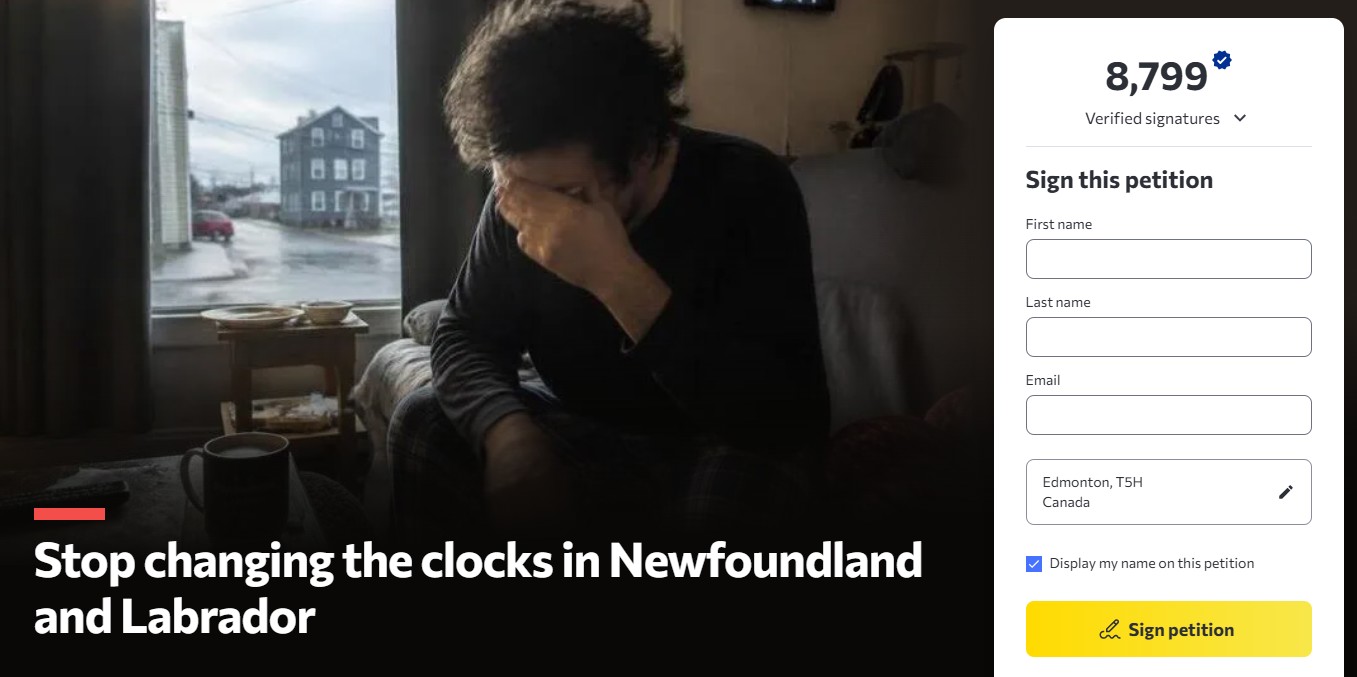
A petition started by Justin Merdsoy, who lives near St. John’s, asks Newfoundland and Labrador to stop changing its clocks and stay on daylight time permanently.
Supporters say more evening light would help people get outside and stay active through the winter, and that the twice-yearly switch disrupts sleep. St. John’s radio station VOCM covered the campaign on Oct. 15.
The province hasn’t committed to anything. Newfoundland and Labrador still turns its clocks back on Nov. 1.
View the petition on Change.org.
Newfoundland has a complication the West didn’t. Most of the island runs on Newfoundland Time, half an hour ahead of the rest of Atlantic Canada. Ending the clock change wouldn’t touch that. Dropping the half-hour would be a separate decision.
What time will it be across Canada this winter?
This is the change most people will notice. Here’s how the country lines up with Alberta after Nov. 1:
| City | Compared to Alberta | Last winter |
|---|---|---|
| Vancouver | 1 hour behind | 1 hour behind |
| Regina | Same time | 1 hour ahead |
| Yellowknife | Same time | Same time |
| Winnipeg | 1 hour ahead | 1 hour ahead |
| Toronto | 1 hour ahead | 2 hours ahead |
| Montreal | 1 hour ahead | 2 hours ahead |
| Halifax | 2 hours ahead | 3 hours ahead |
| St. John’s | 2½ hours ahead | 3½ hours ahead |
| London, U.K. | 6 hours ahead | 7 hours ahead |
So at noon in Edmonton this December, it’ll be 11 a.m. in Vancouver, noon in Regina, 1 p.m. in Winnipeg and Toronto, 2 p.m. in Halifax and 2:30 p.m. in St. John’s.
The country is an hour narrower this winter.
Is permanent daylight time actually better?
Ending the clock change is popular. Which time to keep is a different question.
Alberta, B.C., Manitoba and the N.W.T. all chose daylight time, with lighter evenings and darker mornings.
Sleep researchers, including the American Academy of Sleep Medicine, recommend the opposite: permanent standard time. Morning light helps set the body’s internal clock, and darker mornings can throw it off.
This winter will be the first real test.
What to check on Nov. 1
Phones and computers with updated time zone settings should handle it on their own.
Older devices, car clocks, ovens and smart home gadgets may still change automatically. Check them Sunday morning.
Meetings and flights across provinces or borders: double-check the time. The old gaps don’t apply anymore.
On Nov. 1, most of Canada gets an hour back. The West keeps its evenings. And Newfoundland is asking whether it should be next.
Sources
Government of Alberta, Alberta Time (link the Alberta.ca page)
Government of British Columbia, permanent Pacific Time (link the B.C. release)
Government of Saskatchewan, “Saskatchewan replaces The Time Act, welcomes Alberta to Central Standard Time,” April 30, 2026: https://www.saskatchewan.ca/government/news-and-media/2026/april/30/saskatchewan-replaces-the-time-act-welcomes-alberta-to-central-standard-time
Government of Manitoba, news release on permanent daylight time, Sept. 17, 2026 (link the release)
Government of the Northwest Territories, time change announcement (link the GNWT release)
Change.org, “Stop changing the clocks in Newfoundland and Labrador”: https://www.change.org/p/stop-changing-the-clocks-in-newfoundland-and-labrador






Comments
Conversation