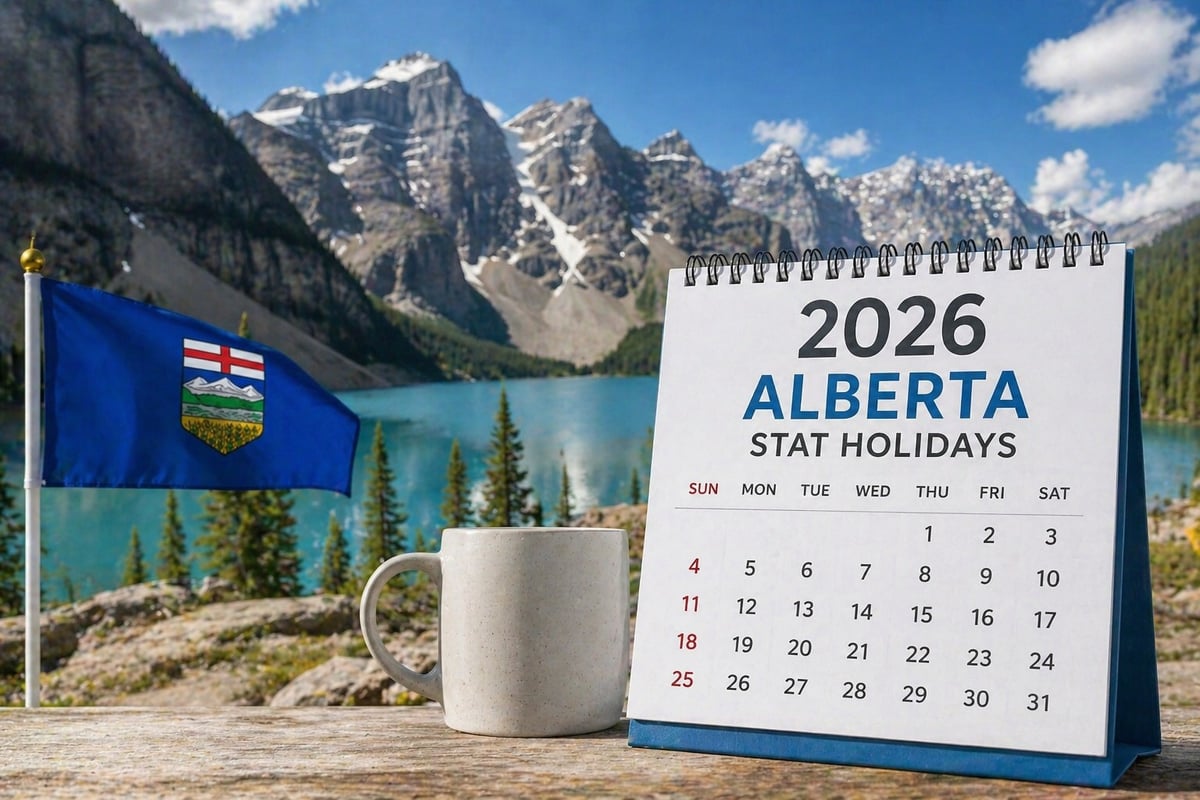
Planning a trip, wondering if your bank is open, or just trying to figure out how many long weekends you have left this year. Here's the full breakdown of every stat holiday in Alberta in 2026.
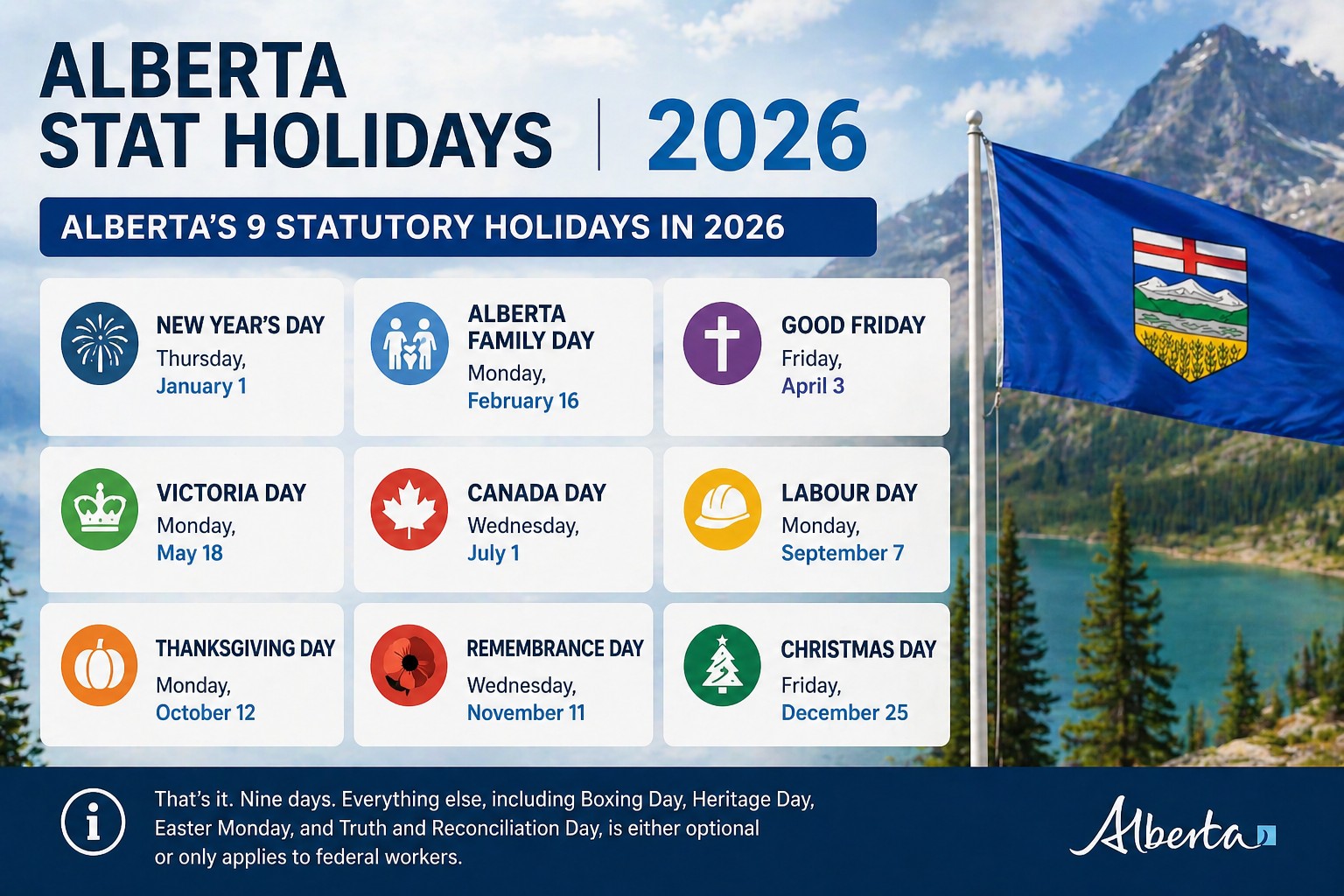
Alberta's 9 Statutory Holidays in 2026
Under the Alberta Employment Standards Code, there are nine general holidays, the official provincial term for what most people call stat holidays. Eligible employees get either a paid day off or stat pay on each of these dates.
New Year's Day — Thursday, January 1
Alberta Family Day — Monday, February 16
Good Friday — Friday, April 3
Victoria Day — Monday, May 18
Canada Day — Wednesday, July 1
Labour Day — Monday, September 7
Thanksgiving Day — Monday, October 12
Remembrance Day — Wednesday, November 11
Christmas Day — Friday, December 25
That's it. Nine days. Everything else, including Boxing Day, Heritage Day, Easter Monday, and Truth and Reconciliation Day, is either optional or only applies to federal workers. More on that below.
Every Long Weekend in Alberta in 2026
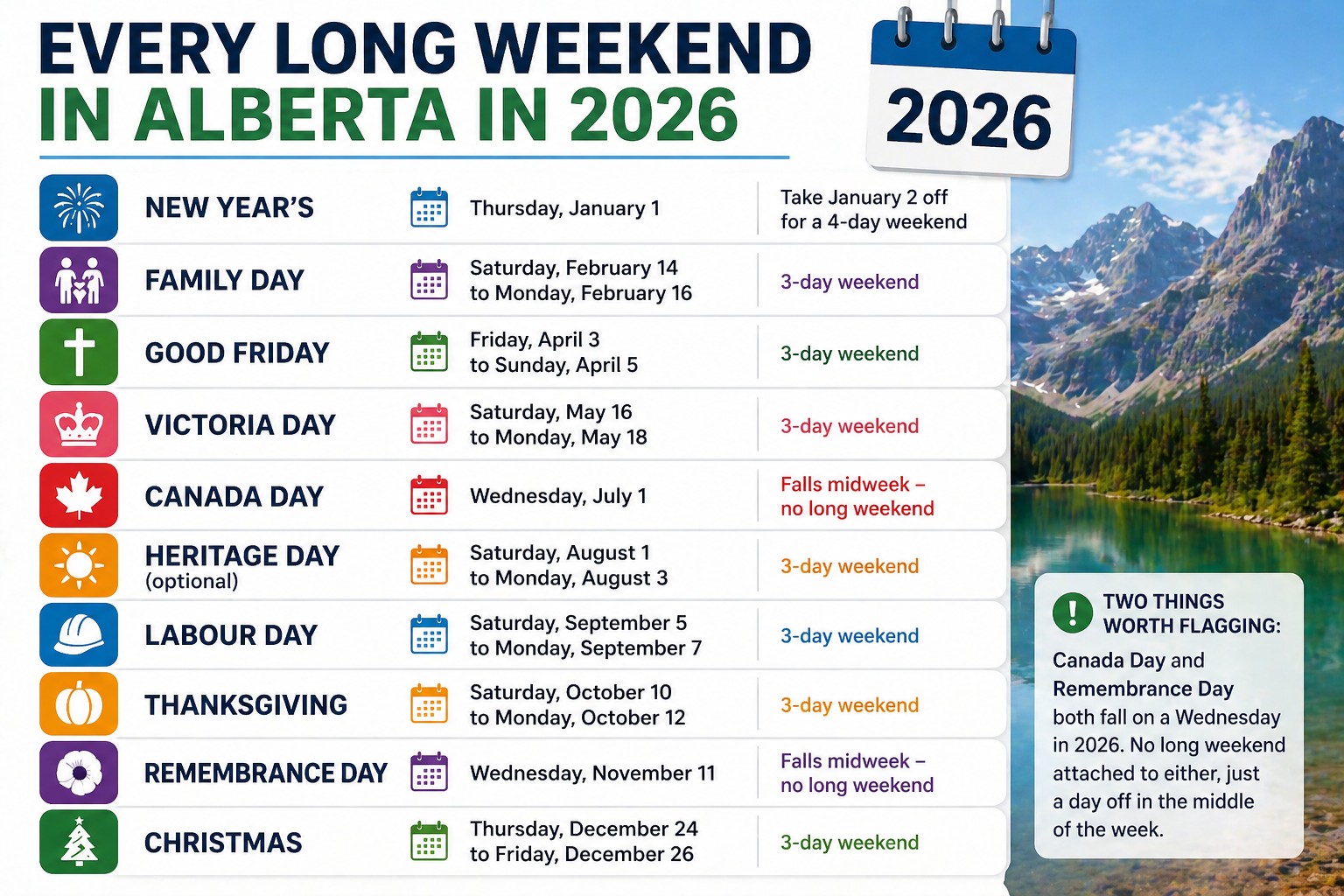
New Year's: Thursday, January 1 (take January 2 off for a 4-day weekend)
Family Day: Saturday, February 14 to Monday, February 16
Good Friday: Friday, April 3 to Sunday, April 5
Victoria Day: Saturday, May 16 to Monday, May 18
Canada Day: Wednesday, July 1 (falls midweek, no automatic long weekend)
Heritage Day (optional): Saturday, August 1 to Monday, August 3
Labour Day: Saturday, September 5 to Monday, September 7
Thanksgiving: Saturday, October 10 to Monday, October 12
Remembrance Day: Wednesday, November 11 (falls midweek, no automatic long weekend)
Christmas: Thursday, December 24 to Friday, December 26
Two things worth flagging: Canada Day and Remembrance Day both fall on a Wednesday in 2026. No long weekend attached to either, just a day off in the middle of the week.
The Holidays That Confuse Everyone
Heritage Day (Monday, August 4) Not a statutory holiday in Alberta. The province has never made it mandatory. Many employers give it anyway because it functions as Alberta's version of the Civic Holiday celebrated in other provinces, but if yours doesn't offer it, they are not breaking any rules.
Boxing Day (Saturday, December 26, observed Monday, December 28) Also not a provincial stat holiday in Alberta. Plenty of salaried workers get it through their employment contract, but there is no legal requirement for Alberta employers to give it.
Easter Monday (Monday, April 6) Not a stat holiday in Alberta.
National Day for Truth and Reconciliation (Wednesday, September 30) This one comes up every year. It is a statutory holiday, but only for federally regulated employees. Banks, airlines, telecom companies, and federal government workers get September 30 off. If you work a provincially regulated job, which covers the majority of Albertans, you have no legal right to this day under provincial law.
What's Open and Closed on Alberta Stat Holidays
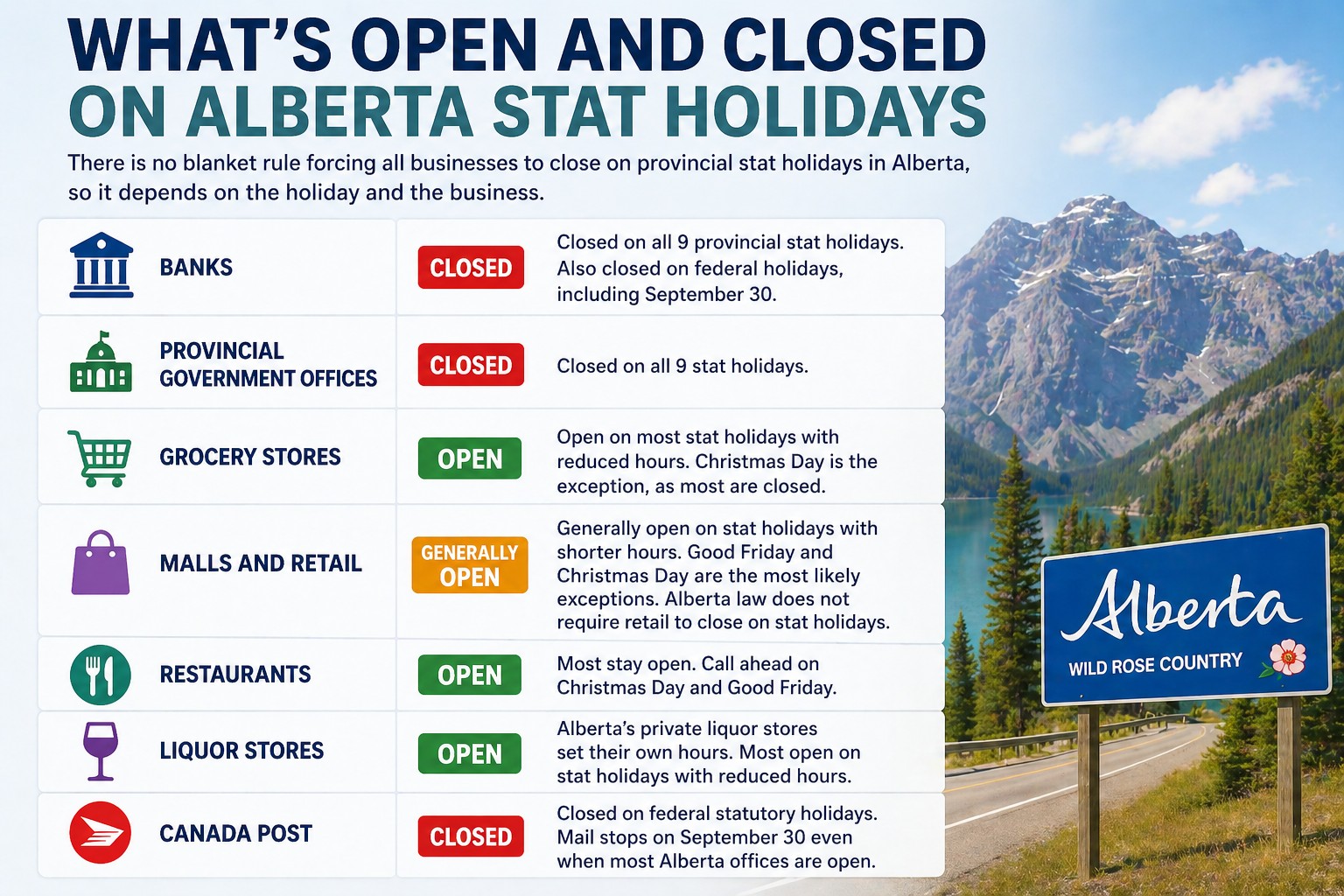
There is no blanket rule forcing all businesses to close on provincial stat holidays in Alberta, so it depends on the holiday and the business.
Banks Closed on all 9 provincial stat holidays. Also closed on federal holidays, including September 30.
Provincial government offices Closed on all 9 stat holidays.
Grocery stores Open on most stat holidays with reduced hours. Christmas Day is the exception, as most are closed.
Malls and retail Generally open on stat holidays with shorter hours. Good Friday and Christmas Day are the most likely exceptions. Alberta law does not require retail to close on stat holidays.
Restaurants Most stay open. Call ahead on Christmas Day and Good Friday.
Liquor stores Alberta's private liquor stores set their own hours. Most open on stat holidays with reduced hours.
Canada Post Closed on federal statutory holidays. Mail stops on September 30 even when most Alberta offices are open.
Stat Holiday Pay in Alberta: What You're Actually Owed
To qualify for general holiday pay, you need to have worked for the same employer for at least 30 workdays in the 12 months before the holiday. You also need to have worked your last scheduled shift before the holiday and your first scheduled shift after it, unless you had a legitimate reason for missing either.
If you take the day off: You are owed your average daily wage, calculated as total wages earned in the previous four weeks divided by the number of days worked in that period.
If you work on a stat holiday: Your employer must choose one of two options. They can pay you time-and-a-half plus your average daily wage for hours worked, or pay you regular wages and give you a paid day off at a later date.
If the stat falls on a day you would not normally work: Different rules apply. Alberta uses what is called the "5 of 9 rule" to determine whether a given day counts as a regular workday for employees with irregular schedules. If you worked a particular day of the week at least 5 times in the previous 9 weeks, it counts as a regular workday. The full details are on Alberta.ca.