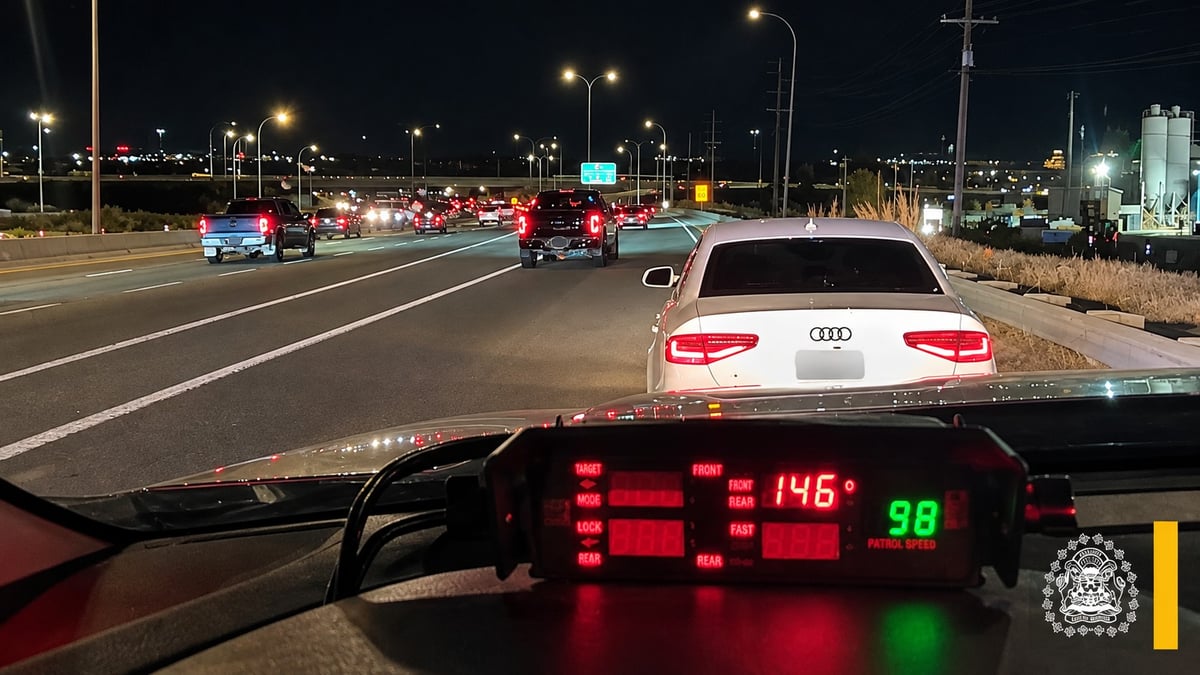
A Calgary driver who isn’t allowed to drive alone was caught going 146 km/h on Glenmore Trail. Alone.
The limit there is 80.
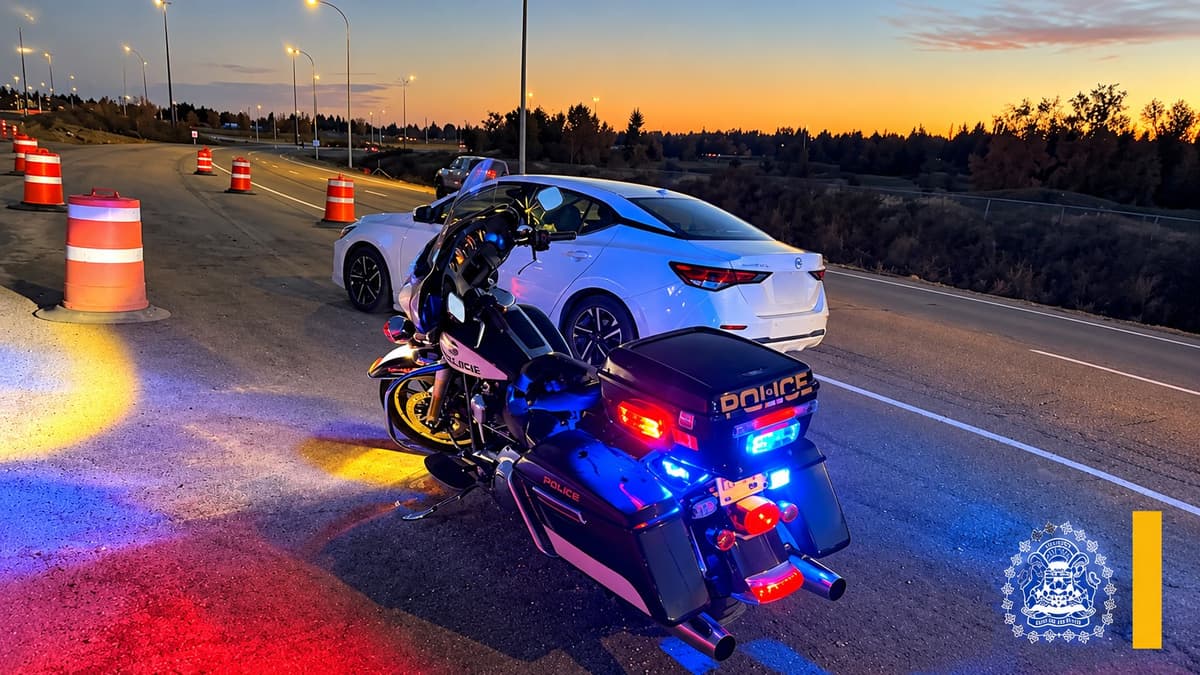
Calgary police say officers spotted the vehicle weaving through traffic shortly after 8 p.m. on Wednesday, Oct. 7. The driver held a Class 7 learner’s licence, which requires a qualified supervising driver in the front passenger seat at all times. There wasn’t one.
By the end of the stop, the driver had four tickets. Convictions on just two of them would put the driver well past the point where Alberta suspends a learner’s licence.
Four tickets
Police ticketed the driver for:
Speeding 64 km/h over the limit
Driving without a qualified supervisor
Careless driving
Illegally tinted windows
The car was clocked 66 km/h over, but the ticket was written at 64 over. Police didn’t explain the difference, and it doesn’t change the outcome.
Police didn’t release the driver’s age either. You can get a Class 7 in Alberta at 14, but adults hold them too, including newcomers to the province and people who learned to drive later in life.
12 demerit points
The speeding and careless driving tickets carry six demerit points each.
| Offence | Demerit points |
|---|---|
| Speeding 51+ km/h over the limit | 6 |
| Careless driving | 6 |
| Total | 12 |
The points only apply if the driver is convicted.
That total matters because learners are held to a tighter standard. A fully licensed Alberta driver is suspended at 15 points. Drivers in the graduated licensing program, including every Class 7 holder, get a warning letter at 4 and are suspended at 8.
Convictions on those two tickets alone would put the driver four points past the line.
How long a suspension would last
For graduated drivers, a first demerit suspension lasts one month. A second within a year lasts three months, and a third within two years lasts six.
When the suspension ends, the licence comes back with 3 demerit points already on it, which stay for two years. That makes the next suspension much easier to trigger.
A careless driving conviction could also raise the driver’s insurance costs, depending on their insurer and record.
A court date, not a fine
Most Alberta speeding tickets come with a set fine you can pay.
Above 50 km/h over the limit, that option is gone. The driver has to appear in court, and a judge decides the penalty. At 64 over, this driver is headed to court.
For tickets that can be paid, it’s worth knowing that paying one counts as pleading guilty. The demerit points go on your record that day.
What a Class 7 allows
A Class 7 is the first stage of Alberta’s graduated licensing program. You get one by passing a knowledge test, and you have to hold it for at least a year before taking a road test.
Learners must have a supervising driver beside them every time they drive. That person has to be at least 18 and hold a full, non-graduated licence. Someone with a probationary Class 5-GDL can drive alone, but can’t supervise a learner.
Learners also can’t drive between midnight and 5 a.m., must have zero alcohol in their system, and can only carry as many passengers as there are seatbelts.
This stop happened around 8 p.m., so the overnight rule wasn’t the problem. The empty passenger seat was.
What 146 km/h looks like
At 146 km/h, a car covers about 40 metres every second. At 80, it covers 22.
Over three seconds, that adds up to about 55 extra metres of road. Braking distance grows even faster, with the square of speed, so at 146 a car needs more than three times the room to stop.
Glenmore Trail is one of Calgary’s busiest east-west routes, full of merges and lane changes. Police say this driver was weaving through traffic.
Part of a pattern
It’s the latest in a string of extreme speeding cases on Alberta roads.
In Calgary, one driver was clocked at 204 km/h on Stoney Trail, and another was caught driving impaired by cannabis at 90 km/h through a construction zone, facing $2,320 in fines.
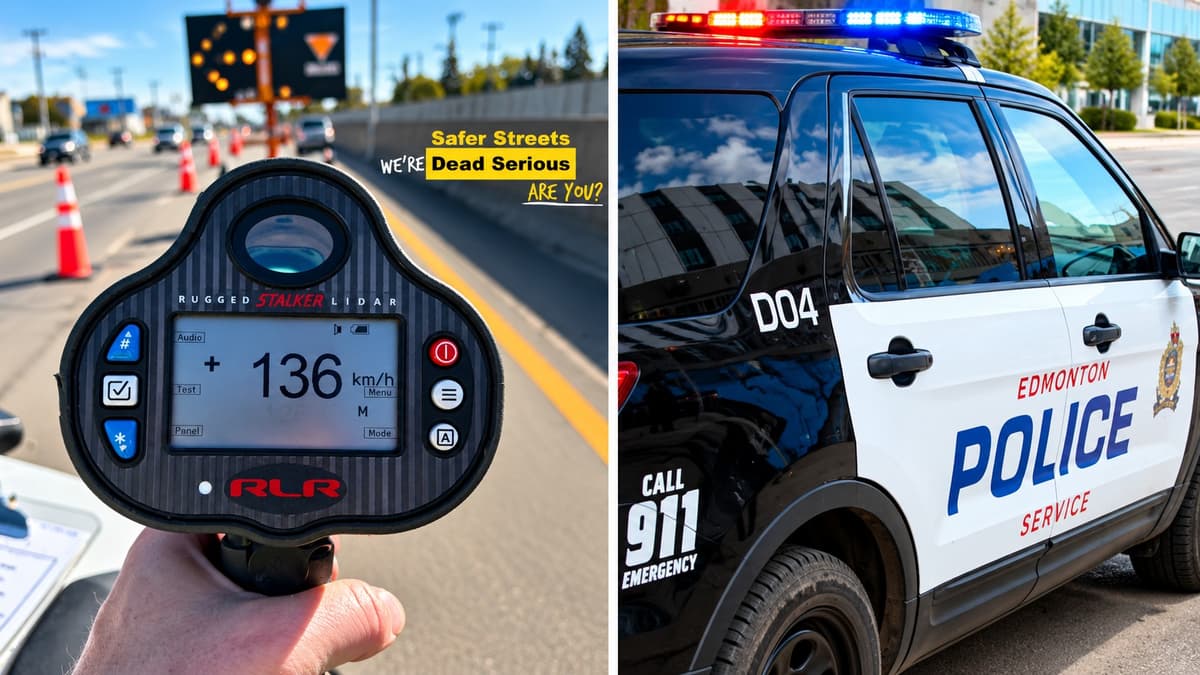
In Edmonton, police caught a 17-year-old at 136 km/h in a 50 km/h construction zone on Yellowhead Trail.
Why Calgary police are cracking down
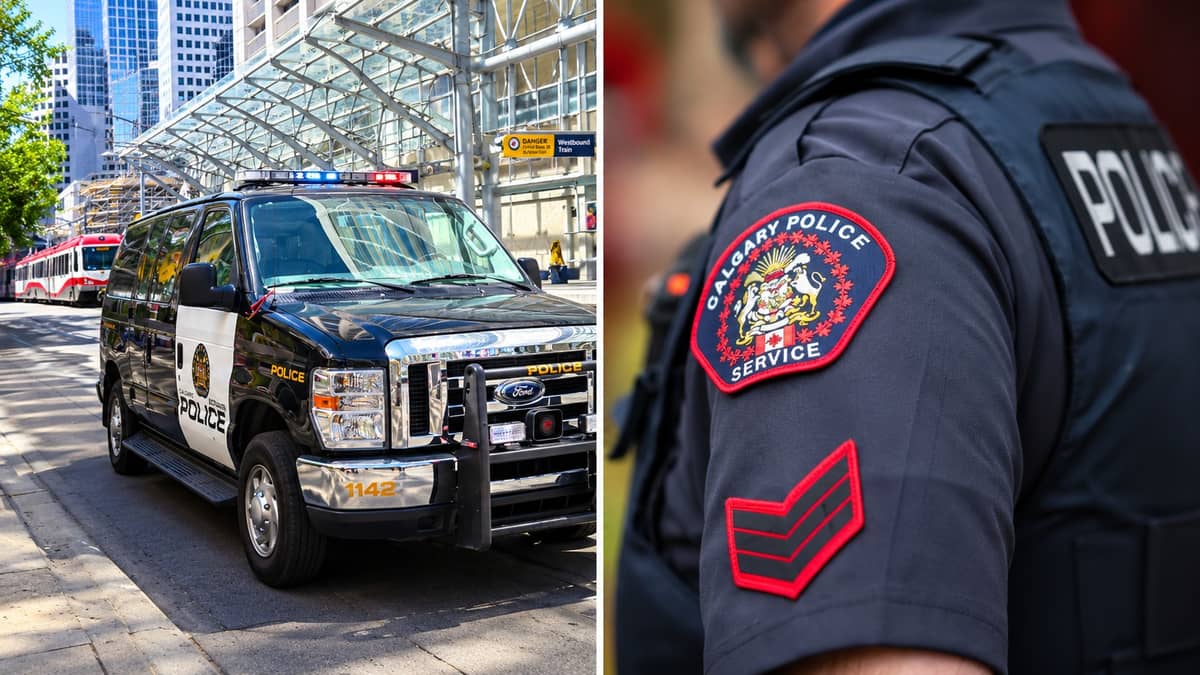
Calgary police ended their post about this stop with a call to “Join the Drive to Zero.” That’s the public campaign behind Vision Zero, the city’s goal of zero deaths and serious injuries on its roads.
The numbers show why police are pushing it so hard.
In 2024, Calgary recorded 29 fatal collisions, up from 24 the year before, and 571 collisions causing major injuries, a 5 per cent increase. Pedestrian deaths jumped from 4 to 13. The city estimates collisions that year cost Calgarians $1.4 billion once medical care, lost work and other damage are counted.
It got worse in 2025. According to the city, 15 pedestrians were killed, the most in 11 years, along with 20 motorists.
In response, the city and Calgary police are working under the Safer Mobility Plan 2024 to 2028, the first traffic safety plan the two have built together instead of separately. The goal is a 25 per cent drop in deaths and major injuries over five years. So far, deaths and major injuries are still moving in the wrong direction.
Speed is at the centre of the plan. It’s one of the factors the city points to behind the rise in deadly crashes, and it makes every crash more likely to kill someone.
The crackdown is visible on the road. Calgary police and Alberta sheriffs have stepped up enforcement on Stoney Trail and other high-speed routes, and police are seeking provincial permission to put automated enforcement at some of the city’s most dangerous spots. In 2025, the city also added a traffic safety team of peace officers, which issued 250 tickets and 119 warnings in its first three weeks alongside police.
Off the road, the city has added speed cushions and speed humps in neighbourhoods, lowered limits on some residential streets to 40 km/h, and made dozens of permanent safety upgrades at intersections and crosswalks.
That’s the backdrop to this stop: a learner driver with no supervisor, weaving through traffic at almost double the limit on one of Calgary’s busiest roads, in a city trying hard to bring its traffic death count down.
For now, the driver has four tickets. Whether they turn into convictions, fines or a suspension is up to the court.
Sources
Calgary Police Service on X, October 2026
Government of Alberta: Demerit driving suspension
Government of Alberta: Fines for speeding
Government of Alberta: Graduated driver licensing
City of Calgary: Vision Zero
City of Calgary: Safer Mobility Plan annual briefing, 2025






Comments
Conversation