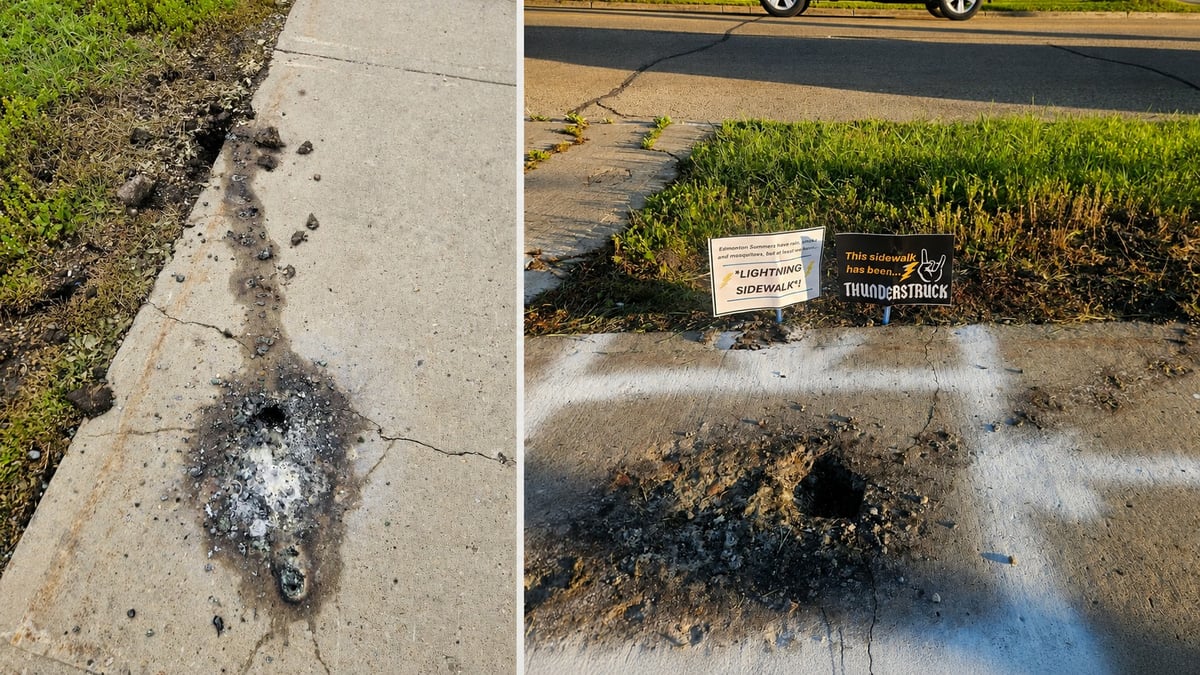
Lightning hit a sidewalk in north Edmonton hard enough to blow a hole in the concrete, and instead of tossing the wreckage, the city is sending it to university researchers.
The strike happened during the storm on Saturday, July 18, near 129 Avenue and 129 Street. It left a crater about 50 centimetres across, ringed by scorch marks that traced the path the current took through the slab. A fire hydrant nearby was charred by the same strike. EPCOR later confirmed a crew replaced the hydrant's damaged external parts and repainted it.
An "abnormally strong positive" strike
The damage came from a particularly violent kind of lightning. Environment Canada meteorologist Janelle Gergely said the sidewalk was likely hit by an "abnormally strong positive lightning strike."
Positive lightning is the rarer, more powerful cousin of the ordinary strike. Most lightning is negative and comes from the base of a storm cloud. Positive strikes originate higher up in the storm, carry far more current, and often hit some distance from the core, which makes them both harder to see coming and more destructive when they land. Gergely said roughly 4,000 lightning strikes were recorded during that Saturday storm, the vast majority intracloud, with only a few reaching the ground. This sidewalk caught one of them.
When that much current hits concrete, it flashes any moisture inside to steam instantly, and the steam blows the slab apart from within. The crater on 129 Avenue is what that looks like.
The neighbourhood made it a landmark
Residents turned the hole into a bit. Joke signs went up around the crater, and the spot became a small local attraction through the week, with people stopping to photograph it. It's the kind of shared, low-stakes weird a neighbourhood rallies around, a genuine act-of-God crater on an ordinary residential sidewalk, in a summer where Edmonton has had no shortage of dramatic weather.
How likely is this, actually?
The obvious question standing over that crater: what are the odds? Low, but not as low as people assume.
A person's annual chance of being struck by lightning in Canada sits around one in a million in a given year, and lightning kills or injures dozens of Canadians annually. Those odds aren't fixed, though. They climb sharply based on what you're doing and where you are. Standing in the open during a storm, sheltering under a lone tree, being on or near water, or being the tallest thing around all push the risk far above the baseline. A strike powerful enough to crater a sidewalk is rare, but it landed on a spot pedestrians use every day, which is the whole reason the "when thunder roars, go indoors" rule exists. The crater is a vivid argument for it.
Why the U of A wants a broken sidewalk
The City of Edmonton confirmed the damaged section won't be ripped out and discarded when crews replace it. It's going to University of Alberta researchers for testing.
A slab that took a direct, unusually powerful strike is a rare physical record of what that energy does to a material, the kind of sample you can't produce on demand in a lab. For researchers studying lightning's effects, or how concrete behaves under extreme electrical and thermal stress, a piece of city infrastructure hit by a once-in-a-long-while positive strike is a real find. The crater that closed a stretch of sidewalk becomes a data point.
The reminder under the jokes
For all the fun the neighbourhood had with it, the strike hit a public sidewalk where anyone could have been standing.
Environment Canada's guidance is worth repeating every Alberta summer: when thunder roars, go indoors. And the danger doesn't pass with the rain, Gergely noted it's safe to head back out 30 minutes after the last rumble of thunder, not before. On July 18, the safest place to be was anywhere but that stretch of concrete.
Sources:
Environment and Climate Change Canada, meteorologist Janelle Gergely, via Postmedia, July 2026
City of Edmonton, statement on sidewalk removal and University of Alberta research
EPCOR, statement on fire hydrant repair









Comments
Conversation