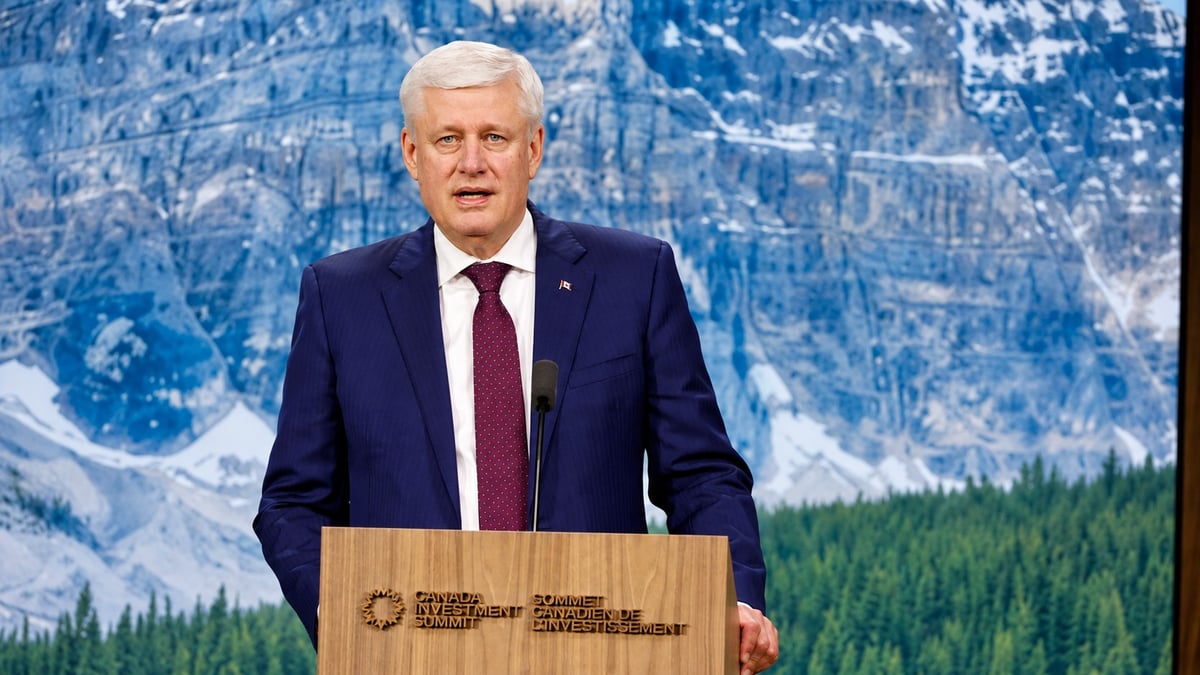
Former prime minister Stephen Harper says Canada will have to accept significant economic costs to reduce its reliance on the United States and protect its sovereignty.
"It is clear that the current U.S. administration views our level of economic integration as incompatible with our separate sovereignty," Harper said Tuesday.
"Thus, to maintain that sovereignty, we must pursue diminished reliance upon the United States."
Harper delivered the closing remarks at the first Canada Investment Summit in Toronto, hosted by the federal government as it pursues $1 trillion in new investment over five years.
"There will be significant costs to this effort," Harper said. "But those are costs that I hope and believe Canadians are able and prepared to accept."
Harper says Ottawa had 'no choice'
Harper backed the Carney government's decision to walk away from trade negotiations with the United States after talks collapsed in August.
"This had to be a very difficult decision, but I do believe that our government had no choice but to take this path," he said, delivering part of his remarks in French.
Harper described himself as a longtime admirer of the United States and said the close relationship between the two countries had been one of Canada's most valuable assets.
He nevertheless called the breakdown in negotiations necessary.
"I do find this all very sad, just as equally necessary," Harper said.
The United States imposed 50 per cent tariffs on $27.6 billion in Canadian goods on August 22. Canada responded with tariffs of 15, 25 and 50 per cent on an equivalent value of American imports beginning September 8.
Additional American tariffs took effect this week.
Harper puts energy at the centre of his argument
Harper said Canada must become "more internally competitive, more externally connected and more truly sovereign than it has been."
That includes removing domestic barriers, expanding international trade and developing Canada's natural resources.
Harper praised the federal government's efforts to accelerate approvals for major projects, particularly in the energy sector, but said further changes are required.
"The burdens and restrictions that do not exist elsewhere simply must be removed in Canada," he said.
"If we do not do these things as a country, the Americans will continue to be our sole customers, and they will not lack the urgency that we have lacked here in Canada."
Harper argued that Canada has come "nowhere close" to reaching its potential and described the country's natural resources as its "special comparative advantage."
That portion of the speech has particular relevance in Alberta, where expanding oil and gas exports beyond the United States has been a provincial priority for years.
Why the timing matters in Alberta
Harper represented Calgary-area ridings for approximately 17 years across two periods. He led the Conservative Party from 2004 to 2015 and served as prime minister from 2006 to 2015.
He remains the most consequential Alberta-based federal politician of his generation.
His speech came about five weeks before Alberta's October 19 referendum, which will present voters with 10 questions, including one concerning the province's future in Canada.
That question asks whether Alberta should remain a Canadian province, or whether the provincial government should begin the legal process required to hold a binding referendum on separation.
The October vote will not itself separate Alberta. If the second option receives majority support, the government says it would begin the legal and constitutional process required for another referendum.
Harper did not mention Alberta's referendum, and there is no indication that his remarks were intended as commentary on it.
But his central argument was that sovereignty carries costs, and that Canadians should be prepared to accept them. It came from a former Calgary MP in the same month Albertans are preparing to answer a sovereignty question of their own.
Harper has been building this argument
Tuesday's speech was not Harper's first warning about Canada's dependence on the United States.
In July 2025, he said he had advised the Carney government to pursue additional trading partners because Canada had become too reliant on the American market. He described the trade conflict as a wake-up call.
In February 2026, Harper argued that American tariffs should be reciprocated to protect Canadian manufacturing.
His latest speech brought those arguments together: less dependence on the United States, faster development of Canadian resources, and a willingness to accept the costs of greater economic independence.
Poilievre responds
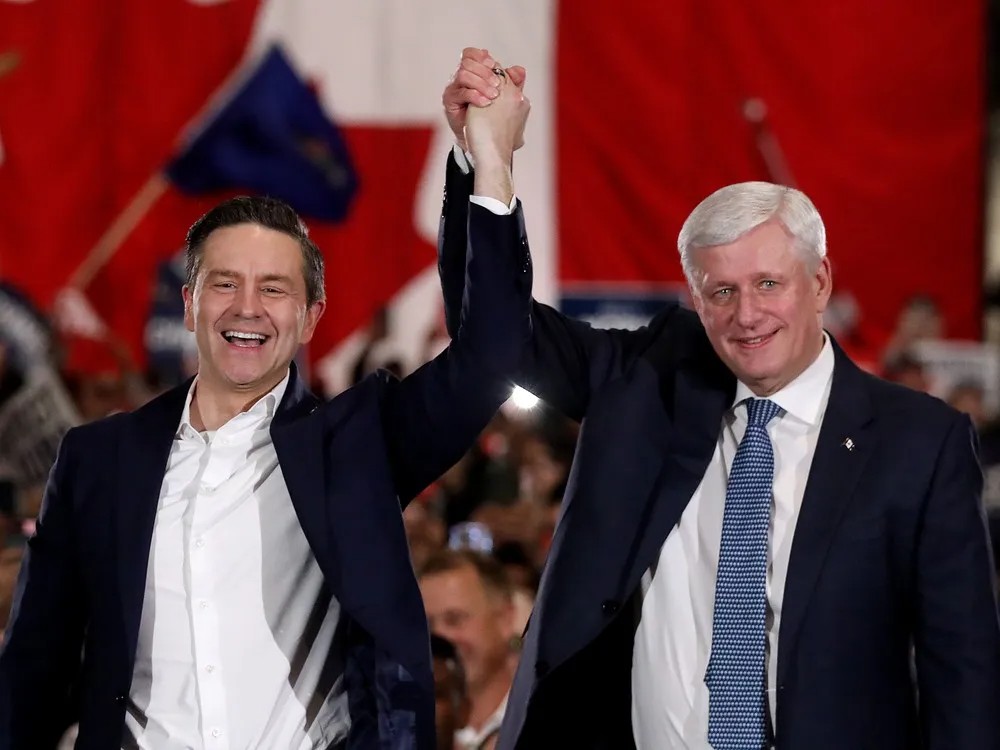
Conservative Leader Pierre Poilievre was asked Tuesday about Harper's participation in the government-hosted summit.
"Conservatives are always willing to put Canada first," Poilievre said.
He welcomed the summit but questioned what the Carney government had produced from what he characterized as months of speeches and signing ceremonies.
The Prime Minister's Office said the summit resulted in nearly $500 billion in investment commitments, including approximately $100 billion in new capital for Canadian assets from pension funds, insurers and institutional investors.
The government is targeting $1 trillion in new investment over the next five years.
Sources
Stephen Harper's closing remarks at the Canada Investment Summit, September 15, 2026
The Canadian Press: Harper says Canada had "no choice" but to walk away
Government of Alberta: October 19 separation question
Finance Canada: September 8 counter-tariffs
CBC News coverage and video of Harper's complete speech


Comments
Conversation