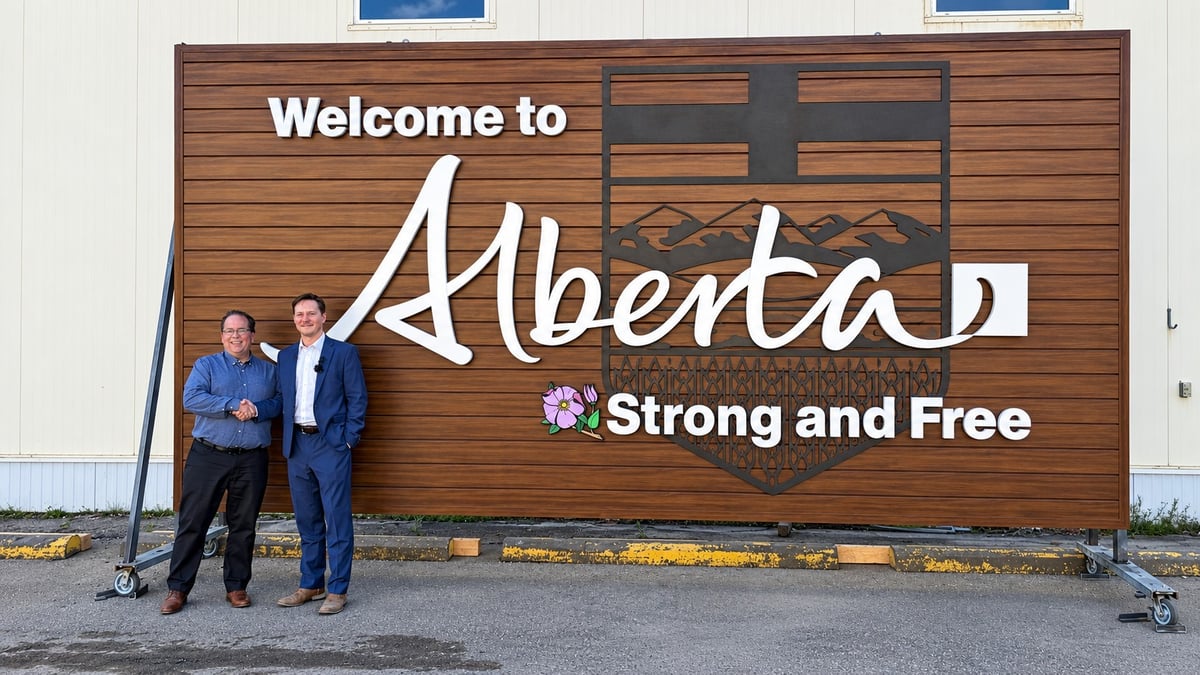
Alberta's new welcome signs were unveiled on Thursday, and the first thing to know is that the wood grain isn't wood.
The signs are fabricated from aluminum and anodized bronze, finished with reflective vinyl. They're designed to look like timber and engineered to last 40 years in Alberta weather.
They replace the "Wild Rose Country" signs that have greeted drivers for more than four decades.
We covered the announcement when the design was first released in May.
What's on them
"Welcome to Alberta" in white, above the province's shield with its St. George's Cross, mountains, foothills and prairie.
"Strong and Free" below, alongside the wild rose.
The rose stays. That's worth noting, because the slogan it accompanied is gone.
Why they look like wood
The signs are meant to keep the warm, roadside feel of the old Wild Rose Country boards without using actual timber.
That's why the province went with aluminum, anodized bronze and reflective vinyl. The finished sign gives drivers the look of wood grain, but with materials built for decades of snow, sun, salt, wind and prairie temperature swings.
It also helps explain the price. This isn't a printed highway board. It's closer to a large custom-built roadside monument, with layered metal, reflective surfaces and a 40-year lifespan.
Where they're going
Twenty-two signs, at provincial border crossings along major highway corridors.
They'll go up at entry points from British Columbia, Saskatchewan, the Northwest Territories and Montana.
Installation begins within the next few weeks, with all of them expected up by the end of the year.
The total cost is $3.5 million.
They were made in Alberta
All materials came from Canadian sources, and nearly every supplier is based in Alberta. The signs themselves were fabricated in Edmonton.
That detail is not accidental. In a year when governments are talking more about Canadian-made procurement, "made in Alberta" is part of the message.
What Dreeshen said
Transportation Minister Devin Dreeshen was at the unveiling.
"'Strong and Free' is Alberta's motto, and I think Albertans will have a great sense of pride when they are driving into the province, seeing this sign," he said.
When the design was announced in May, Dreeshen put it this way: "Our new Welcome to Alberta border signs are proudly branded with our Strong and Free motto. Whether people are travelling from our Rocky Mountains, beautiful forests, or our fertile agricultural lands, these signs will greet visitors and welcome Albertans home."
Where "Strong and Free" comes from
It's the province's actual motto.
Fortis et liber, Latin for strong and free, appears on Alberta's coat of arms and has for decades.
So the change isn't an invention. It's a swap from a nickname to the official motto, which is the same logic behind the licence plate redesign.
The licence plates came first
In October 2025, the province announced it was changing the plate slogan from "Wild Rose Country" to "Strong and Free."
Albertans then voted on a backdrop. More than 240,000 votes were cast, and Moraine Lake in Banff National Park won. It's the first new Alberta plate design in more than 40 years.
At the time, the government described the new motto as a nod to Canada's national anthem and to Alberta's position as a strong and sovereign province within a united Canada.
The signs arrive five weeks before the referendum
The timing gives the rollout another layer.
Installation begins in the weeks before October 19, when Albertans vote on whether to remain a province or begin the legal process toward a binding referendum on leaving Canada.
The phrase going up at every land border is one the province itself described as a reference to O Canada and to Alberta's place within a united country.
The replacement project was already underway, and the design was announced in May. Still, the timing is hard to miss.
Why the old signs are going
The existing signs have withered after 40 years of harsh weather and have reached the end of their usable lifespan, according to the province.
That's the practical reason for the project. The motto change came along with a replacement that was happening regardless.
What happens to the old ones
The province hasn't said.
Forty-year-old highway signs generally go to scrap, though in other jurisdictions decommissioned welcome signs have gone to municipalities, museums or public auction.
Worth asking, because a "Welcome to Wild Rose Country" sign is the kind of thing a small-town museum or a collector would want.
Sources
Government of Alberta
Comments from Minister Devin Dreeshen as reported by CTV News Edmonton and CFWE Radio. Sign specifications, cost and locations as reported by CBC News and Sign Media Canada. Licence plate voting details as reported by Global News.





Comments
Conversation