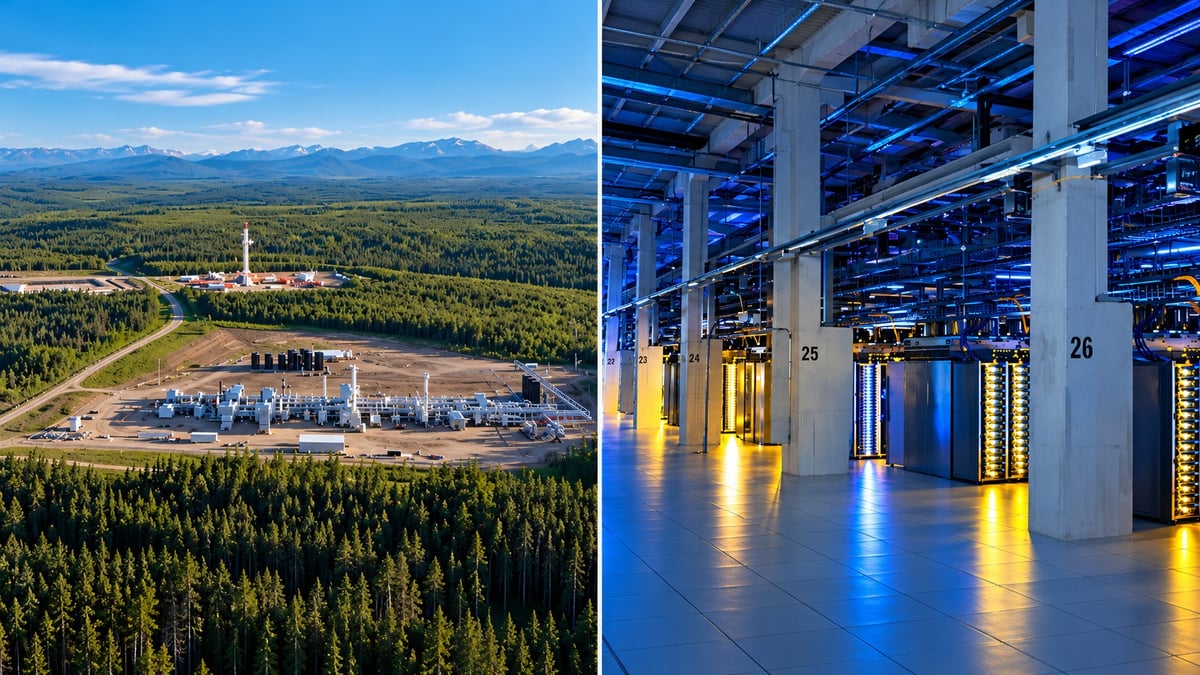
A $20-billion AI data centre proposed southwest of Edson would come with something most large computing facilities don’t have: its own natural gas power plant.
The development is called Malachite One. It would be built on Crown land near the hamlet of Robb, off Highway 47 in Yellowhead County, about 40 kilometres southwest of Edson. The power plant would generate roughly one gigawatt of electricity, which would make it a major new industrial energy user in Alberta.
The project could create hundreds of permanent jobs, but it’s still in the planning stages. Residents have raised questions about water, traffic and noise, and the developer still needs regulatory approvals.
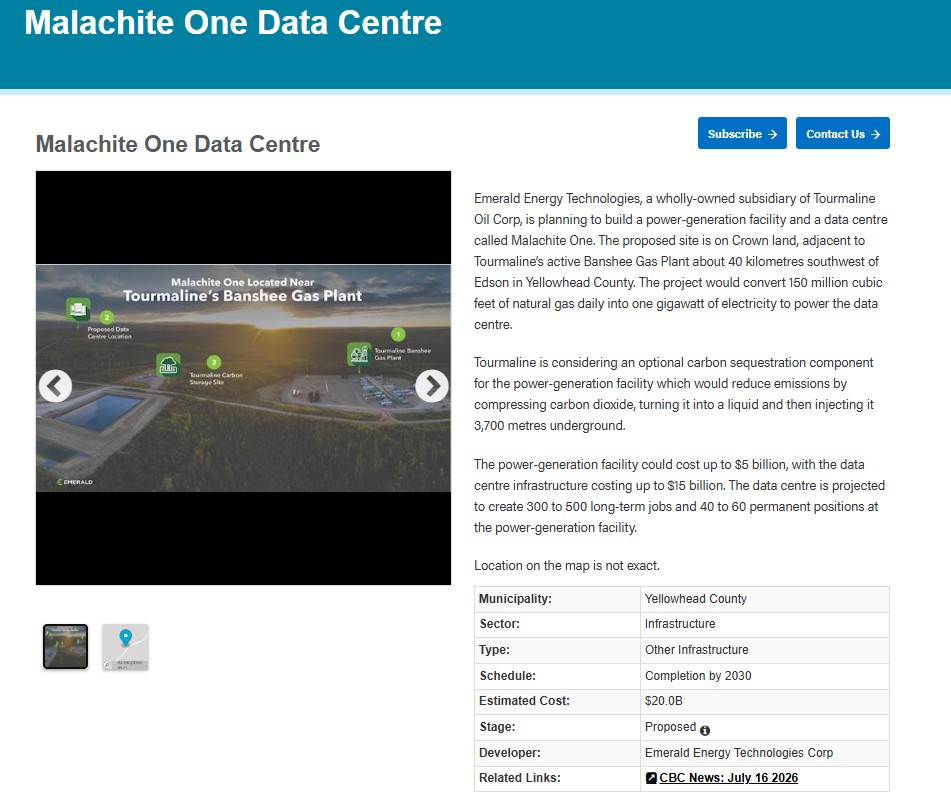
The Alberta government’s Major Projects database puts the estimated cost at up to $20 billion:
Up to $15 billion for the data centre
Up to $5 billion for the power plant
That’s a bigger announced price tag than Meta’s $13-billion data centre, now under construction north of Edmonton. As of July, Malachite One’s developer hadn’t signed a tech company to use it.
Who’s behind it
Malachite One is being developed by Emerald Energy Technologies, a wholly owned subsidiary of Tourmaline Oil, one of Canada’s largest natural gas producers.
The site is right beside Tourmaline’s Banshee Gas Plant. The plan is to produce the gas, turn it into electricity on site, and use that electricity to run the computers next door.

What an AI data centre actually is
A data centre is a building full of computer servers. Servers store files, run websites and apps, and handle the data behind everyday things like streaming, online banking and cloud storage.
An AI data centre goes further. It’s packed with thousands of specialized processors that train and run artificial intelligence systems, like the chatbots and image tools many people now use every day.
Those processors use a lot of electricity and give off a lot of heat. That’s why AI data centres need so much power and serious cooling.
Tourmaline says Malachite One would be used for cloud computing, large-scale data processing and training AI models. Earlier project information presented to Yellowhead County described up to 7.1 million square feet of data centre space, built in phases.

The $20-billion price tag
Most of the money is for the computing side, with up to $15 billion for the data centre and up to $5 billion for the power plant.
The power plant is what makes Malachite One different. Most data centres buy their electricity from the grid. This one would make its own.
The listed cost has also grown. A provincial record in July put the project at $15 billion. The current Major Projects listing says $20 billion.
How much power it would make
At full build, the plant would burn about 150 million cubic feet of natural gas a day to produce roughly 1 gigawatt of electricity.
A gigawatt is 1,000 megawatts. Alberta’s record peak demand is about 12,384 megawatts, so Malachite One’s generating capacity would equal about 8 per cent of that. Capacity isn’t the same as what a facility uses around the clock, but it shows the scale.
Earlier project details presented to the county described about 930 megawatts generated on site, plus a grid connection of about 74 megawatts.
Making its own power matters. Alberta’s rules favour data centres that bring their own electricity rather than relying heavily on the grid. Tourmaline has also said the plant could connect to the grid if the AI market changes.
What about emissions?
Burning that much gas produces a lot of carbon dioxide.
Tourmaline is considering carbon capture and storage. The system would pull CO2 from the power plant’s exhaust, compress it into a liquid and inject it about 3.7 to 3.8 kilometres underground. The company told CBC it’s drilling a sequestration well next to the Banshee plant.
Carbon capture is optional, though. It isn’t part of the first phase, and Tourmaline hasn’t committed to it.
Jobs for Yellowhead County
The province estimates the project would create:
300 to 500 permanent jobs at the data centre
40 to 60 permanent jobs at the power plant
Tourmaline told CBC construction would also employ several hundred short-term workers.
That’s up to 560 long-term jobs within commuting distance of Edson and Hinton, plus possible work for contractors, suppliers and other local businesses. For a rural county, it would also mean a major new taxpayer.
These are projections. None of the jobs exist yet.
The facility is expected to run for 30 to 50 years. The computer chips inside would be replaced much more often, every three to five years, which is why councillors asked what happens to old equipment.
What residents are worried about
Tourmaline held open houses in Edson, Robb and Hinton, and more than 250 people came. It reported back to county council on Oct. 13.
The biggest concerns were:
Traffic and safety on Highway 47
Water use
Noise
Effects on wildlife and the community
How close the site is to Robb
Heat coming off the facility
On the heat, Tourmaline told council its modelling shows warm air rising and spreading out within a few hundred feet of the site. Those are the company’s projections.
When Tourmaline first presented in June, councillors pressed it on electricity, water and plans for cleaning up the site at the end of its life. Deputy Mayor Brigitte Lemieux told CBC it was the start of a long public process. She said it was too early to say whether the project fits the county’s priorities, and that any benefits had to be balanced with responsible development.
Where the water would come from
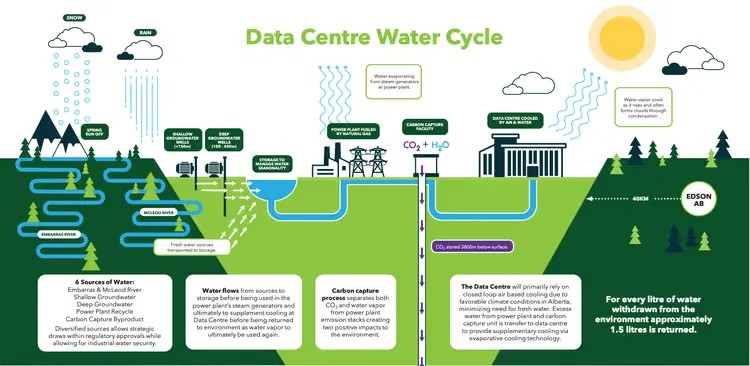
Tourmaline has published a graphic showing how water would move through the site. It lists six sources:
The Embarras River
The McLeod River
Shallow groundwater, less than 150 metres down
Deep groundwater, 150 to 450 metres down
Recycled water from the power plant
Water recovered from the carbon capture process
Water would be held in storage on site to even out seasonal swings. Most of it would go to the power plant’s steam generators.
The data centre would mostly be cooled with a closed-loop, air-based system, which works well in Alberta’s cold climate. It wouldn’t be completely dry, though. Extra water from the power plant and the carbon capture system would be sent to the data centre for supplementary evaporative cooling when needed.
Tourmaline told CBC river draws would be capped at 1.74 per cent of the Embarras’s annual flow and 0.19 per cent of the McLeod’s, about 50 litres per second combined.
The company’s graphic also claims that “for every litre of water withdrawn from the environment approximately 1.5 litres is returned.” But most of that would go back as water vapour into the air from the power plant and cooling, not back into the rivers. That’s the point Yellowhead County councillors questioned in June, when they asked how it could affect local water.
Similar concerns at other Alberta data centres
Malachite One isn’t the only data centre in Alberta facing questions about water and power.
In August, dozens of people protested Meta’s $13-billion data centre in Sturgeon County, north of Edmonton, over its water use, power demand and environmental impact.
Meta’s project is already being built, and Malachite One is still seeking approvals. But residents near Edson are asking the same basic questions. How much water and power will it need? What will it mean for the area? And what safeguards will be in place?
Part of Alberta’s data centre boom
Malachite One is one of dozens of data centre projects proposed, under construction or running across Alberta.
The biggest one already underway is Meta’s $13-billion AI data centre in Sturgeon County. The company broke ground on its first Canadian data centre there in July.
Kevin O’Leary’s Wonder Valley project near Grande Cache has been promoted at up to $70 billion, and it has run into a legal fight. In August, Sturgeon Lake Cree Nation won a court ruling allowing its challenge over a water licence to go ahead. The ruling didn’t decide the dispute itself.
Meanwhile, northeast Edmonton could become one of North America’s largest data centre districts under a separate land development proposal.
All of these projects are at different stages, and their announced figures aren’t money already spent.
Compare their locations, costs and status on our Alberta Data Centre Tracker.
Has it been approved?
No. The province lists Malachite One as proposed.
According to Tourmaline’s October update to council:
Done: the province has granted a lease for the Crown land, and studies on water, wetlands, wildlife, fish, plants and soils are complete
Underway: air quality and environmental impact studies for the power plant
Next: approvals under the Water Act
Still ahead:
Alberta Utilities Commission approval for the power plant
Consultation with Indigenous communities
County approvals, including rezoning the land from forestry to industrial and issuing a development permit
The province lists a target completion date of 2030. Tourmaline has said construction could start as early as 2027. Both depend on approvals, financing and finding a customer.
What to watch for
The next things to watch for are a signed tech tenant, the province’s water decisions and the county’s rezoning vote.
For now, Malachite One is a plan, a site and a $20-billion estimate. Residents can send questions and feedback through malachite-one.com or by email to feedback@malachite-one.com.
Sources
Government of Alberta, Major Projects: Malachite One Data Centre: https://majorprojects.alberta.ca/details/Malachite-One-Datacenter/12192
Yellowhead County, Council Highlights, Oct. 13, 2026: https://www.yhcounty.ca/county-office/county-news/post/council-highlights
Yellowhead County, Malachite One open house notice: https://www.yhcounty.ca/county-office/county-news/post/malachite-one-data-centre-open-house
Emerald Energy Technologies, Malachite One project website and “Data Centre Water Cycle” graphic: https://malachite-one.com/
Meta, “Breaking Ground on Meta’s First Data Center in Canada,” July 8, 2026: https://about.fb.com/news/2026/07/breaking-ground-on-metas-first-data-center-in-canada/






Comments
Conversation