
The water licence at the centre of the fight over Kevin O'Leary's proposed $70-billion Wonder Valley data centre doesn't belong to O'Leary Digital.
It belongs to the Municipal District of Greenview.
That distinction mattered this week when Court of King's Bench Justice Parminder K. Johal dismissed O'Leary Digital's attempt to strike Sturgeon Lake Cree Nation's judicial review of the licence.
The ruling does not cancel the licence or stop Wonder Valley. It means the Nation's challenge over whether Alberta fulfilled its duty to consult can proceed.
What O'Leary Digital wanted
O'Leary Digital argued it was directly affected by the judicial review and should have been served within the required timeframe.
Johal rejected the company's application. O'Leary Digital also sought intervenor status or, alternatively, to be added as a respondent.
Those requests were dismissed as well.
The key issue is unusually straightforward: O'Leary Digital isn't the holder of the water licence. Greenview is.
That matters because the licence is closely connected to a project O'Leary Digital is developing, but legally those aren't the same thing.
The licence allows Greenview to draw water from the Smoky River
The dispute predates Thursday's ruling.
Alberta issued Greenview a Water Act licence associated with the industrial development near Grande Prairie. Sturgeon Lake Cree Nation has challenged the province's consultation surrounding that decision. Earlier reporting on the case confirms the licence was issued to the municipality, not O'Leary Digital.
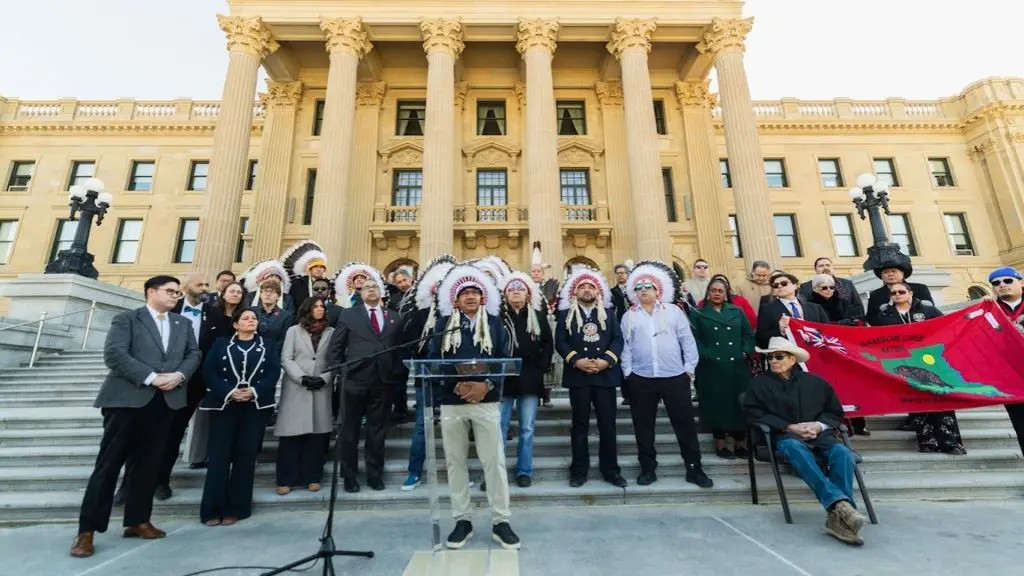
The Nation has reserve lands near the project area and has said its members rely on the Smoky River and use the surrounding territory for traditional activities. Chief Sheldon Sunshine has argued since the project became public that his Nation wasn't adequately consulted.
This isn't the Nation's first challenge to the licence.
In April, Alberta's Environmental Appeals Board dismissed its appeal after concluding the Nation had not provided sufficient evidence to establish that it was directly affected by the licence.
The judicial review is different. It puts the focus on the Crown's consultation process surrounding the provincial decision.
The municipality-company split is at the centre of the dispute
This is where Thursday's decision gets more interesting.
O'Leary Digital's position is that it has enough at stake in the licence to be directly affected by the judicial review.
Sturgeon Lake Cree Nation's broader complaint is almost the reverse: it argues Alberta has advanced approvals connected to Wonder Valley through Greenview without adequately consulting the Nation about the larger development.
Chief Sunshine said after the decision that the Nation wants the opportunity to have its treaty-rights and consultation arguments heard.
The court has not ruled on whether those allegations are correct.
But the structure of the project is worth understanding. Greenview and O'Leary Ventures announced their partnership in December 2024. Greenview said at the time it had signed a letter of intent with O'Leary Ventures involving thousands of acres in and around the Greenview Industrial Gateway. The announcement also specifically identified nearby water infrastructure as one reason the site was attractive.
Wonder Valley is enormous if it gets fully built
Wonder Valley was announced in December 2024 as a proposed AI data-centre development south of Grande Prairie.
The original plan called for a 1.4-gigawatt first phase costing approximately US$2 billion, followed by additional development that could eventually push the total investment above $70 billion. Alberta's Major Projects database also lists the first phase at 1.4 GW.
That $70-billion figure needs some context.
It isn't $70 billion already committed or under construction. It is the projected investment over the lifetime of the project if the broader development is built out, including power infrastructure, data centres and related structures.
O'Leary Digital's current plans are even larger than the original Alberta announcement. Its website now describes Wonder Valley as a two-campus platform in Alberta and Utah with 15 GW of planned power across 26,000 acres. The Alberta campus is listed at 13,000 acres and 7.5 GW.
The Alberta project remains in the permitting process.

Water has become one of Wonder Valley's biggest questions
AI data centres require enormous amounts of electricity, and their cooling systems can also make water use a major issue.
O'Leary Digital says its current Wonder Valley design uses hybrid air-and-liquid cooling and describes it as a low-water system.
But Sturgeon Lake Cree Nation's dispute isn't simply about how much water servers might consume.
It's about the provincial decision-making that happened around a Water Act licence and whether the Crown met its constitutional consultation obligations before issuing it.
Alberta itself lists Indigenous consultation and water approvals among the regulatory issues that data-centre developers may have to address.
That makes the December judicial review more significant than Thursday's procedural decision.
Wonder Valley's relationship with the Nation was strained before this ruling
The disagreement goes back almost to the project's announcement.
Sunshine has previously said he learned about Wonder Valley through the public announcement rather than through consultation with his Nation. In January 2025, he sent Premier Danielle Smith a cease-and-desist letter objecting to provincial coordination on the project without what he considered adequate involvement of Sturgeon Lake Cree Nation.
O'Leary Ventures had said in its original Wonder Valley announcement that engagement with First Nations was one of the project's core values and that it wanted relationships that benefited Indigenous communities.
Those two accounts have sat beside each other since the project was announced.
This isn't just a Grande Prairie fight anymore
Wonder Valley is now part of a much larger debate over Alberta's push to attract AI infrastructure.
The province's data-centre strategy explicitly identifies power capacity, cooling and economic growth as its three pillars. It also promises Indigenous partnerships while acknowledging that individual projects may require Water Act approvals and consultation.
Meanwhile, O'Leary Digital is developing a second Wonder Valley campus in Box Elder County, Utah. The company announced a joint venture for that project in February and says the Alberta and Utah campuses together represent 15 GW of planned capacity.
The Utah project has generated its own opposition over its scale, environmental effects and public benefits.
What happens next
The most important part of Thursday's ruling is also the simplest:
Sturgeon Lake Cree Nation gets to continue its judicial review.
The court has not found that Alberta failed to consult. It has not revoked Greenview's water licence. And it has not ruled that Wonder Valley can't proceed.
Those questions weren't before the court at this stage.
The underlying judicial review is expected to be heard in December. That's when the dispute moves away from whether O'Leary Digital belongs in this particular proceeding and back to the issue Sturgeon Lake Cree Nation has been raising from the beginning: what consultation was Alberta required to carry out before issuing the water licence, and did it do enough?
Sources:
Court of King's Bench of Alberta; Sturgeon Lake Cree Nation; Municipal District of Greenview; Alberta Environment and Protected Areas; Environmental Appeals Board; Government of Alberta; O'Leary Digital.







Comments
Conversation