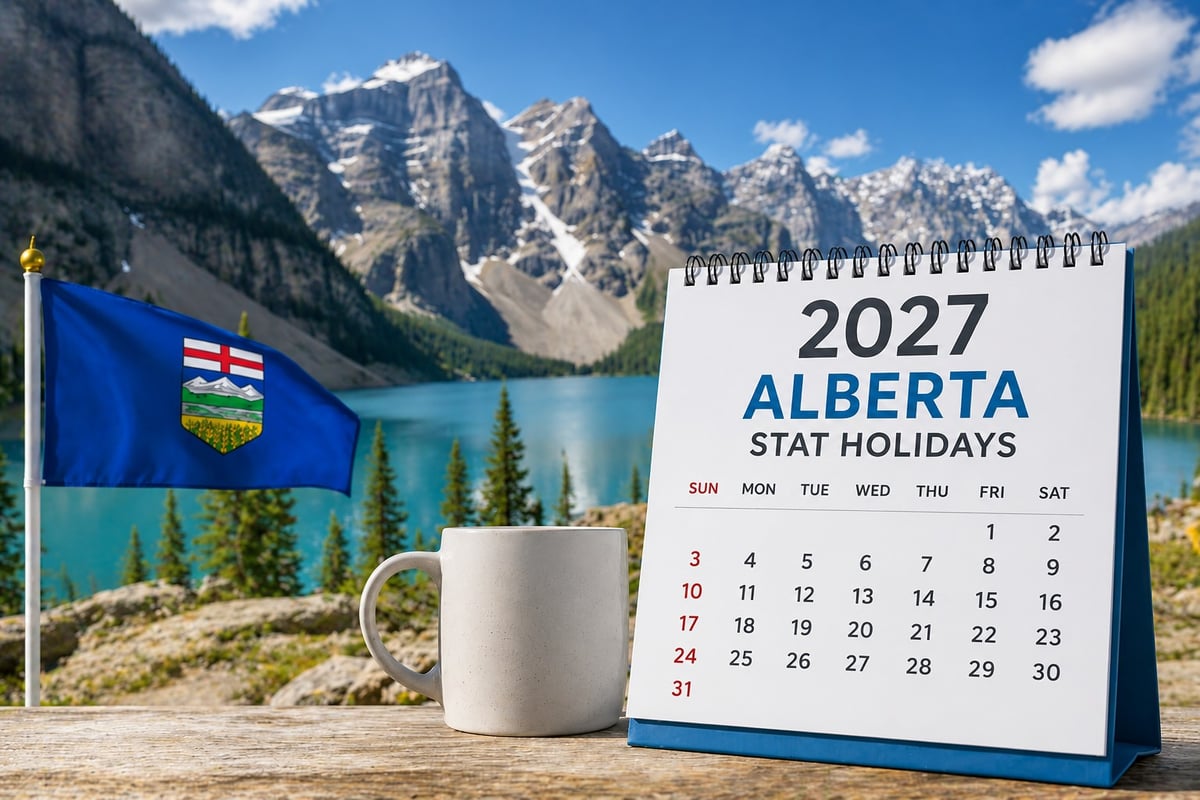
Alberta has nine statutory holidays in 2027, but not all of them mean a paid day off.
Christmas falls on a Saturday. Canada Day and Remembrance Day both land on a Thursday, which turns one vacation day into a four-day weekend. And the holiday season at the end of the year gives you nothing automatic: Christmas, Boxing Day and New Year’s Day 2028 all fall on weekends.
There are also four optional holidays, including Heritage Day and Boxing Day, that plenty of employers give but Alberta’s Employment Standards don’t require.
Here’s every date, which ones make long weekends, how holiday pay works, and what happens when a stat falls on a Saturday.
Looking for this year? See Alberta Stat Holidays 2026.
Alberta’s 9 statutory holidays in 2027
| Holiday | Date | Day |
|---|---|---|
| New Year’s Day | January 1 | Friday |
| Alberta Family Day | February 15 | Monday |
| Good Friday | March 26 | Friday |
| Victoria Day | May 24 | Monday |
| Canada Day | July 1 | Thursday |
| Labour Day | September 6 | Monday |
| Thanksgiving | October 11 | Monday |
| Remembrance Day | November 11 | Thursday |
| Christmas Day | December 25 | Saturday |
These are the nine days Alberta’s Employment Standards Code calls general holidays. If you qualify (rules below), your employer owes you holiday pay whether or not it’s in your contract.
The 4 optional holidays
| Holiday | Date | Day |
|---|---|---|
| Easter Monday | March 29 | Monday |
| Heritage Day | August 2 | Monday |
| National Day for Truth and Reconciliation | September 30 | Thursday |
| Boxing Day | December 26 | Sunday |
Optional means your employer decides. Banks, federal offices and many large employers take Easter Monday, Heritage Day and Boxing Day. September 30 is a federal holiday, so Canada Post, federal offices and federally regulated workplaces close, while most Alberta stores and provincial offices stay open.
If your employer designates an optional day as a general holiday, Alberta’s holiday pay rules apply to it. If it’s just a paid day off under your contract or a collective agreement, those terms govern instead. Ask which one it is.
Alberta’s long weekends in 2027
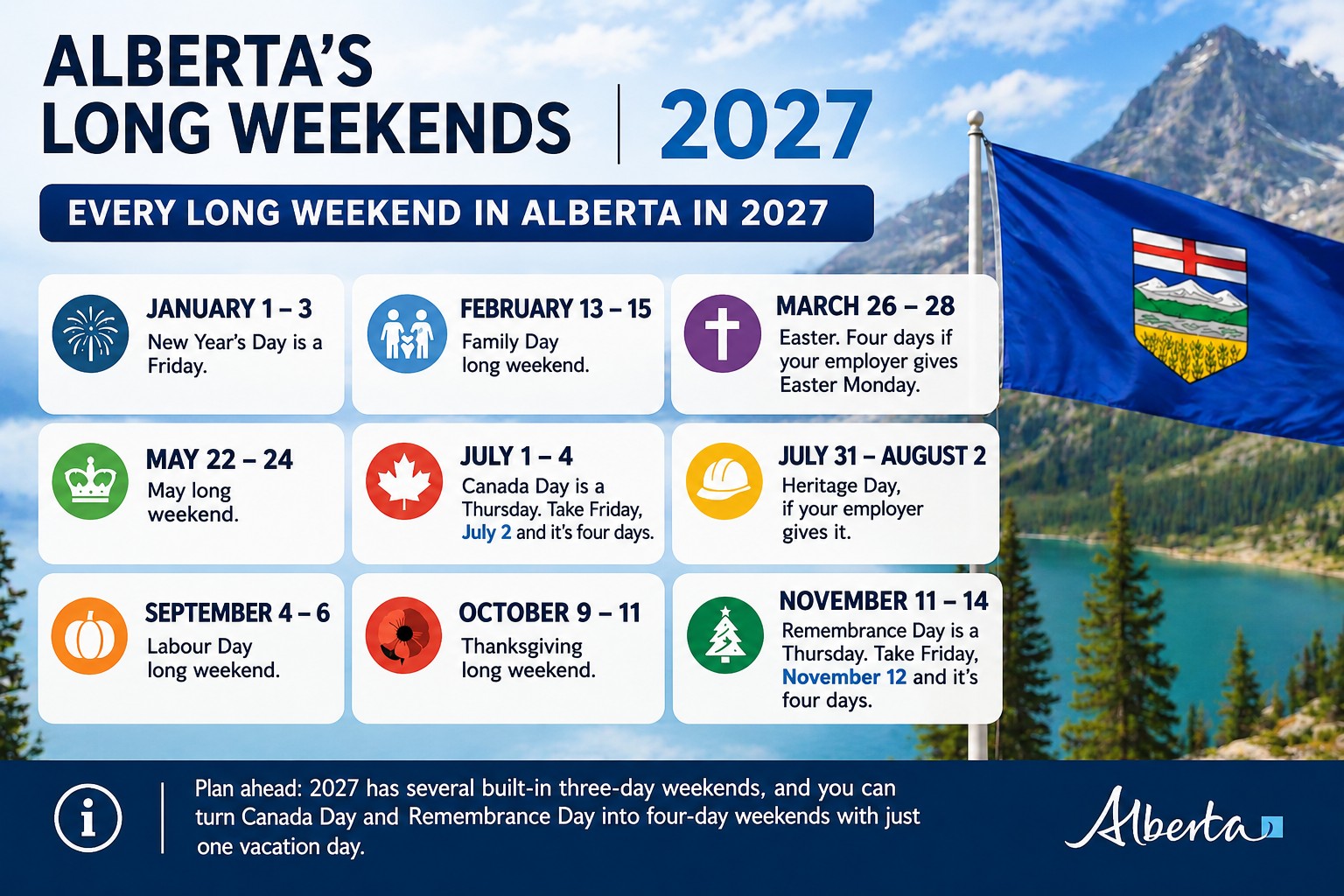
January 1 to 3: New Year’s Day is a Friday.
February 13 to 15: Family Day.
March 26 to 28: Easter. Four days if your employer gives Easter Monday.
May 22 to 24: May long.
July 1 to 4: Canada Day is a Thursday. Take Friday, July 2 and it’s four days.
July 31 to August 2: Heritage Day, if your employer gives it.
September 4 to 6: Labour Day.
October 9 to 11: Thanksgiving.
November 11 to 14: Remembrance Day is a Thursday. Take Friday, November 12 and it’s four days.
Then nothing. Christmas is a Saturday, Boxing Day a Sunday, New Year’s Day 2028 a Saturday. What you get in late December depends entirely on your employer.
Christmas 2027 is a Saturday. Do you get Monday off?
Under Alberta’s rules, it comes down to one question: is Saturday a day you’d normally work?
If yes, Christmas is treated like any other stat and the pay rules below apply.
If no, and you don’t work it, Alberta doesn’t require your employer to pay you for it or give you another day off. Many employers give Monday, December 27 anyway, and some collective agreements require it. Check with yours early.
The same goes for Boxing Day on the Sunday and New Year’s Day 2028 on the Saturday.
One exception: this is the provincial rule. If you’re federally regulated (banks, telecoms, airlines, rail, interprovincial trucking, Canada Post), the Canada Labour Code applies instead, and it generally gives you a substitute paid day off when a holiday falls on a day you don’t work.
Who qualifies for stat holiday pay in Alberta
You need to have worked for the same employer for at least 30 workdays in the 12 months before the holiday. Full-time, part-time and casual all count.
You lose the pay for that holiday if you’re scheduled to work it and don’t show up, or if you skip your last scheduled shift before it or your first one after without your employer’s okay.
Irregular schedule? The 5-of-9 rule. If you don’t have a set schedule, Alberta looks at the nine weeks before the holiday. If you worked that weekday in at least five of them, it counts as a regular workday for you. A server who’s worked five of the last nine Thursdays gets Canada Day treated as a normal workday.
What you get paid
The holiday is a normal workday and you get it off: your average daily wage.
The holiday is a normal workday and you work it: your employer picks one. Either 1.5 times your regular wage for every hour worked plus your average daily wage, or your regular wage for the hours worked plus another day off paid at your average daily wage.
The holiday is not a normal workday but you work it: 1.5 times your regular wage for the hours worked.
The holiday is not a normal workday and you don’t work it: nothing is owed.
How to calculate your average daily wage
Average daily wage is 5 per cent of your wages, general holiday pay and vacation pay earned in a four-week window. Your employer can use either the four weeks right before the holiday, or the four weeks ending on the last day of the pay period before it. Overtime isn’t included.
Example: you earned $3,200 in wages and vacation pay over the four weeks before Labour Day. Your average daily wage is $160. Get the day off, you’re paid $160. Work an eight-hour shift at $20 an hour, you’re paid $240 for the shift plus the $160, or $160 for the shift plus another paid day off.
Our stat holiday pay calculator does the math with your own numbers.
Three questions people keep asking
Is September 30 a stat holiday in Alberta? No. The National Day for Truth and Reconciliation is a federal holiday, not one of Alberta’s nine. Federally regulated workers get it. Everyone else depends on their employer.
Is Boxing Day a paid holiday in Alberta? Not under provincial rules. It’s optional. Federally regulated workers get it.
Do part-time workers get stat holiday pay? Yes, if they pass the 30-workday test. The amount is 5 per cent of what they earned in the four-week window, so a part-timer’s holiday pay is smaller than a full-timer’s, but it’s owed.
What’s open and closed on a stat
Banks, provincial offices and registries, Canada Post, courts, schools and most public libraries close. Grocery stores, pharmacies, malls, restaurants and gas stations usually open with shorter hours, because Alberta doesn’t restrict retail on holidays, including Remembrance Day. Calgary and Edmonton transit run holiday schedules.
We publish a what’s-open guide before each holiday.








Comments