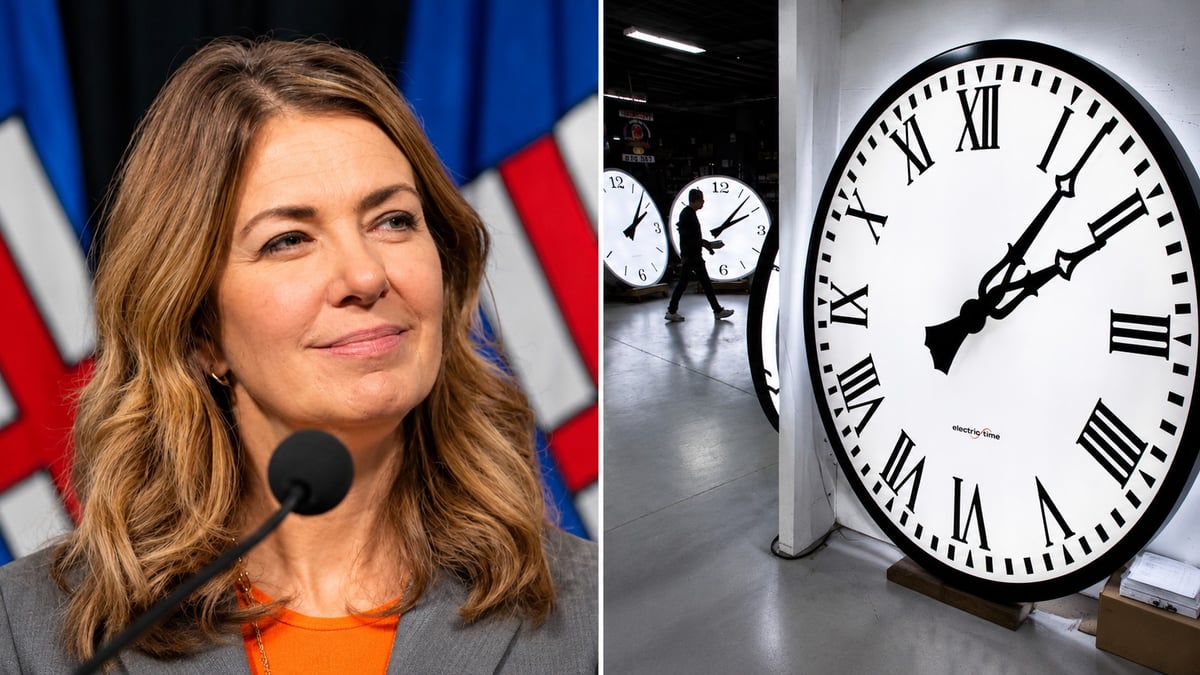
Five years ago, Albertans were asked whether they wanted to stop changing their clocks and stay on summer hours all year.
They said no.
On Sunday, Nov. 1, Alberta does it anyway.
The province’s new system, Alberta Time, keeps the clocks on what used to be Mountain Daylight Time year-round. It’s the same option voters narrowly turned down in October 2021.
When Service Alberta Minister Dale Nally posted “Alberta Time is here!” on Friday, a lot of the replies said the same thing: we already voted on this.
They’re right. Here’s what that vote actually said, and why the government went ahead.
What Albertans were asked
The question was on the ballot on Oct. 18, 2021, alongside municipal elections, under Jason Kenney’s United Conservative government. It read:
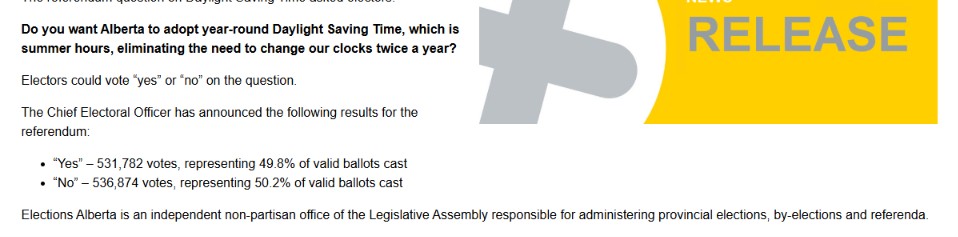
“Do you want Alberta to adopt year-round Daylight Saving Time, which is summer hours, eliminating the need to change our clocks twice a year?”
Elections Alberta’s final count:
| Vote | Ballots | Share |
|---|---|---|
| No | 536,874 | 50.2% |
| Yes | 531,782 | 49.8% |
The margin was 5,092 votes out of more than 1.06 million valid ballots. Turnout was just under 39 per cent.
It was even closer on election night. Elections Alberta later corrected the totals after the City of Grande Prairie reported that its Yes and No counts had been swapped.
One thing the ballot didn’t offer was permanent standard time. Voters could choose permanent summer hours or keep switching. The 2021 vote rejected the first. It didn’t endorse the second.
How your city voted
The split wasn’t urban versus rural. It was all over the map.
| Community | Result |
|---|---|
| Edmonton | No, 54.6% |
| Calgary | No, 51.5% |
| St. Albert | No, 57.7% |
| Strathcona County | No, 54.3% |
| Grande Prairie | No, 56.0% |
| Canmore | No, 64.5% |
| Banff | No, 57.8% |
| Jasper | No, 54.5% |
| Red Deer | Yes, 54.6% |
| Lethbridge | Yes, 51.2% |
| Medicine Hat | Yes, 61.9% |
| Lloydminster | Yes, 79.8% |
Some patterns stand out.
Grande Prairie said no by 12 points. It has the latest winter sunrises of any major Alberta city, about 10:19 a.m. on Dec. 21 under Alberta Time.
The mountain towns said no by wide margins. Canmore had one of the strongest No votes in the province. Ski patrollers have since raised concerns about dark mornings on the hills.
Lloydminster went the other way, nearly four to one. The border city already runs on the same clock as Saskatchewan for most of the year, and Alberta Time keeps it that way.
“The results of the referendum are binding”
That line is the government’s own wording.
The province’s 2021 engagement page, which is still on alberta.ca, says: “The results of the referendum are binding.” It then adds: “Alberta will continue changing their clocks twice a year.”
Alberta did, for four more years.
A referendum binds the government that holds it. It doesn’t stop a later legislature from passing a new law. That’s what happened in 2026. The province passed the Red Tape Reduction Statutes Amendment Act, 2026, also known as Bill 31, which replaced the old Daylight Saving Time Act with a new Official Time Act. The sections ending the clock change came into force on June 18.
Read more: Alberta Time Is Official: Bill 31 Ends Clock Changes for Good in Alberta
The 2019 survey that pointed the other way
The referendum wasn’t the first time the province asked.
In late 2019, it ran an online survey. Of 141,280 responses, 91 per cent supported moving permanently to daylight time, according to the province. “We hear those Albertans,” Kenney said when the results came out in March 2020.
Two years later, the referendum came out the other way.
The two aren’t the same kind of evidence. Anyone who wanted to could fill out the survey, and people with strong feelings are more likely to. The referendum was a provincewide vote with more than a million ballots counted.
What both results do show is that Albertans want the switching to stop. The disagreement is over which hour to keep.
Why the government changed course
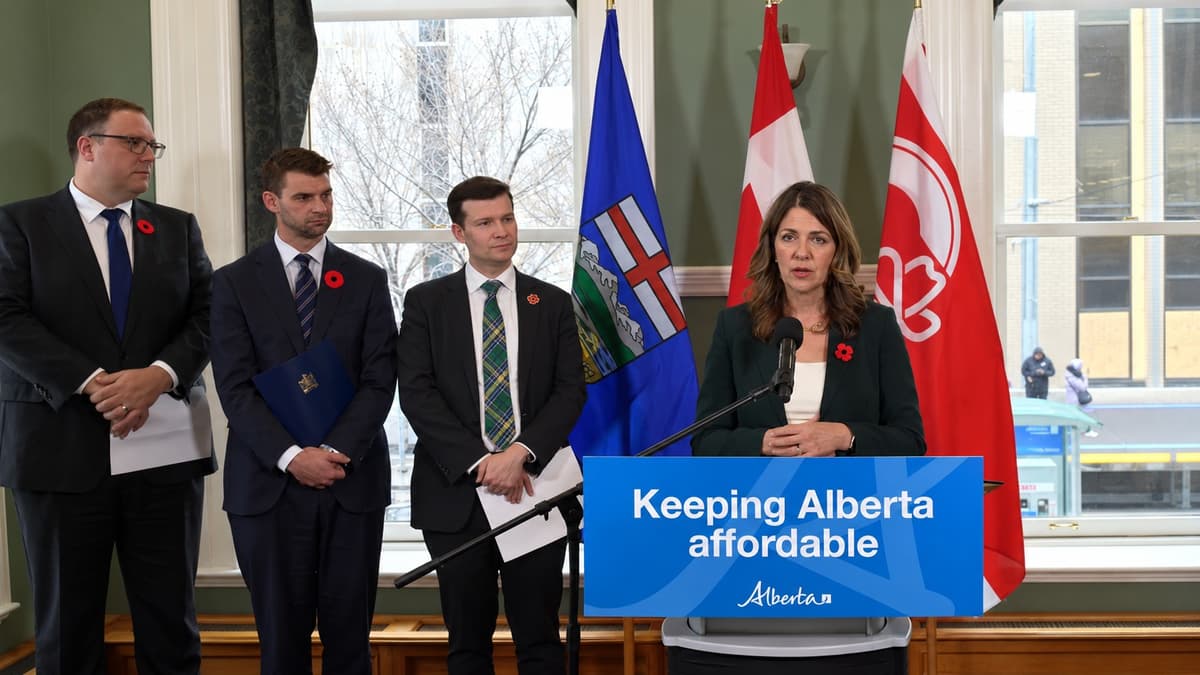
Premier Danielle Smith has said the map changed after 2021.
British Columbia stopped changing its clocks this year. Saskatchewan and Yukon already had. Manitoba and the Northwest Territories followed. Speaking to reporters in April, Smith said Alberta would otherwise be “an island,” and called the decision “forced” on the province.
She has also argued Albertans would rather have light after work than very early summer sunrises.
Nally was blunter when the bill was introduced. “If ever there was an example of paralysis by analysis, it was time change,” he said.
The province says permanent Alberta Time will mean fewer disruptions, more predictable schedules for families and businesses, and a better fit with neighbours that have already stopped switching.
What sleep researchers say
Most sleep scientists agree with ending the switch. They disagree with which time Alberta kept.
The American Academy of Sleep Medicine says permanent standard time lines up better with the body’s internal clock, because morning light is what sets it.
Researchers at the universities of Alberta, Calgary and Lethbridge have made the same argument this fall. “What all the sleep organizations in the world would recommend is that we stay on standard time, not stay on daylight saving time,” said Dr. Joanna MacLean, medical director of the sleep lab at the Stollery Children’s Hospital.
The cost shows up in the mornings. Under Alberta Time, Edmonton’s sunrise drifts to nearly 9:50 a.m. around Boxing Day, and Calgary’s to about 9:40 a.m. Edmonton won’t see a sunrise before 8 a.m. again until mid-March. Kids in grade school will be walking to class in the dark for months.
The benefit shows up after work. Sunsets stay an hour later all winter.
What changes Sunday
Nothing, if you don’t touch a clock.
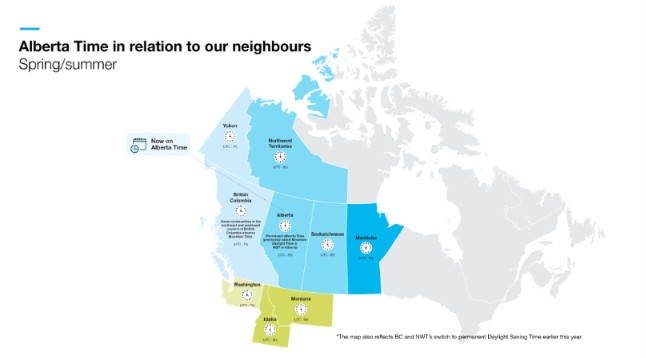
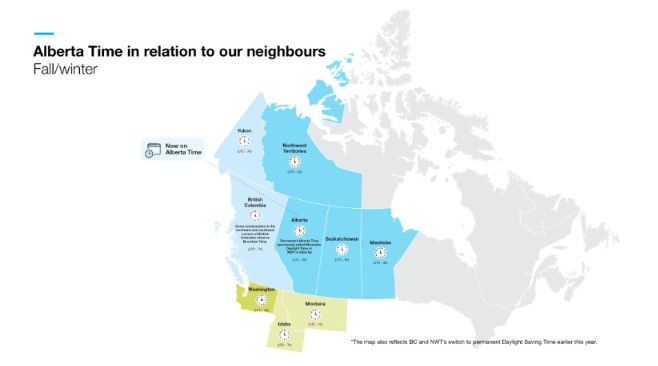
Alberta stays on UTC-6. It’s now the same time as Saskatchewan year-round, one hour ahead of B.C., and one hour behind Ontario instead of two.
Some phones, computers, calendars and cars may still try to fall back on their own. If one of your devices is an hour behind on Sunday morning, it needs an update or a manual fix.
Could there be another vote?
Possibly, but nothing has been promised.
The province says it will gather feedback after the first full year on Alberta Time. Smith has gone a step further. “We have time if we need to add an additional referendum question to the ballot in October 2027,” she said in April. “But I think we need to live it first and then see what the reaction is.”
If that question does come, it would likely be the one that wasn’t asked in 2021: daylight time or standard time, with no switching either way.
Alberta’s first winter on Alberta Time starts Sunday. The darkest mornings arrive in about seven weeks.
Sources
Elections Alberta, Daylight Saving Time official results (updated): https://www.elections.ab.ca/senate-and-referendum/referendum-questions/daylight-saving-time/
Elections Alberta, 2021 Senate Election and Referendum Report: https://www.elections.ab.ca/uploads/2021-Senate-and-Referendum-Report.pdf
Government of Alberta, Daylight saving time engagement (2021): https://www.alberta.ca/daylight-saving-time-engagement.aspx
Government of Alberta, Permanent daylight saving time engagement: https://www.alberta.ca/permanent-daylight-savings-time-engagement
Government of Alberta, Alberta’s new time system: https://www.alberta.ca/albertas-new-time-system
American Academy of Sleep Medicine, Permanent standard time position statement: https://pmc.ncbi.nlm.nih.gov/articles/PMC10758561/




Comments