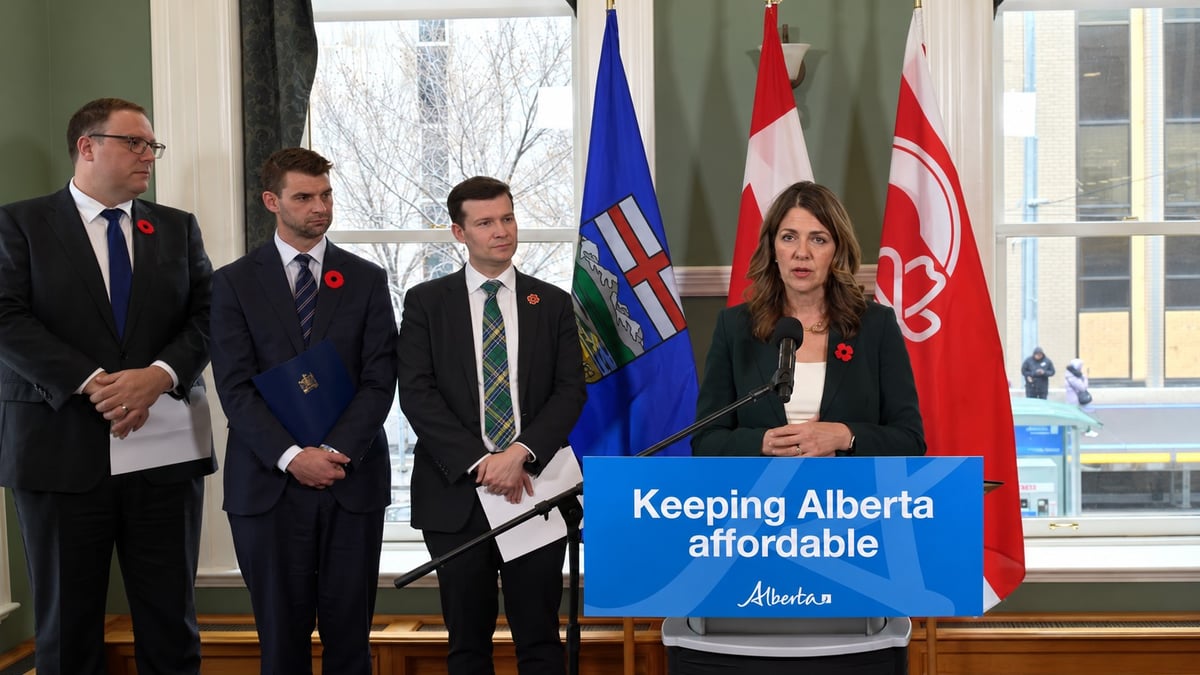
Alberta is cutting its education property tax rate and freezing it for the next three years.
Premier Danielle Smith announced the change Friday at Calgary city hall. She said it will save Albertans about $100 million provincewide.
"We’re reducing the education property tax rate, freezing the rate for 3 years, and applying a standard rate across all municipalities"
The new rate takes effect in 2027. The province is also changing how the tax works. Instead of billing each municipality a lump sum, it will apply one rate directly to property assessments.
“The vast majority of Albertans, particularly in the two largest cities, will pay less tax,” Finance Minister Jason Nixon told the Calgary Herald before the announcement. “Nobody is going to pay more education property tax.”
The province hasn’t yet said what the new rate is, or how much individual homeowners will save.
Key takeaways
Alberta is cutting its education property tax rate and freezing it for three years.
The province expects about $100 million in savings provincewide.
The change applies to 2027 property tax bills.
Calgary and Edmonton are expected to benefit most. Nobody will pay more, according to Nixon.
Nixon says school funding from Budget 2026 will not be cut.
The three-year freeze runs past the October 2027 provincial election.
Your total bill can still go up if your assessment rises or your city raises its own taxes.
What’s changing
Two things are changing: the rate, and how it’s charged.
Until now, the province set the total amount each municipality had to collect for education. That lump sum was based on provincewide equalized assessment. Each municipality then turned it into a local tax rate.
The result was uneven. Two homes with the same value could pay very different education tax depending on the city. Nixon said Friday that the current structure isn’t clear and varies from one municipality to the next. Earlier, he called it “confusing as heck.”
Municipal Affairs Minister Dan Williams said the new rate will be applied directly to municipal property assessments in 2027. It will no longer be a lump sum, as it was in past years.
That should make the education line on your bill easier to understand. Similar homes should pay similar amounts, no matter where they are in Alberta.
Who will pay less?
Nixon says most Alberta property owners will pay less, including owners of homes and commercial properties.
Calgary and Edmonton are expected to see the biggest benefit. Both cities send the province huge sums. In 2026, the province requisitioned $1.25 billion from Calgary and $639 million from Edmonton.
A small number of municipalities that already pay significantly less will see no change. The province hasn’t said which ones.
Why Calgary pushed so hard
On Calgary bills, the provincial education portion rose about 21% this year. It rose more than 15% the year before.
The city’s own portion rose less than 2% this year.
Calgarians get one combined bill that covers both city services and the provincial education tax. Most people look at the total. They don’t see how much of the increase came from the province rather than city council.
Mayor Jeromy Farkas made that his fight. Smith joked Friday that Farkas had pushed “very, very, very” strongly against the increase in the last provincial budget.
Nixon gave him credit. “I heard him on that and I’m making it fair,” he told the Herald.
Alberta raised education property taxes earlier this year
This cut comes eight months after a big increase.
Budget 2026 raised the education property tax rate from $2.72 to $2.84 per $1,000 of equalized assessment for residential and farmland properties. The non-residential rate rose from $4.00 to $4.17.
Combined with rising property values, total education property tax revenue climbed from about $3.12 billion in 2025-26 to about $3.59 billion in 2026-27. That’s an increase of roughly $470 million, or 15%.
The $100-million cut:
is less than 3% of the $3.6-billion total
reverses about one-fifth of this year’s increase
still leaves Alberta collecting far more than it did last year
Will schools lose funding?
No, according to Nixon. He said the change will not reduce school and education funding announced in Budget 2026.
The province hasn’t said how it will cover the $100 million it won’t be collecting.
For scale, this month’s provincial referendum is estimated to have cost even more. Former chief electoral officer Lorne Gibson put the price of the October 19 vote at $120 million to $130 million, more than three times the roughly $37 million cost of the 2023 provincial election. Elections Alberta hasn’t released a final figure. A third-party campaign argued before the vote that the money could have paid for 188 teachers or 150 family doctors. Roughly three in four voters chose to keep Alberta in Canada.
How much will you save on a $500,000 home?
Not known yet. The province hasn’t released the new rate.
Here’s how the math works. Say the rate fell by $0.10 per $1,000 of assessed value. That number is made up, for illustration only.
A $500,000 home would save about $50 a year.
A $750,000 home would save about $75 a year.
Your real savings will depend on the new rate and your assessed value.
Will your total property tax bill go down?
Not necessarily. There are two reasons.
A frozen rate isn’t a frozen bill. The rate stays the same for three years, but your education tax is the rate multiplied by your assessment. If your home’s value goes up, your education tax goes up with it.
Your city sets its own taxes. A provincial cut doesn’t stop your municipality from raising its portion.
Here’s an example. You save $60 on education tax. Your city raises its portion by $150. Your total bill still goes up $90.
What about businesses and renters?
Nixon says the cut covers both residential and non-residential properties, so businesses should benefit too. They already pay a higher rate, so the dollar impact could be larger.
Renters won’t see a direct benefit. Landlords pay the property tax. Lower costs may ease rent pressure over time, but nothing requires landlords to cut rent.
Why do Albertans pay education property tax?
Education property tax helps fund kindergarten to Grade 12, including teacher salaries and classroom instruction.
Almost every property owner pays it, whether or not they have kids in school. Municipalities collect it, but the money goes to the province.
Most of it flows into the Alberta School Foundation Fund. The province distributes it to school boards on a per-student basis. The rest of education funding comes from general provincial revenue.
In 2026-27, education property tax is expected to cover 33.4% of education operating costs, up from 31.6% the year before.
What happens next?
Still to come from the province:
the new education tax rate
savings by municipality
how the province will make up the $100 million
The new rate will show up on 2027 property tax bills. Watch the education line on your own bill. The provincewide figure won’t tell you much about your own savings.
There’s also a political wrinkle. Albertans go to the polls on October 18, 2027, and the three-year freeze runs past that date. The freeze is a government policy, not a law, so the next government could change it. If Naheed Nenshi’s NDP wins, it could keep the freeze, raise the rate, or rework the tax in its first budget. The NDP criticized Budget 2026 for raising property taxes, but as of Friday afternoon it hadn’t said publicly whether it would keep this cut and freeze.
Frequently asked questions
Is Alberta cutting education property tax?
Yes. Premier Danielle Smith announced on October 30, 2026 that Alberta will cut its education property tax rate and freeze it for three years. The province expects about $100 million in savings.
When does the cut take effect?
In 2027. Municipal Affairs Minister Dan Williams said the new rate will be applied to municipal property assessments that year.
Will Calgary and Edmonton homeowners pay less?
Nixon says the vast majority of Albertans, particularly in the two largest cities, will pay less. Exact savings haven’t been released.
Will anyone pay more education property tax?
No, according to Nixon. A few municipalities that already pay significantly less will see no change.
Will schools lose funding?
Nixon says the change won’t reduce school funding announced in Budget 2026.
Does a rate freeze mean my bill won’t go up?
No. Your education tax can still rise if your assessed value rises, and your city can still raise its own portion.
What happens to the freeze if the NDP wins the 2027 election?
A new government could change the rate in its own budget. The NDP hasn’t said publicly whether it would keep the freeze.
Sources
CPAC, Alberta Premier Danielle Smith Makes an Announcement, October 30, 2026: https://www.cpac.ca/headline-politics/episode/alberta-premier-danielle-smith-makes-an-announcement?id=377ed3b4-822e-46e5-a2f4-29758bb1df51
Adam MacVicar (Global News), live coverage on X, October 30, 2026:
Rick Bell, “Bell: Danielle Smith rolls out property tax break for Calgary and other Albertans,” Calgary Herald, October 30, 2026: https://calgaryherald.com/opinion/columnists/bell-danielle-smith-property-tax-break-calgary-other-albertans
Government of Alberta, Education property tax: https://www.alberta.ca/education-property-tax
Elections Alberta, Alberta’s Next Provincial General Election: https://www.elections.ab.ca/?p=7528
CTV News Calgary, “Alberta’s October referendum could cost taxpayers up to $130M: expert,” June 17, 2026: https://www.ctvnews.ca/calgary/article/albertas-october-referendum-could-cost-taxpayers-up-to-130m-expert/




Comments
Conversation