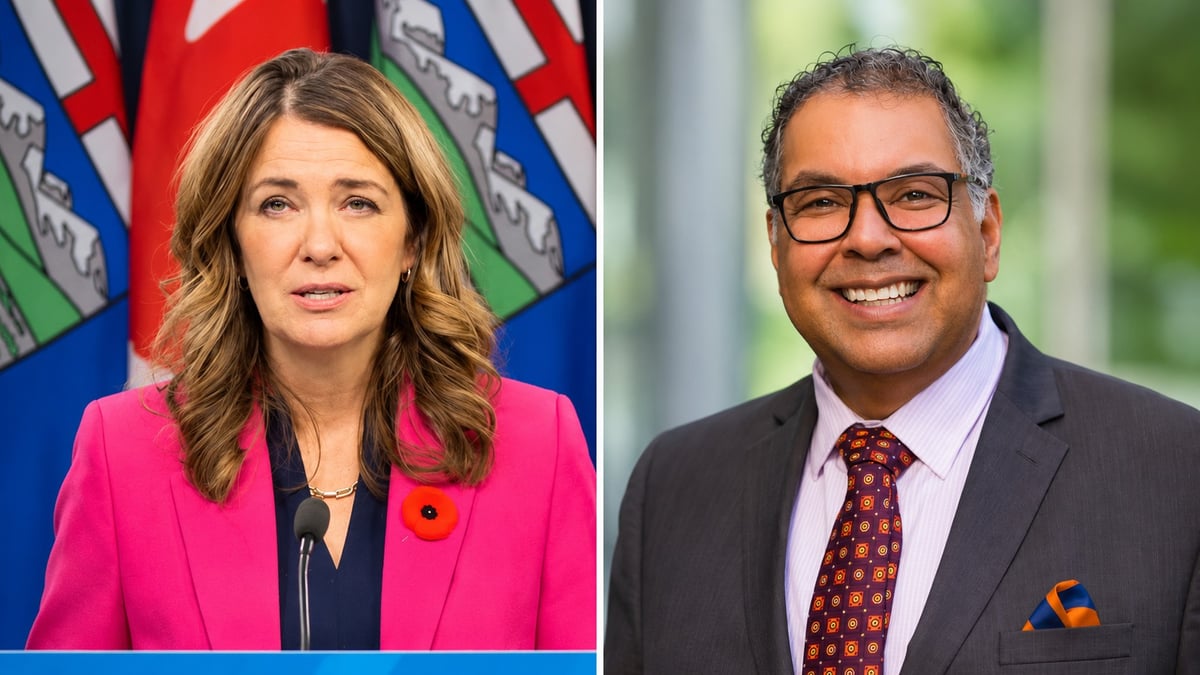
In September, Danielle Smith’s United Conservatives led Alberta by 13 points.
Six weeks and one referendum later, one poll has Naheed Nenshi’s NDP ahead. Another has the parties tied. And the pollster behind the newest survey says the premier would lose an election held tomorrow.
“I think the UCP can lose,” ThinkHQ’s Marc Henry said this week. “I think if the election was tomorrow they would lose.”
Not every poll agrees. Two October surveys still have the UCP ahead by two to five points. But none of them shows anything like the comfortable lead the governing party had all year.
Here’s what every poll says, and why the race is suddenly close.
Every Alberta poll since the summer
| Pollster | Field dates | UCP | NDP |
|---|---|---|---|
| Pollara | Oct. 2 to 15 | 46% | 50% |
| Abacus Data | Oct. 7 to 13 | 47% | 42% |
| Léger | Oct. 2 to 4 | 47% | 45% |
| Janet Brown (for CBC) | Sept. 8 to 21 | 41% | 41% |
| Abacus Data | Sept. 4 to 7 | 52% | 39% |
| Research Co. | Aug. 24 to Sept. 2 | 46% | 43% |
| Léger | Aug. 21 to 23 | 51% | 41% |
Decided voters. Pollara surveyed 1,347 Albertans online; 18 per cent were undecided.
Read down the right-hand column. The NDP went from 39 and 41 in the summer to 42, 45 and 50 in October. The UCP went the other way.
Poll trackers now put the two parties within a point of each other provincewide. In February, Abacus had the UCP up 13. In early September, still 13. By mid-October, five.
The ThinkHQ poll that set off the alarm
The survey everyone in Alberta politics is talking about this week comes from ThinkHQ Public Affairs, conducted in late October after the referendum.
It didn’t ask the horse-race question the usual way. It asked how Albertans feel about the two leaders.
Smith: 39 per cent approve, 59 per cent disapprove. Nearly half, 49 per cent, strongly disapprove.
Nenshi: 44 per cent approve, 48 per cent disapprove.
“Her approval was like an ice cube,” Henry said. “You could watch it melt a little bit more each time we did a poll.”
The number that matters most is in Calgary. Across the greater Calgary area, including Airdrie, Cochrane and Okotoks, Nenshi leads Smith 48 to 37. Inside the city itself, his lead is 16 points.
“If there was a 17-point swing in Calgary overall, the NDP would win in a landslide,” Henry said.
One caveat the headlines skipped: about three in four people who voted UCP last time still approve of Smith. The base hasn’t left. The middle has.
What the referendum did
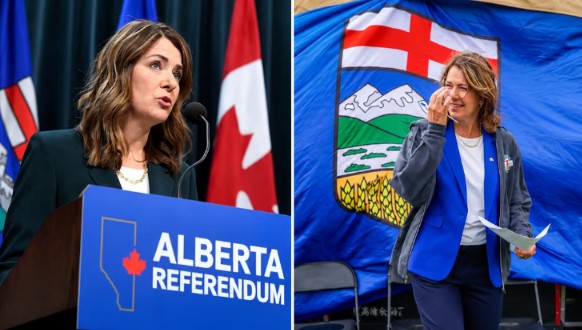
The Oct. 19 referendum put separation on the ballot. Albertans said no.
Pollara’s October survey, taken as mail ballots were coming in, found just 24 per cent of decided voters planned to vote to leave Canada. Seventy per cent called the whole exercise a waste of time and money. One in five said they’d stopped talking to a friend or family member over it.
Smith’s government held the vote. Nenshi campaigned against separation.
Polls can’t prove the referendum caused the slide. But the timing is hard to ignore. Pollara’s survey, the one with the NDP ahead, was in the field during the campaign. ThinkHQ’s was in the field the week after.
Former premier Jason Kenney had already drawn the line in September, after the UCP lost Calgary-Shaw, a seat it had held for two terms. He linked the loss to the separation vote.
Calgary-Shaw was the warning
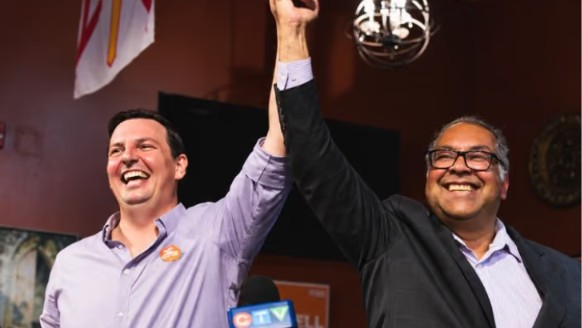
On Sept. 14, NDP candidate Kyle Campbell won the Calgary-Shaw byelection by 582 votes. Nenshi said the NDP had lost the riding by 40 points in 2019.
“There are no safe conservative seats in Calgary,” Nenshi said that night. He called it an “earthquake.”
Smith’s response: “The voters of Calgary-Shaw have spoken.”
A byelection isn’t a general election. Turnout is lower and voters like to send messages. But Pollara’s October numbers point the same direction: NDP up 2 in Calgary, up 27 in Edmonton, UCP well ahead everywhere else.
That’s the map of the next election. Edmonton goes orange. Rural Alberta goes blue. Calgary picks the premier.
Would the NDP win an election today?
Nobody can say for sure, and the honest answer is “maybe.”
Pollara has the NDP up four. Abacus has the UCP up five. That’s a nine-point spread between two reputable firms polling the same week. Some of that is method. Some of it is a province that hasn’t made up its mind.
Vote share isn’t seats, either. The NDP piles up huge margins in Edmonton that don’t help it anywhere else. The UCP’s rural vote is spread across dozens of safe ridings. A 45-45 tie provincewide could still mean a UCP government, depending on what happens in 20 or so Calgary seats.
And the election isn’t expected until 2027. A year is a long time. The referendum is over, the trade war is shifting, and governments get to spend the budget.
What Albertans say they care about
Research Co. asked likely voters in August what the province’s most important issue was. The economy and jobs came first at 22 per cent. Health care was next at 20 per cent. Housing, homelessness and poverty: 13 per cent. Government accountability and national unity: 11 per cent each.
In Calgary, the economy led. In Edmonton, health care did.
Separation got a referendum. It didn’t get the top spot on the list. The next election will probably be fought on the things that did.
What to watch
For Smith, the question is whether the referendum was a bruise or a break. Her own voters are still with her. The people who decided the last three elections, suburban Calgary, aren’t.
For Nenshi, the question is whether an NDP lead in one poll and a tie in another becomes a lead in all of them. He’s more popular than his party. He needs the party to catch up.
For everyone else, there’s a clean test coming. The next round of polls will show whether October was a referendum hangover or the start of something.


Comments