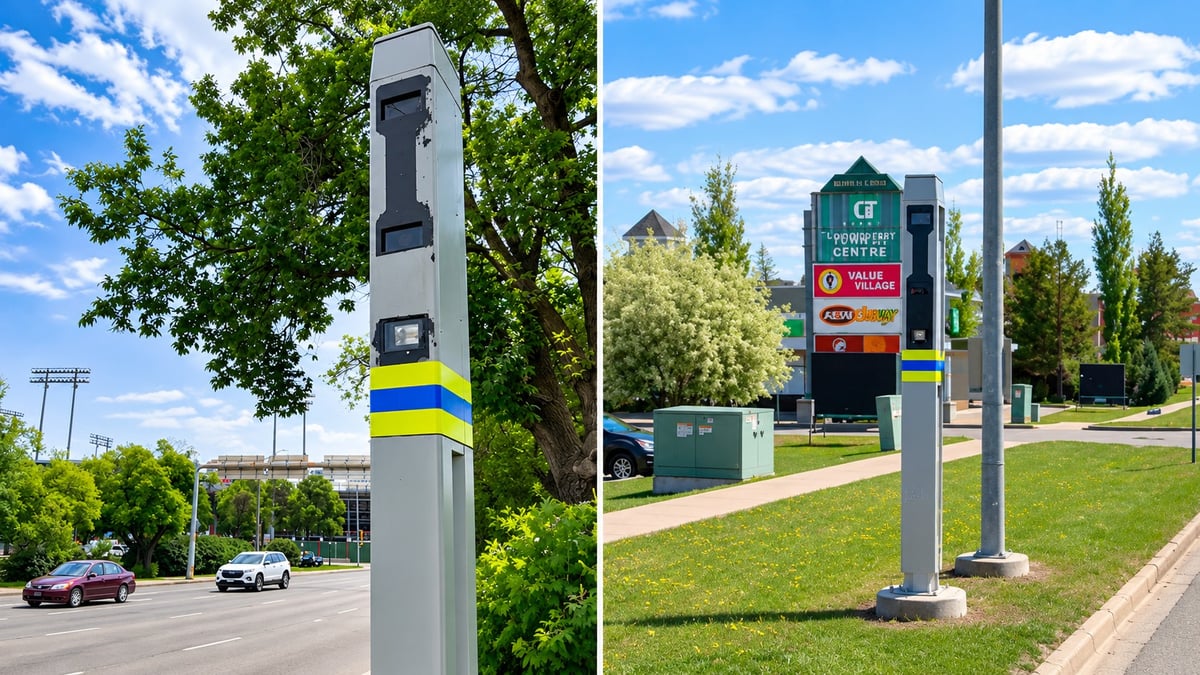
One Edmonton intersection is getting its speed camera back. Seven others aren’t.
The province told the City of Edmonton on Wednesday, Oct. 28, that it had approved speed-on-green enforcement at 97 Street and 167 Avenue in north Edmonton. It was the only one of the eight intersections the city applied for that made the cut.
City officials say all eight met the province’s own rules for an exemption. The province says seven didn’t.
No start date has been announced, so the camera isn’t ticketing anyone yet.
What “speed-on-green” means
Most intersection cameras in Alberta can now only catch drivers running red lights. A speed-on-green camera also tickets drivers who speed through the intersection while the light is green.
That kind of enforcement has been largely banned at intersections since Alberta’s photo radar rules took full effect in April 2025. Cities can apply for an exemption at intersections with unusually frequent or severe collisions compared with similar locations. Edmonton applied for eight.
Why 97 Street and 167 Avenue got approved
The north Edmonton intersection had 60 collisions in 2024, according to a city memo. Speeding violations there rose nine per cent between 2022 and 2024.
That was enough for the province. It’s the city’s first speed-on-green approval under the new rules.
The seven intersections that were rejected
Edmonton applied for these eight intersections:
| Intersection | Result | What the city reported |
|---|---|---|
| 97 Street & 167 Avenue | Approved | 60 collisions in 2024; speeding up 9% from 2022 to 2024 |
| 91 Street & 34 Avenue | Rejected | 47 collisions in 2023; more than 3,000 speeding violations a year |
| 23 Avenue & 91 Street | Rejected | 56 collisions in both 2023 and 2024 |
| 118 Avenue & Wayne Gretzky Drive | Rejected | Nearly 9,000 speeding violations a year on average |
| Mark Messier Trail & 156 Street | Rejected | Two major-injury collisions and one fatal collision, 2022 to 2024 |
| 23 Avenue & Parsons Road | Rejected | No figures released |
| 82 Avenue & 99 Street | Rejected | No figures released |
| Calgary Trail & 34 Avenue | Rejected | No figures released |
Some of the rejected intersections had more reported collisions than the one that was approved. 23 Avenue and 91 Street had 56 collisions in 2024, close to 97 Street and 167 Avenue’s 60, and 56 again the year before.
Edmonton says the rejected sites qualified
Transportation Minister Devin Dreeshen said 10 applications across Edmonton and Calgary were denied because the exemption criteria “were simply not met.”
The city disagrees. Jessica Lamarre, Edmonton’s director of safe mobility, said every location met or exceeded the thresholds in the province’s Automated Traffic Enforcement Guideline. A city memo says Edmonton has asked the province for the data behind its decisions and hasn’t received it.
Mayor Andrew Knack said one approval “is better than zero.” He has said the restrictions have had a “massive impact on traffic safety” in Edmonton, and that he raised the issue directly with Premier Danielle Smith.
Coun. Michael Janz called the lack of action “unconscionable,” pointing to recent deadly crashes where police listed speed as a factor.
Speeding is up since the cameras went dark
The city’s case rests on what happened after the cameras were shut off.
A memo from deputy city manager Craig McKeown says:
The number of vehicles going over the speed limit rose 18 per cent in 2025 compared with 2024.
Speeding went up at more than 82 per cent of the intersections the city monitors.
The rate of fatal and major-injury collisions per kilometre driven rose 137 per cent after automated enforcement was removed.
Those numbers line up with the timing of the rule change. They don’t prove the cameras alone would have prevented the crashes, since traffic volumes, weather and driver behaviour all play a part.
Edmonton police added one more piece. A spokesperson said none of the eight intersections had a fatal collision in 2025 or 2026. That doesn’t contradict the city’s numbers. The city’s figures cover roads across Edmonton, while the police statement is about deaths at these eight sites.
How Edmonton compares with Calgary
Calgary got there first.
In September 2025, the province approved speed and red-light enforcement at two Calgary intersections: 16 Avenue at 68 Street N.E., and Highway 1A at Twelve Mile Coulee Road N.W. The cameras switched back on Oct. 3, 2025. Calgary police later announced a third.
The numbers there were extreme. At 16 Avenue and 68 Street N.E., the city recorded speeds as high as 192 km/h in a 70 zone in the first seven months of 2025.
That means Calgary had at least three intersections back a year ago, and Edmonton now has its first.
Why Alberta restricted photo radar
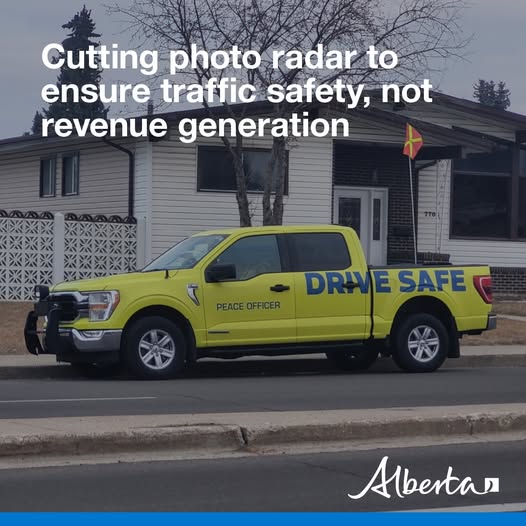
The province announced the crackdown in December 2024, arguing photo radar had become a “cash cow” for governments instead of a safety tool.
Since April 2025:
Photo radar is mostly limited to school zones, playground zones and construction zones.
It’s banned on provincial highways and connectors, including Anthony Henday Drive.
Intersection cameras are limited to red-light enforcement unless an exemption is approved.
The province said the changes would cut about 70 per cent of photo radar locations. That has left cities with smaller enforcement budgets.
Read more: Alberta Banned Photo Radar. Now Every City in the Province Is Scrambling to Pay for It
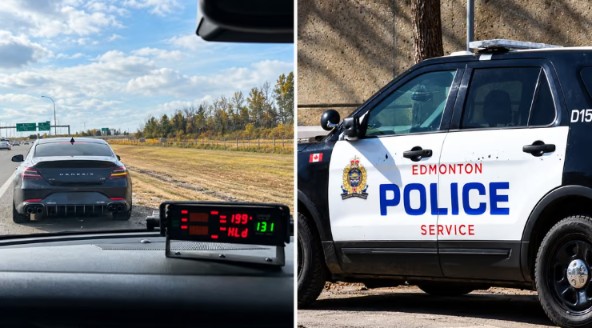
Edmonton has also asked to bring back speed enforcement on the Henday, where police have recently clocked drivers at 199 km/h and 212 km/h. The province turned that down in September.
Read more: Edmonton Police Clock Driver Going 199 km/h on Anthony Henday Near Yellowhead Trail
What Edmonton drivers need to know
One intersection is changing: 97 Street and 167 Avenue. Once the camera is running, it can ticket you for speeding on a green light, not just for running a red.
It isn’t on yet. No start date has been announced. In Calgary, cameras came back about a month after approval.
The other seven intersections stay red-light only.
School, playground and construction zones can still have photo radar.
Police can still pull you over anywhere, including the Henday.
The bigger fight isn’t settled. Edmonton says the data supports more cameras, and the province says the criteria weren’t met. Until the province shows how it scored the other seven, the city says it will keep pushing.

Comments