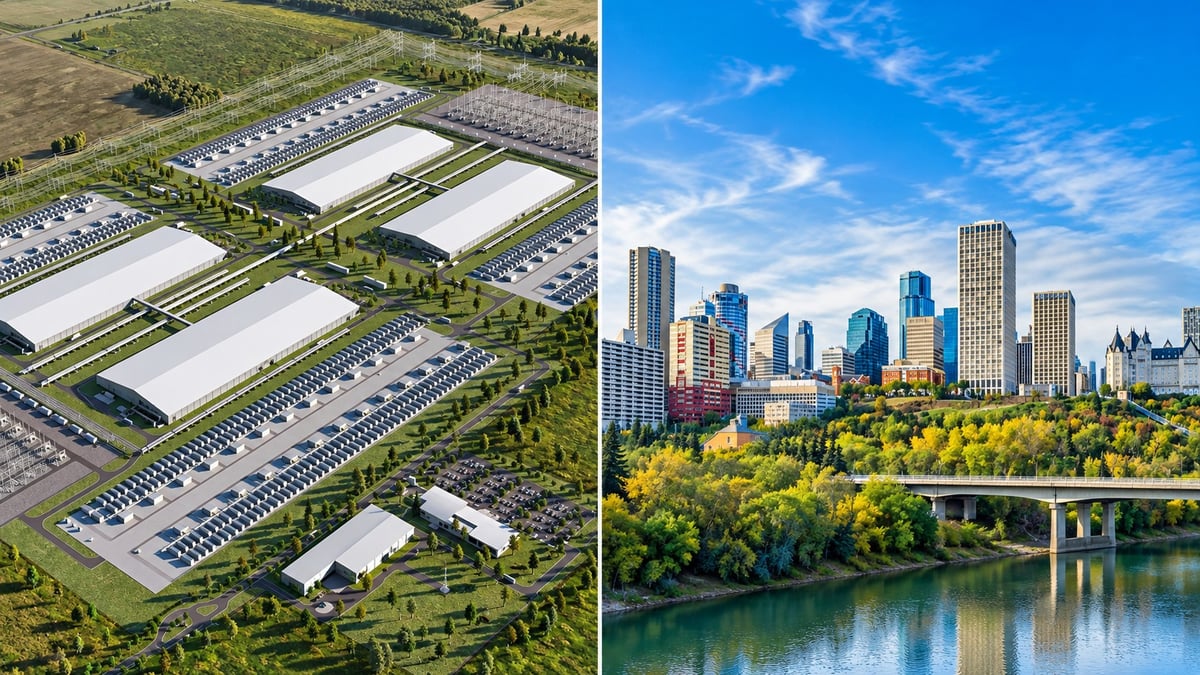
A U.S. land company wants to open a big piece of northeast Edmonton to data centres and power plants, potentially creating what it calls one of the largest data centre districts in North America.
But much of what Edmontonians would want to know hasn't been made public.
There's no published figure for how much power it would need, how much water it would use, what it would cost, how many buildings there would be, or how many permanent jobs it would create. No data centre has been approved.
Walton Global Investments, an Arizona-based land company, has applied to change the planning rules for part of the Edmonton Energy and Technology Park. The application was filed by Stantec on Walton's behalf.
It describes "a master-planned, hyperscale-ready digital infrastructure project" designed to become one of North America's largest data centre and compute-oriented industrial districts.
The City is collecting public feedback until Oct. 25.
Where this is
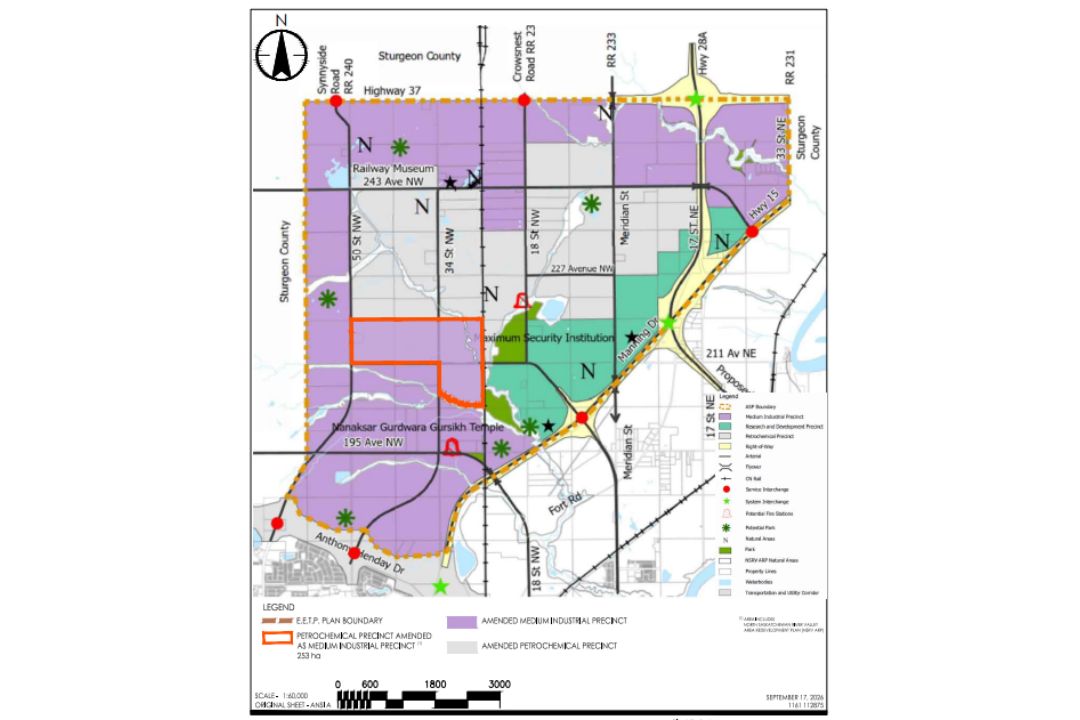
The Edmonton Energy and Technology Park covers a large swath of the city's far northeast, from Anthony Henday Drive north to Highway 37, west of Manning Drive, bordering Sturgeon County.
Most of it is still farmland. The City's planning map shows the Alberta Railway Museum, the Edmonton Institution maximum-security prison and Nanaksar Gurdwara within its boundary.
It's also part of Alberta's Industrial Heartland, a roughly 580-square-kilometre heavy industrial region that stretches into Strathcona, Sturgeon and Lamont counties and Fort Saskatchewan.
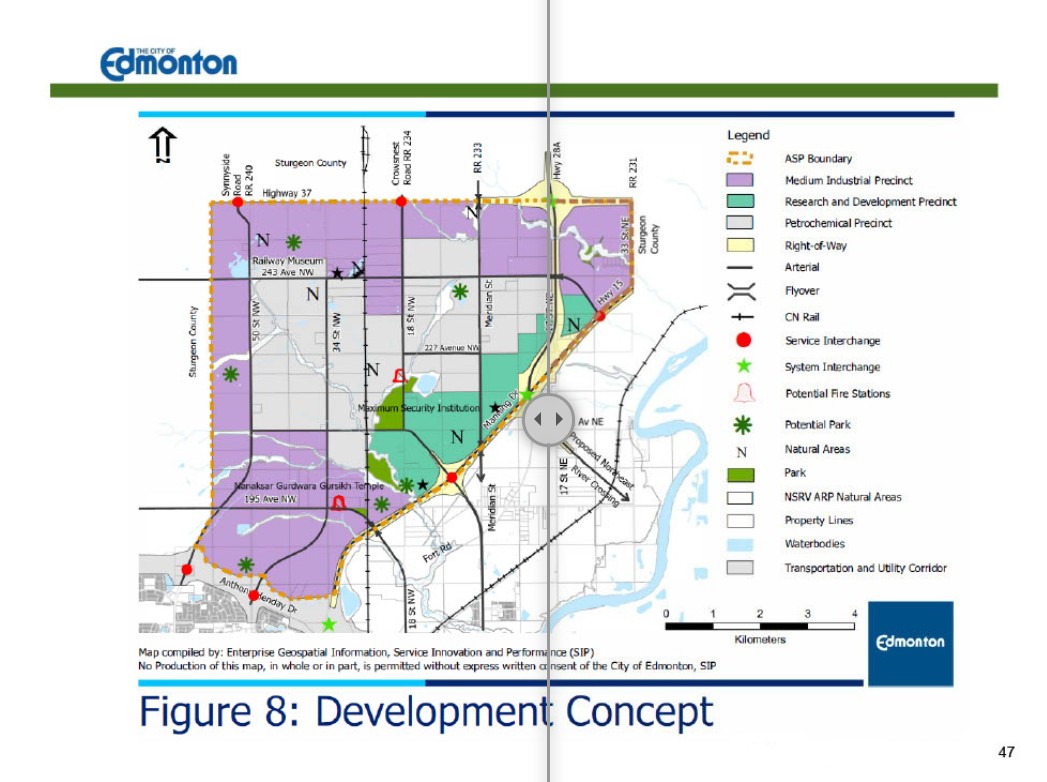
The Edmonton Energy and Technology Park's current development concept. Purple is the Medium Industrial Precinct; grey is the Petrochemical Precinct. (City of Edmonton)
What Walton wants changed
This isn't a permit to build. It's a request to rewrite the park's area structure plan, the long-range plan that sets what can go where.
Walton is asking for three changes:
Allow data centres and power generation facilities in the park's Medium Industrial Precinct.
Move 253 hectares, about 625 acres, from the Petrochemical Precinct into the Medium Industrial Precinct.
Limit the park's eco-industrial principles to the Petrochemical Precinct only.
That third change is easy to miss. The park was designed in 2010 around an eco-industrial idea: industries locate near each other, share infrastructure and resources, and reduce waste and environmental impact. The amendment would stop those principles from applying to the rest of the park.

Data centres are already allowed in part of the park
The City classifies a large data centre as a Major Industrial Use. Large data centres and power plants are already permitted in the park's Petrochemical Precinct.
What they can't do right now is go into the Medium Industrial Precinct. Small data centres can, as long as their impacts mostly stay on site. Walton wants that opened up to large ones.
What we still don't know
The application is ambitious about what the campus could become, and vague about what would be built.
There's no published power demand in megawatts, no estimate of water use, no construction value, no named operator or tech company, and no estimate of construction or permanent jobs.
The amendment would allow power generation, but there's no specific power plant proposal before council.
That matters because today's AI data centres are nothing like the server rooms cities have hosted for decades. The City calls them "much larger and more intense industrial developments," typically made up of an energy source, power generation and distribution, and the data centre itself. It says the first energy source for Alberta projects will likely be natural gas.
Who decides whether one gets built
Council doesn't control every piece of a data centre project.
The City handles land use plans, zoning, development permits and building permits.
The Alberta Electric System Operator decides whether a project can connect to the provincial power grid.
The Alberta Utilities Commission rules on new power plants, transmission lines and backup generation.
The Alberta Energy Regulator oversees the natural gas and pipelines that feed power plants.
The City says once an issue has been decided through a provincial approval, it can't simply reconsider that same issue in its own review. So a project like this needs a chain of approvals, and Edmonton only holds some of them.
What about the power grid?
This is the biggest question hanging over Alberta's data centre boom.
The province encourages data centre developers to bring their own power generation, but grid-connected projects are still allowed, through the Alberta Electric System Operator.
Demand has been huge. The grid operator set an early cap of 1,200 megawatts for new large connections, saying the grid couldn't take everything being requested without risking reliability. Two projects took all of it: Meta's Sturgeon County campus at 970 megawatts, and TransAlta's Keephills data centre at 230.
For comparison, the grid operator puts Edmonton's entire electricity load at about 1,400 megawatts.
How Walton's campus compares isn't known, since it hasn't published a power figure.
Why this land
The park was approved in 2010 for petrochemical and related industry. More than 15 years later, much of it is still undeveloped.
Walton's application says petrochemical demand has dropped, and calls a data centre campus "a critical opportunity for the city to ensure it capitalizes on a multi-billion dollar investment to kick-start development in a historically underdeveloped area."
That argument matters for City finances. Industrial land is taxed at a higher rate than homes, without the same demand for services as new neighbourhoods. Edmonton's share of the region's non-residential property has fallen from 72 per cent in 2008 to 60 per cent in 2022.
But the application doesn't say how much property tax this project would actually bring in.
Who Walton is
Walton isn't a tech company. It buys and prepares land for development, then sells it.
It has done that with data centres before. In Texas, it sold 1,515 acres to data centre developer Tract for a large campus. In Virginia, it sold about 30 acres to PowerHouse Data Centers.
Walton is also marketing a separate 393-acre parcel just south of the proposed Edmonton campus.
So the application sets out where a data centre campus could go. It doesn't say who would build or run one.
Council is about to debate data centre rules
On Oct. 6, council is expected to consider a motion from Coun. Ashley Salvador asking for a report on how Edmonton could better regulate large data centres, including their land use and environmental impacts, and options for changing where they're allowed.
So one company is asking Edmonton to open more land to data centres, at the same moment council is asking whether it needs tighter rules for them.
The province wants more of them
Alberta's AI Data Centre Strategy aims to make the province a North American leader in AI data centres, built around power capacity, sustainable cooling and economic growth. The province says it wants jobs and revenue while keeping electricity reliable and affordable.
Technology Minister Nate Glubish has set a goal of $100 billion in data centre investment by 2029.
In nearby Sturgeon County, Meta is building a $13-billion data centre and a $4.6-billion power plant, which it says will support about 3,000 construction jobs and 300 permanent positions. Hundreds of people protested outside the county office in August.
Where it fits in Alberta's buildout
Culture Alberta's Alberta Data Centre Tracker follows every proposed, approved and operating data centre in the province. It currently tracks 45 projects, with 36 proposed or under construction.
The proposals with a published power figure would add about 23.3 gigawatts of demand. Alberta's record peak demand is about 12.4 gigawatts.
The Edmonton region is already crowded. Beyond Meta, the tracker lists proposals in Sturgeon, Parkland and Leduc counties. The grid operator has warned that data centres clustering around Edmonton and Calgary could strain capacity in those areas.
Walton's campus isn't counted in the tracker's totals, since it hasn't published a power figure.
What happens next
Public feedback runs until Oct. 25. The City will summarize it in a What We Heard report for council.
Walton can revise its application based on the City's review and public feedback. City administration will then recommend whether council should support it, and council will decide at a public hearing.
Even if council says yes, Walton would still need a rezoning and zoning bylaw text amendment before any data centre or power plant could be built, with another round of public engagement and another public hearing. After that come development and building permits, plus whatever provincial approvals the power, gas and grid pieces need.
Have your say
You can give feedback on the proposal until Oct. 25 at engaged.edmonton.ca/EETPDataCentre.
Sources
LDA26-0225 Edmonton Energy & Technology Park AI Data Centre Amendment, City of Edmonton
Data centres, City of Edmonton
Artificial Intelligence Data Centres Strategy, Government of Alberta
Large load projects, Alberta Electric System Operator
AESO Data Centre Update, March 2025, Alberta Electric System Operator
Council motion, Walton land sales and Meta figures as reported by Taproot Edmonton.








Comments
Conversation