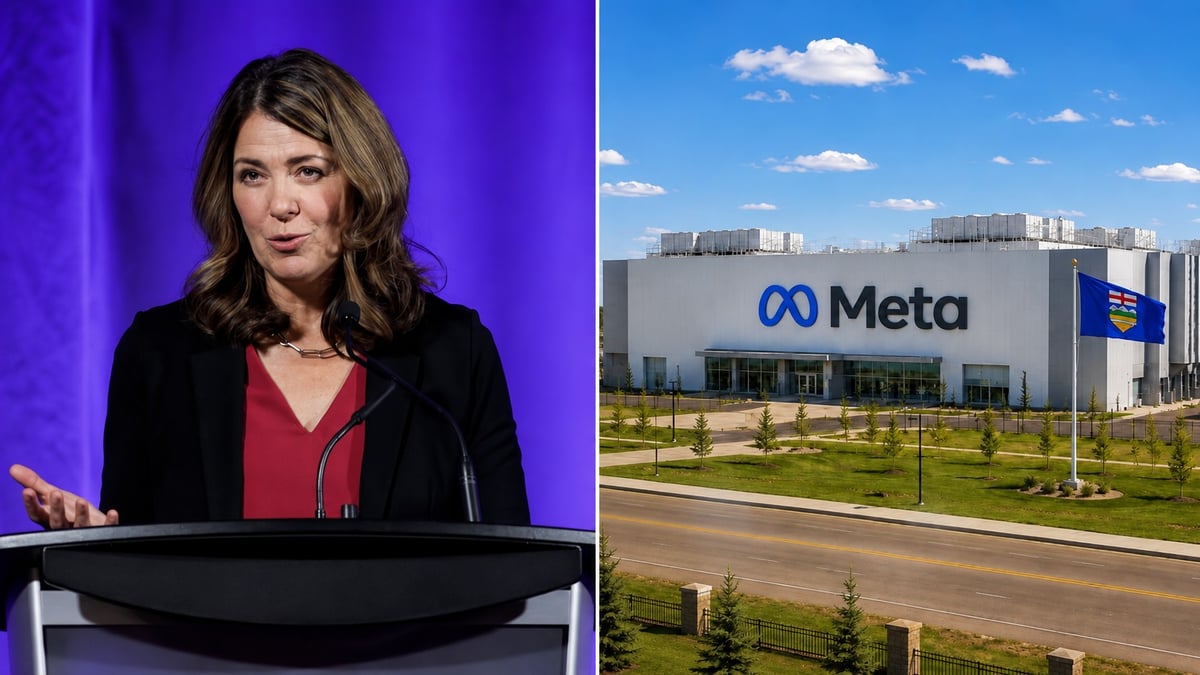
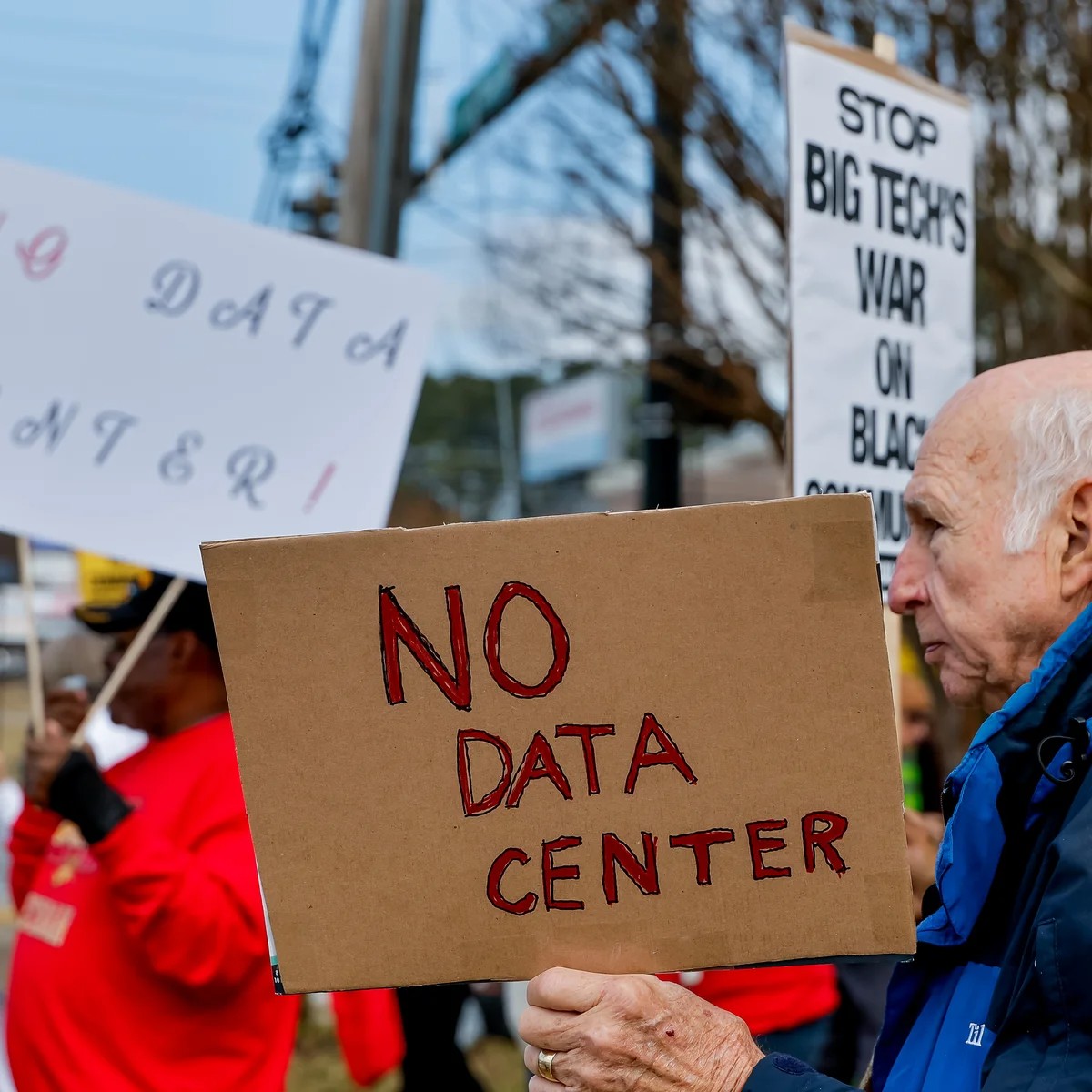
Dozens of people gathered outside the Sturgeon County Centre in Morinville on Sunday to protest Meta's $13 billion data centre, the company's first in Canada and the largest AI infrastructure investment in Canadian history.
The rally ran from 11 a.m. to 1 p.m. at 9613 100 Street. It was organized by Ben Baril, a 20-year-old Sturgeon County resident and university student, who had expected between 50 and 100 people, with support coming from Edmonton and other municipalities.
What the organizer is arguing
Baril says the facility will strain Alberta's water supply and electricity grid and contribute to climate change, and that AI's expansion threatens jobs.
His objection to the technology is separate from the infrastructure one, and he's blunt about it. He told the St. Albert Gazette that AI isn't a particularly useful tool in his view, and that it dulls the mind and makes people less effective communicators.
What changed for him was government involvement. He said the issue didn't feel personal until federal, provincial and municipal governments began actively courting AI projects, and described North America as the epicentre of the hyperscale build-out.
His specific environmental concern is emissions from the natural gas plant being built to power the campus.
The opposition isn't tracking party lines
Baril told the Gazette his organizing committee includes people he would disagree with on essentially every other political question. The Facebook groups coordinating around the project, including Sturgeon County Residents for Transparency and Voice of Sturgeon County, draw from across the spectrum.
Amnesty International has also criticized the project, which CTV News noted as an unexpected intervention when the organization weighed in three weeks ago.
The two years before the gas plant arrives
Premier Danielle Smith has said Alberta's grid operator will use surplus energy to power the centre until the Greenlight Electricity Centre begins supplying it in 2030. Meta says the campus will be online within two to three years.
That leaves roughly two years in which a 970-megawatt load draws on the existing grid before its dedicated generation exists.
The grid operator has a term for that period. AESO calls it bridging load, and a spokesperson told Canada's National Observer it is anticipated to increase pool prices while reducing transmission costs. Chris Connoly, AESO's program manager for large load connections, has said allocating scarce grid capacity to large new users will drive prices upward.
Smith calls it surplus energy. AESO says it moves the pool price.
Greenlight is a $4.6 billion, 932-megawatt plant being built by Pembina Pipeline, Morgan Stanley Infrastructure Partners and Kineticor Asset Management.
What the province and Meta say
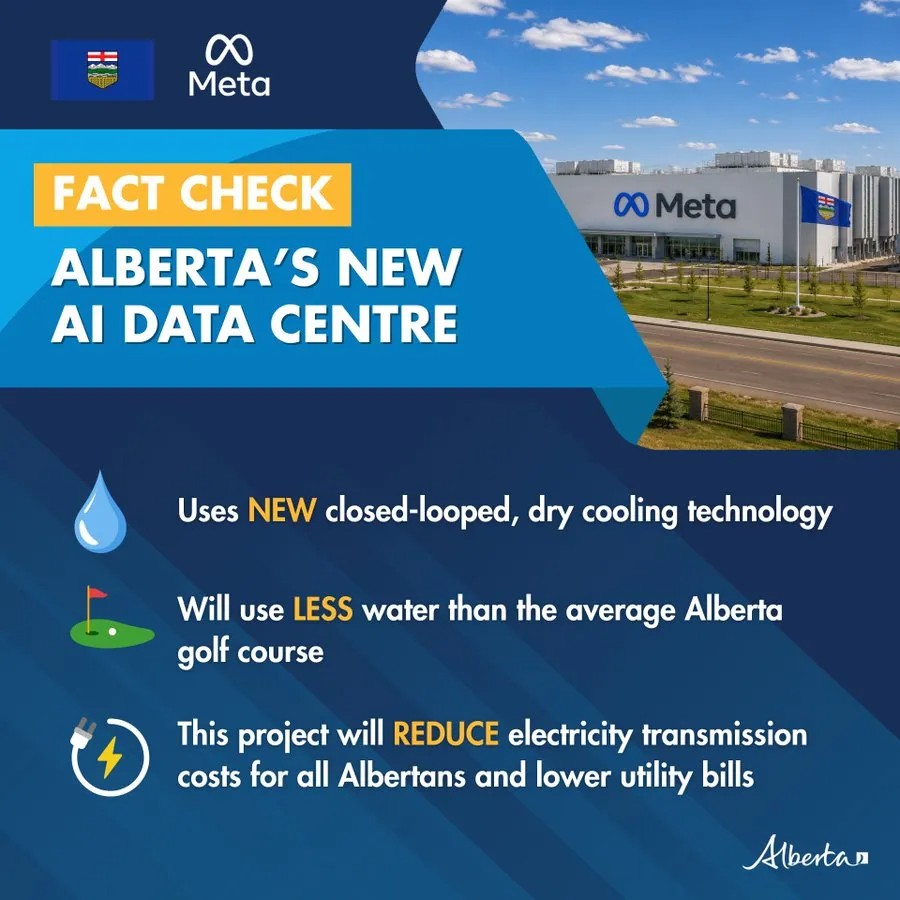
The province launched a website last week answering questions about data centres, and its position is that the project costs Albertans nothing.
Meta funds the campus entirely, with no subsidies, grants or discounted power. The province projects roughly $250 million a year in royalties, taxes, levies and transmission fees, more than 3,000 construction jobs at peak and about 300 permanent ones, plus approximately $60 million from Meta toward local roads and water infrastructure.
On water, the province says the cooling system is closed-loop and liquid-cooled with dry cooling, using no water for day-to-day operations. Site water serves people, fire protection and equipment maintenance, is licensed under the Water Act, and by Meta's own comparison totals less than a typical Alberta golf course uses in a year. A new licence would be among the most junior in its basin, facing restrictions before older holders during a shortage. Meta says it has a global goal of being water positive by 2030, restoring more water than it consumes.
The campus covers roughly 2.9 million square feet in Alberta's Industrial Heartland, near Highway 643 and Range Road 222, with buffer areas separating it from homes.
Sturgeon County Mayor Alanna Hnatiw framed the project at its announcement as being about Alberta's future and Canada's place in a rapidly changing world.
The zoning fight here happened in 2022, before anyone knew who was coming
Opposition to data centres is continental, and elsewhere it has worked. Google withdrew a $1 billion rezoning request in Franklin Township, Indiana after council opposition and resident protests. A $16 billion proposal in Pacific, Missouri was pulled minutes into a special zoning meeting with the room full of people prepared to speak against it. A Michigan township planning commission recommended denying a $1 billion project reportedly backed by Meta after 500 residents turned out and a petition gathered more than 2,100 signatures.
Nearly all of those outcomes came at rezoning votes.
Sturgeon County held its rezoning vote in April 2022, when council amended Land Use Bylaw 1385-17 to add data processing facilities as a permitted use. Council amended it again at a public hearing on April 8, 2025, splitting the use into major and minor categories with separate regulations, the major category covering permanent buildings requiring elevated levels of infrastructure.
Because the use is permitted rather than discretionary, the county says public open houses are not required to approve a data centre development. Meta's development permit was issued and posted to the county website on June 16, three weeks before the project was publicly announced.
The decision that determined whether this could be built was made four years ago, in a bylaw amendment, before there was a company name attached to argue about.
There is still a route for objectors. Provincial applications post public notice, and filing a statement of concern during that window preserves a right to appeal later. Alberta's Expedited 120-Day Approvals Act, 2026 also requires regulators to decide each permit within 120 days for designated projects over $250 million, which makes those windows short.
What comes next
A grading permit was issued in May 2026 for site preparation, and a topsoil permit went to Greenlight Electricity Centre for the same purpose. Construction on both is expected to begin this year. Greenlight is expected to produce first power in 2030.
Organizers say a public town hall on the project is planned for later this month.
Sources:
Sturgeon County, Data Centre Development: https://www.sturgeoncounty.ca/building-development/data-centre-development/
Government of Alberta, AI Data Centres in Alberta: https://www.alberta.ca/datacentres/index.html
Meta, "Hello, Sturgeon County," July 8, 2026: https://datacenters.atmeta.com/2026/07/hello-sturgeon-county/
Pembina Pipeline Corporation, Greenlight Electricity Centre final investment decision: https://www.pembina.com/media-centre/news/details/3403fb77-2257-466b-a8e2-f043f4cd4650
Sturgeon County Land Use Bylaw 1385-17, as amended April 2022 and April 8, 2025
Expedited 120-Day Approvals Act, 2026




Comments
Conversation