
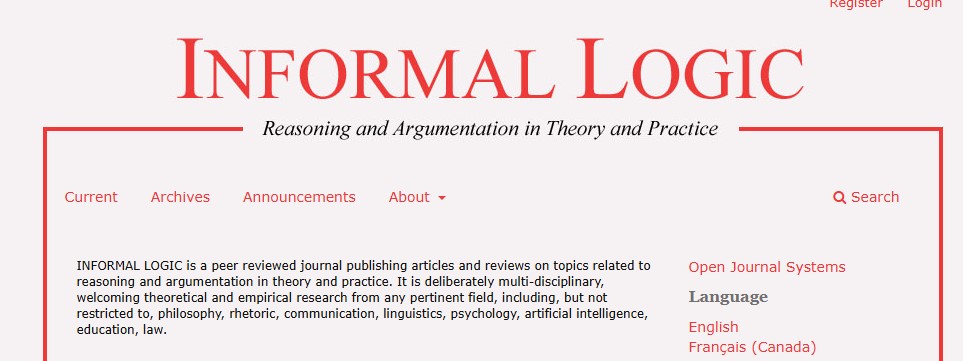
The University of Lethbridge has a new claim in the academic world: it is now the publisher of Informal Logic, a peer-reviewed philosophy journal that has been running for 47 years and is widely considered the field-founding publication in Argumentation Theory.
The move was driven by Dr. Katharina Stevens, a ULethbridge philosophy professor who joined the journal's editorial team in 2018 and spent the years since building the case to bring it to Lethbridge. The Social Sciences and Humanities Research Council has backed the transition with a three-year Aid to Scholarly Journals grant worth approximately $127,000. The first Lethbridge-based edition of the journal is expected in June.

What the journal actually is
Informal Logic isn't a niche publication. It's the journal that established the academic field of Informal Logic as a discipline the study of how people reason in everyday conversations, arguments, and dialogue, as distinct from the formal symbolic logic taught in math departments.
The broader field it sits within, Argumentation Theory, examines how people use reasoning and dialogue to challenge claims and resolve disagreements. It's the kind of scholarship that sits at the intersection of philosophy, communication, and critical thinking and has real-world applications in law, education, political discourse, and media literacy.
The journal has been open-access since 2008, which means anyone can read it for free. It publishes four issues a year and is the only open-access journal in Argumentation Theory. That combination of longevity, reputation, and accessibility makes it a significant get for any institution.
"This is the field-founding journal in Informal Logic and one of Argumentation Theory's most important journals," Stevens said. "With this journal, a lot of attention from Informal Logic, and more generally from the Argumentation Theory and Critical Thinking communities will now be directed to Lethbridge."
What it means for ULethbridge students
The SSHRC grant isn't just keeping the lights on it's funding student positions. Two undergraduate students have already been hired as editorial assistants and are currently in training. Their work will include copy-editing accepted articles, communicating with authors, assembling issues, and uploading content to the journal's website.
Stevens framed it as an education in itself. Students working in those roles will be reading and editing cutting-edge scholarship in Informal Logic and Critical Thinking as part of their job not as a side benefit, but as the core of the work.
At ULethbridge, Informal Logic will be associated with the Critical Thinking and Civic Engagement Lab, giving the journal an institutional home connected to applied research in the field.

The journal's history
Informal Logic started as a newsletter at the University of Windsor, where it was financed through subscriptions and small university grants. A series of SSHRC grants beginning in the late 1990s allowed the editors to start hiring student interns. The shift to open-access in 2008 expanded its readership significantly, and the journal has been building its reputation and submission volume ever since.
It is now co-edited by Stevens alongside Dr. Michael Baumtrog of Toronto Metropolitan University and Dr. Christopher Tindale of the University of Windsor the institution where the journal originally launched.
The first edition published out of Lethbridge is expected this June.
Sources:
University of Lethbridge news release, May 25, 2026
Social Sciences and Humanities Research Council — Aid to Scholarly Journals program









Comments
Conversation