Red Deer lost $12 million in federal housing money in January. On Wednesday morning Mark Carney stood in Red Deer and announced $510 million.
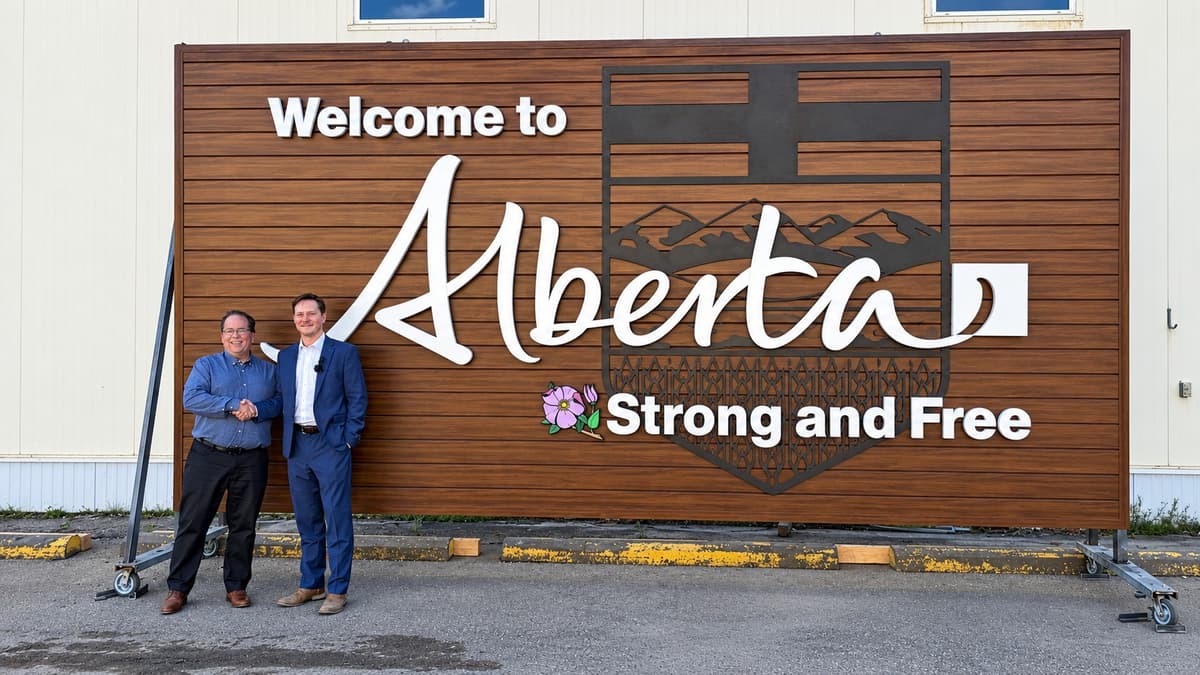
He was there with Premier Danielle Smith to sign the Canada-Alberta Housing Infrastructure Fund Agreement, the last major piece of a federal program Alberta spent more than two years refusing to join. Mayor Cindy Jefferies stood next to them. Protesters gathered outside, according to CBC.
The split: $510 million federal, up to $428 million provincial
Ottawa puts more than $510 million into Alberta municipal infrastructure over eight years through the Canada Housing Infrastructure Fund. Alberta covers a minimum of one third of eligible costs on projects led by municipal governments, which the province says unlocks up to $428 million on its side. If uptake is full, the combined pot clears $930 million. The eligible list is short. Drinking water. Wastewater. Stormwater. Solid waste. Projects can add system capacity, improve reliability, protect capacity that already exists, or divert waste from landfills. Municipalities, public sector entities, Indigenous communities and certain private organizations working with public partners can all apply. At least 20 per cent of the federal money has to land in rural or Indigenous communities, which Ottawa puts at $100 million minimum.
None of it builds a house. It builds what a house has to connect to.
"Builders can only build when the infrastructure is there to support new communities," Smith said. "A whole lot of work has to happen in the background, and literally under the ground, before the first shovel ever breaks the surface."
Carney said the Alberta agreement supports 750 skilled trades jobs a year, naming engineers, pipefitters, electricians and plumbers.
Alberta missed the deadline by 19 months and kept more than the provinces that met it
CHIF launched in April 2024 with five conditions attached and a January 1, 2025 deadline for provinces to sign. Alberta's answer at the time came from Jason Nixon, who called it another case of Ottawa ignoring provincial jurisdiction and playing politics with housing. The province went further than a statement. It tabled legislation to stop the federal government from signing agreements with Alberta municipalities without the province at the table, modelled on a law Quebec already had. January 1 came and went with Alberta, Ontario and Quebec all unsigned. In July 2025 the Parliamentary Budget Officer flagged what that meant: if those three never reached terms, the $3 billion allocated to them reverted to Ottawa's direct delivery stream, where the federal government picks the projects and deals with municipalities directly. For a province that had just passed a law to prevent exactly that, the clock was working against Alberta twice.
Look at what the provinces that did sign walked away with. B.C. finalized its agreement in March 2025 and took $250 million of a $590 million allocation, all of it committed to a single wastewater plant in Metro Vancouver. The remaining $340 million went to direct delivery. Ontario never signed a CHIF agreement at all. It received a $525 million transfer for Toronto's waterfront and the rest of its allocation went the same way as B.C.'s leftovers.
Alberta signed 19 months past the deadline for $510 million that the province administers. The provincial release says why that mattered to them, and it says it twice. Alberta secured terms that "protect provincial jurisdiction." Transportation and Economic Corridors Minister Devin Dreeshen repeated the phrase in his own quote and spelled out the mechanism: "With provincial oversight of project selection, we will be able to select projects that will meet regional needs and support growing Alberta communities." Alberta builds the list. Ottawa reviews it.
Red Deer wasn't a random backdrop
In February 2025 Red Deer signed a $12 million Housing Accelerator Fund agreement with Ottawa. The condition was blanket zoning permitting four units on any residential lot, as-of-right, no council approval needed.
Council wouldn't pass it. The city's position, in documents submitted to Ottawa, was that four units on a single lot was unacceptable to residents and that Red Deer had other tools for densification. CMHC found the city non-compliant as of July 21, 2025 and cancelled the agreement effective January 16, 2026. Red Deer had already received about $3.1 million of the money and council voted not to return it.
Alberta escalated three weeks before Wednesday's announcement. Nixon, then the province's housing minister, wrote to federal Housing Minister Gregor Robertson to say Alberta had approved one-time HAF increases for Edmonton and Airdrie but would not sign off on any further agreements until Red Deer and other Alberta municipalities were given the same flexibility communities in other provinces had received.
Twenty-one days later the Prime Minister announced half a billion dollars from a Red Deer stage, with Red Deer's mayor beside him.
The condition nobody addressed
CHIF's published terms are not quiet about zoning.
To qualify under the provincial and territorial stream, municipalities over 30,000 people are required to adopt zoning permitting four units as-of-right per lot in low-density residential areas with municipal water and sewer. Municipalities over 300,000 are required to freeze development charges at April 2, 2024 levels for three years.
That first requirement is the one that cost Red Deer its grant.
It's also the one Calgary reversed. On April 8, 2026, council voted to repeal blanket rezoning and restore the low-density districts that existed before 2024. Calgary is receiving $251.3 million in HAF instalments and roughly $129 million of it had already been frozen pending clarity on the repeal. CMHC's position at the time was that if commitments are reversed, funding is at risk.
So the two Alberta cities with the loudest zoning fights of the past 18 months both moved away from the standard.
Neither release issued Wednesday says whether those conditions apply to Alberta municipalities under this agreement. Neither government was asked to explain it at the podium. Alberta's release describes an agreement that "aligns with existing provincial water infrastructure programs," which is not the same as saying the federal municipal conditions were dropped.
For Red Deer, for Calgary, and for every Alberta city over 30,000, that unanswered question determines whether any of this money is actually reachable.
What it changes if you're trying to buy right now
Nothing yet. There's no application, no rebate and no payment to households anywhere in this agreement. Money moves from Ottawa to the province to municipalities and public bodies, for pipe. Alberta hasn't named a single project and won't until at least the end of November. The federal measures that reach buyers directly are the ones that already exist. GST is off new homes up to $1 million for first-time buyers, worth as much as $50,000. Build Canada Homes, launched last September, has committed to nearly 15,000 units through 16 partnerships, with more than 1,900 under construction nationally including some in Alberta. If you're looking for provincial programs that pay out to households now rather than at the end of the decade, our Alberta benefits and rebate guides cover what's currently open.
Dates to write down
Alberta has to submit its first project list, representing at least $25 million in federal contributions, by November 30, 2026. Everything else is due by March 31, 2030. Transportation and Economic Corridors is assembling the first list now. The releases did not explain how an eligible recipient applies, what the assessment criteria are, or whether any single recipient faces a cap. Alberta's stated target is 25,000 additional affordable homes by 2031. Wednesday bought pipe toward some of them. Which communities get it is a decision the province hasn't made, and hasn't said how it will make.
Sources
Prime Minister of Canada, "Canada and Alberta forge new infrastructure partnership to accelerate homebuilding," July 29, 2026 — https://www.pm.gc.ca/en/news/news-releases/2026/07/29/canada-and-alberta-forge-new-infrastructure-partnership-accelerate
Government of Alberta, "Alberta and Canada sign major housing agreement," July 29, 2026 — https://www.alberta.ca/release.cfm?xID=96570D4E2C3C5-BF6D-C3F5-EC1E9D96855B311D
Government of Alberta, news conference recording, July 29, 2026 —
Office of the Parliamentary Budget Officer, "An Update on the Canada Housing Infrastructure Fund," July 2025 — https://www.pbo-dpb.ca/en/additional-analyses--analyses-complementaires/BLOG-2526-004--an-update-canada-housing-infrastructure-fund--point-fonds-canadien-infrastructures-liees-logement
CMHC, "Update on the Housing Accelerator Fund Agreements for Red Deer, Toronto, Vaughan," January 16, 2026 — https://www.cmhc-schl.gc.ca/media-newsroom/news-releases/2026/updates-housing-accelerator-fund-agreements
Government of Canada, "The governments of Canada and British Columbia finalize an agreement for the Canada Housing Infrastructure Fund," March 21, 2025 — https://www.canada.ca/en/housing-infrastructure-communities/news/2025/03/the-governments-of-canada-and-british-columbia-finalize-an-agreement-for-the-canada-housing-infrastructure-fund.html
Government of Alberta, Airdrie regional wastewater line funding, July 2025 — https://www.alberta.ca/release.cfm?xID=93705A069C347-DFCC-D1C2-2FC5B35359251716








Comments
Conversation