
Winnipeg finished last among Canada's ten largest cities in Leger's 2026 Happiness Index.
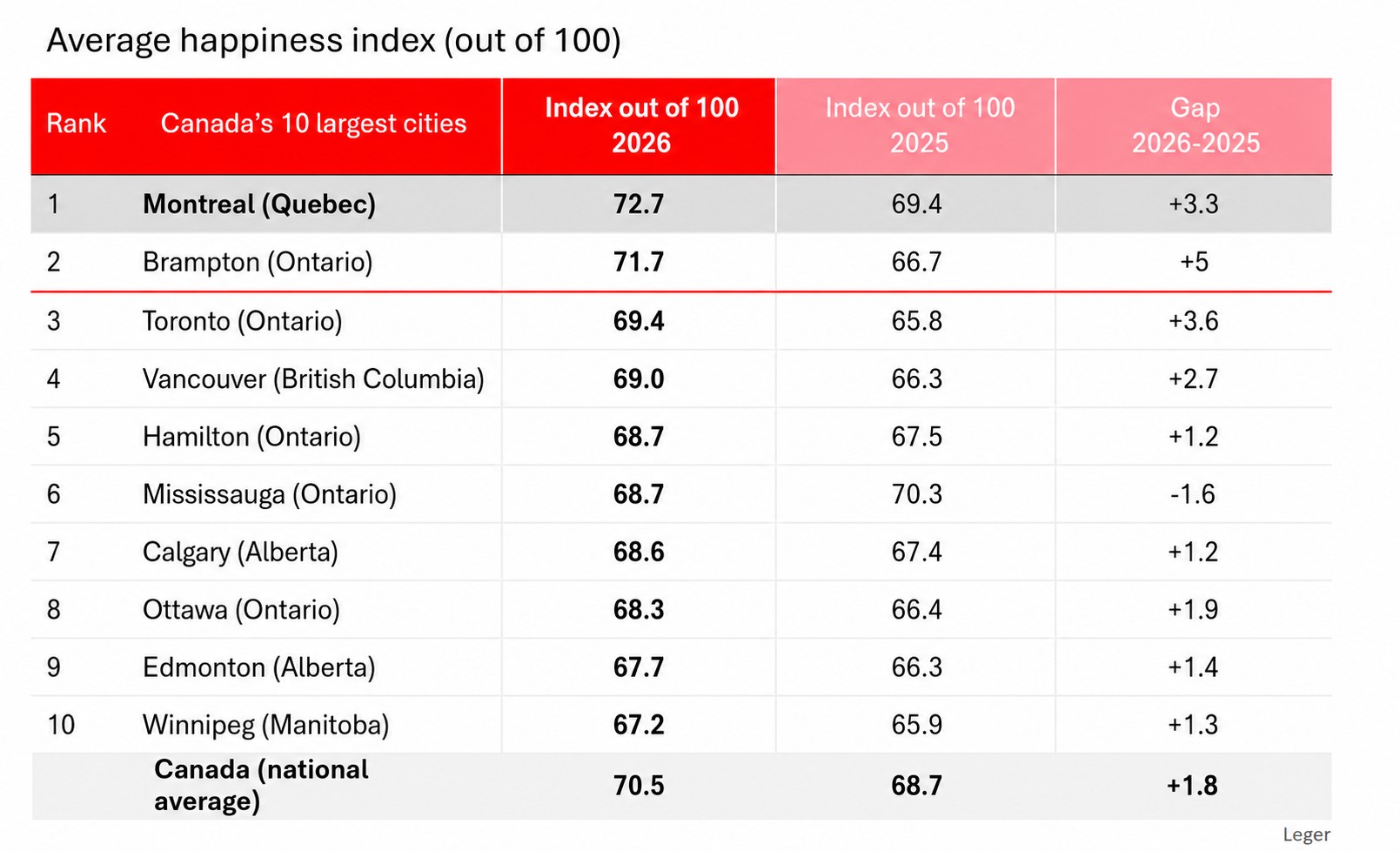
The city scored 67.2 out of 100, half a point behind Edmonton at 67.7 and 3.3 points below the national average of 70.5.
Its score went up. Winnipeg gained 1.3 points from last year, and still came tenth.
The full ranking
Montreal — 72.7, up 3.3
Brampton — 71.7, up 5.0
Toronto — 69.4, up 3.6
Vancouver — 69.0, up 2.7
Hamilton — 68.7, up 1.2
Mississauga — 68.7, down 1.6
Calgary — 68.6, up 1.2
Ottawa — 68.3, up 1.9
Edmonton — 67.7, up 1.4
Winnipeg — 67.2, up 1.3
The bottom is tighter than the ranking suggests
Ninth and tenth are separated by half a point.
Only 1.5 points separate Winnipeg in tenth from Hamilton in fifth. Six cities are packed between 67.2 and 68.7, which means small movements reshuffle most of the bottom half.
Winnipeg and Edmonton have effectively the same score. The ordering is real but the gap isn't.
Mississauga was the only city to fall
Every city in the index gained except one.
Mississauga dropped 1.6 points, from 70.3 to 68.7, falling from first place in 2025 to sixth.
Manitoba as a province posted the largest provincial gain in the country at 2.6 points, ahead of Ontario at 2.4 and Quebec at 2.1. So the province improved faster than anywhere else while its largest city finished last among big-city peers.
What Canadians said makes a city happy
Safety and security, cited by 46 per cent.
Access to green spaces, parks and nature, at 40 per cent.
Quality of neighbourhood life, at 27 per cent.
Leger's city results don't break scores down by factor, so the survey doesn't establish which of these explains Winnipeg's position.
And what puts happiness under pressure
Cost of living, at 58 per cent, well ahead of anything else. Financial pressure broadly, including housing, debt and income security, was cited by 57 per cent.
Physical health at 32 per cent. Mental health and uncertainty about the future at 23 per cent each.
Fewer people are getting less happy
Nationally, 23 per cent of Canadians said their happiness deteriorated over the past year, down from 28 per cent in 2025.
Fifty-two per cent said it stayed stable. Twenty-five per cent reported an improvement.
Canada and the United States came out nearly identical
New this year, Leger extended the survey to the United States.
The American Happiness Index landed at 70.0, against Canada's 70.5.
Americans were somewhat more likely to report their happiness improved, at 29 per cent against 25 per cent of Canadians, and also more likely to say it deteriorated, at 26 per cent against 23.

What the index measures
It measures how residents rate their own happiness. It isn't an independent assessment of municipal services, affordability, crime, infrastructure or overall quality of life.
How the survey worked
Leger surveyed 63,710 Canadians aged 18 and over between June 9 and 29, 2026, online through its LEO panel.
Respondents rated their happiness from one to ten, converted into a standardized score out of 100. Results were weighted by gender, age and region.
The questions about what contributes to happiness and what puts it under pressure came from separate omnibus surveys of 1,528 Canadians and 1,015 Americans, and were not used to calculate the city rankings.
As a non-probability web panel, the index doesn't carry a conventional margin of error. Leger notes a probability sample of comparable size would have a maximum margin of about 0.33 per cent, 19 times out of 20.
The full ranking is on Leger's website.
Our Edmonton coverage: Edmonton Ranks 9th for Happiness Among Canada's Biggest Cities, Ahead of Only Winnipeg
Sources
Happiness Index 2026: Happiness Is Up Across Canada — Leger
Leger Happiness Index 2025





Comments
Conversation