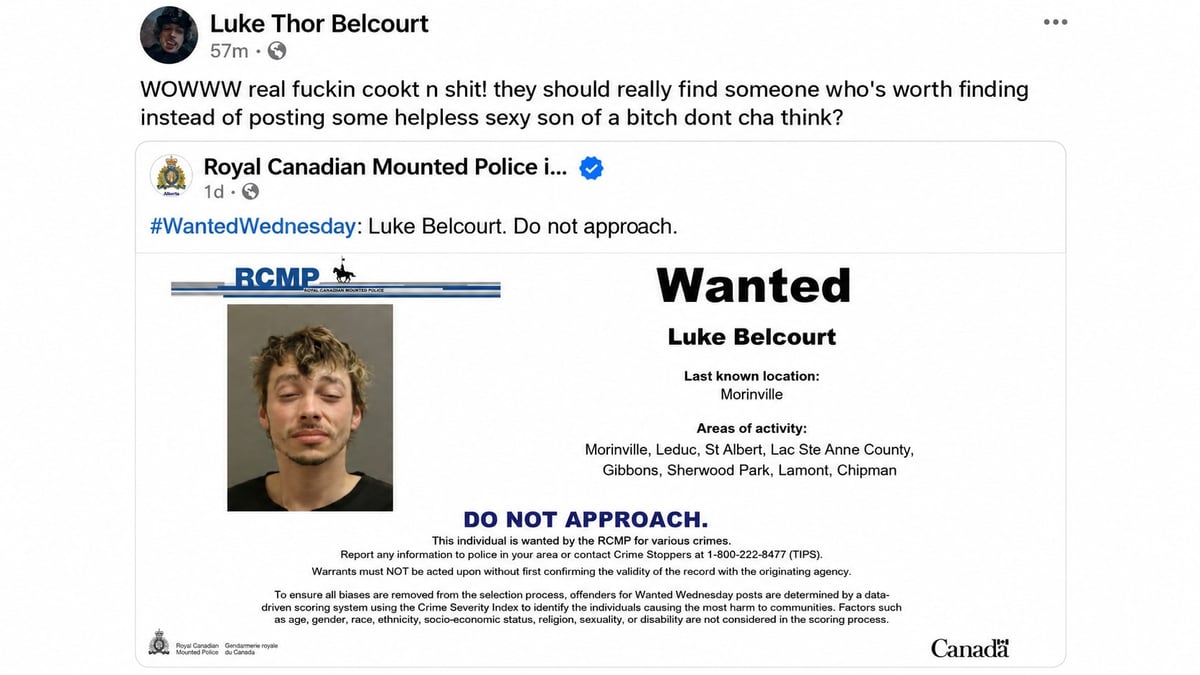
Alberta RCMP posted Luke Belcourt to their Wanted Wednesday page and asked the public not to approach him. Belcourt, it seems, decided to approach the post instead.
A comment appearing under his name turned up beneath the RCMP's wanted notice, mocking police for putting him up rather than, as he put it, someone actually worth their time. The tone was cocky and dismissive, the kind of comment that turns a routine wanted post into something thousands of people share. Whether it does anything for his situation is another question. He's still wanted.
Where he was last known to be
Belcourt was featured in Alberta RCMP's Wanted Wednesday campaign with a last known location of Morinville, the town just north of Edmonton.
The RCMP listed his areas of activity as Morinville, Leduc, St. Albert, Lac Ste. Anne County, Gibbons, Sherwood Park, Lamont and Chipman, a wide band of communities stretching north, east and west of Edmonton. That spread is the practical part of the post for most readers: it's the RCMP signaling the areas where someone might actually cross paths with him, and where a tip is most likely to come from. The post carried the campaign's standard instruction, do not approach.
This has happened before, and it ended in an arrest
Commenting on your own wanted poster seems like it should be vanishingly rare. It isn't.
The clearest example is out of Manitoba. In 2017, RCMP posted that Chris Toews, 25, was wanted for theft and a probation breach, and said he was believed to be in the Minnedosa or Onanole area. A Facebook user then commented on the post, "I'm in Kelowna B.C. now," and followed up insisting he'd been working there for months. RCMP confirmed the account belonged to the wanted man. Two days later, they announced he'd been arrested.
The lesson writes itself. Engaging with the post that's trying to find you doesn't throw police off, it does the opposite. It confirms the account is active, it can hint at where the person actually is, and it pushes the post higher in everyone's feed, in front of more of the exact people who might recognize the face.
What Wanted Wednesday actually is
The posts aren't chosen at random, and it's worth knowing how the list is built, because it changes how you read it.
Alberta RCMP select Wanted Wednesday features using the Crime Severity Index, a Statistics Canada measure that weighs more serious offences more heavily. The people featured have active arrest warrants, meaning a judge has already authorized their arrest, and they're chosen because their cases are considered among the higher priorities to resolve, not because a constable picked a name off a stack. It's a targeted public-help request, not a random rogues' gallery.
That's also why the RCMP is firm about how the public should respond. The campaign exists to generate tips, not confrontations. If you recognize someone, the ask is to report what you know and let police handle the rest, never to approach, contact or try to detain anyone yourself. A wanted person amplifying their own post, whatever they're trying to prove, tends to help the campaign do its job rather than their own.
How these posts actually get people caught
There's a reason the RCMP keeps running Wanted Wednesday despite comments like Belcourt's, it works, and it works through the crowd.
A wanted poster is only useful if the right person sees it, and social media solves that better than a poster on a detachment wall ever did. A single share can put a face in front of someone who served the person coffee that morning, or lives two doors down, or drove past them an hour ago. The areas of activity the RCMP lists, in Belcourt's case Morinville, Leduc, St. Albert and the rest, are the targeting: they aim the post at the communities where recognition is most likely. Every share widens that net. When a wanted person comments and their post goes viral, they aren't beating the system, they're feeding it, handing the RCMP exactly the reach the campaign is designed to get.
If you have information
Belcourt is wanted on outstanding warrants. Being wanted is not a finding of guilt, and the allegations against him have not been tested in court.
Anyone with information about his whereabouts is asked to contact the Morinville RCMP at 780-939-1600, call 310-RCMP (7267), or reach Crime Stoppers anonymously at 1-800-222-8477. In an emergency, call 911. Police ask the public not to approach him.
Sources:
Alberta RCMP, Wanted Wednesday campaign and Crime Severity Index selection criteria: https://www.facebook.com/RCMPinAlberta
Morinville RCMP detachment, Town of Morinville: https://www.morinville.ca/living-here/emergency-and-protective-services/morinville-rcmp/
Global News, Manitoba wanted-post arrest precedent, 2017







Comments
Conversation