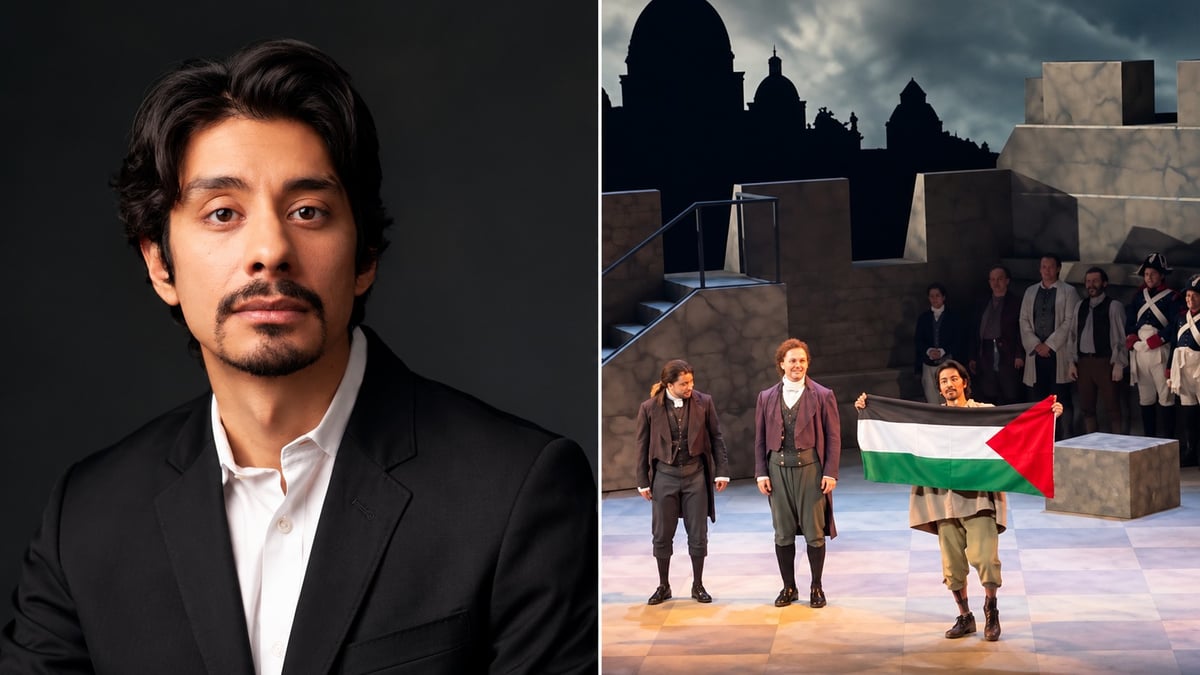
Gabriel Sanchez-Ortega spent opening night of Calgary Opera’s Tosca playing a man on the run from the state. By Sunday, he was out of the show.
The company has replaced him as Cesare Angelotti for the rest of the run after he unfurled a Palestinian flag during the curtain call on Friday, Oct. 16, at the Southern Alberta Jubilee Auditorium.
“I have no regret,” he wrote on Instagram.
What happened on opening night
Sanchez-Ortega came out for his bow and then revealed a Palestinian flag on stage. He posted video of the moment on Instagram the next day.
Calgary Opera put out a statement over the weekend that didn’t name him.
“During the October 16 opening-night performance of ‘Tosca,’ a cast member displayed a flag during the curtain call. This action was unexpected and unauthorized,” the company said. “Individual political protest contravenes not only company policy, but also our responsibility to create a more connected, caring, and civil society through shared artistic experiences.”
The company said the moment may have affected the audience, cast, crew, orchestra and Jubilee staff “in different ways,” and that it regrets “any discomfort and distress it caused.” It said it had dealt with the cast member directly and reminded the rest of the cast and production team what it expects.
“The role of Angelotti will be performed by another artist for the remaining performances,” the statement said.
On Monday, the company told The Globe and Mail that personal protest is banned on its stages and at its events, and that showing any protest symbol would lead to the same result.
Gabriel Sanchez-Ortega responds
Sanchez-Ortega replied in an Instagram story that has since expired.
“I have been informed that I have been removed from further performances of ‘Tosca’ with the Calgary Opera following my display of the Palestinian flag during curtain call. I have no regret. This is the state of cultural institutions in Canada.”
He also wrote: “I was informed that financial threats had been made against Calgary Opera. I hold no resentment.”
That claim is his. Calgary Opera hasn’t commented on it publicly, and Sanchez-Ortega didn’t say who made the threats or what they were.
He finished by pointing to the role he played.
“After the theatre, (political or otherwise) we all have to go home, and look at ourselves in the mirror. It was my honor to play the role of Angelotti, an escaped political prisoner.”

Why his role in Tosca matters
Political persecution is at the centre of Puccini’s Tosca. Angelotti is a political prisoner who has escaped from Rome’s Castel Sant’Angelo and is being hunted by the city’s police chief, Scarpia. The painter Cavaradossi hides him, and that decision drives the rest of the opera.
Calgary Opera promoted its 2026-27 season as opening with a “political thriller.”
Critics of the company’s decision see irony in removing a singer for a political gesture while he plays a political prisoner. Supporters of the decision say what happens on stage is the story, and a curtain call isn’t the place for a statement the company didn’t approve.
Who is Gabriel Sanchez-Ortega?
Sanchez-Ortega isn’t a visiting star. He’s one of Calgary Opera’s own young artists.
He was born in Montreal and started voice lessons in Ottawa. He earned a performance diploma from the Glenn Gould School at Toronto’s Royal Conservatory of Music, where he won the Ihnatowycz Emerging Artist Scholarship. He also studied at the Aspen Music Festival and School in Colorado.
His company bio lists him as a bass. He has sung Colline in La Bohème, Zuniga in Carmen, Il Commendatore in Don Giovanni and Sarastro in The Magic Flute.
Will he stay with Calgary Opera?
That’s the biggest question still open.
Sanchez-Ortega is in his first year of Calgary Opera’s McPhee Artist Development Program, which trains early-career singers through a full season with the company. Being removed from Tosca doesn’t automatically mean he’s out of the program.
He’s also cast in three more Calgary Opera productions this season:
The King in Massenet’s Cinderella, in January and February
Lodovico in Verdi’s Otello, in April
The title role in The Pied Piper, in a double-cast production
Calgary Opera’s statement only covered the rest of Tosca. It hasn’t said whether his other roles or his place in the program have changed. As of Monday, he was still listed on the company’s website.
When is the final Tosca performance?
This Tosca has three performances. Sanchez-Ortega sang opening night on Friday, Oct. 16, and was replaced for the second show on Sunday, Oct. 18. The final performance is Saturday, Oct. 24, at the Southern Alberta Jubilee Auditorium.
Jonathan Brandani conducts and Joshua Borths directs. Maria Natale sings Tosca, David Esteban is Cavaradossi and Boaz Daniel is Scarpia. The company hasn’t named the new Angelotti.
A similar flag protest happened in London
Something similar happened at London’s Royal Opera House in July 2025. At the curtain call of Verdi’s Il trovatore, a cast member unfurled a Palestinian flag. Director of opera Oliver Mears came out from the wings and tried to pull it away, and the two briefly struggled on stage.
The Royal Ballet and Opera called it “an unauthorised action by the artist” and “a wholly inappropriate act.” No removal of that performer was publicly reported.
Canadian arts groups have dealt with the same tension since the Israel-Hamas war began in October 2023. The Giller Prize, Hot Docs and the Art Gallery of Ontario have all faced protests, boycotts or resignations tied to the conflict.
Sources
Calgary Opera statement (Instagram): https://www.instagram.com/calgaryopera/
Gabriel Sanchez-Ortega (Instagram): https://www.instagram.com/gs.ortega/
Calgary Opera, Gabriel Sanchez-Ortega artist bio: https://www.calgaryopera.com/people/gabriel-sanchez-ortega-zpj4
Southern Alberta Jubilee Auditorium, Calgary Opera’s Tosca: https://jubileeauditorium.com/calgary/calgary-opera-tosca








Comments
Conversation