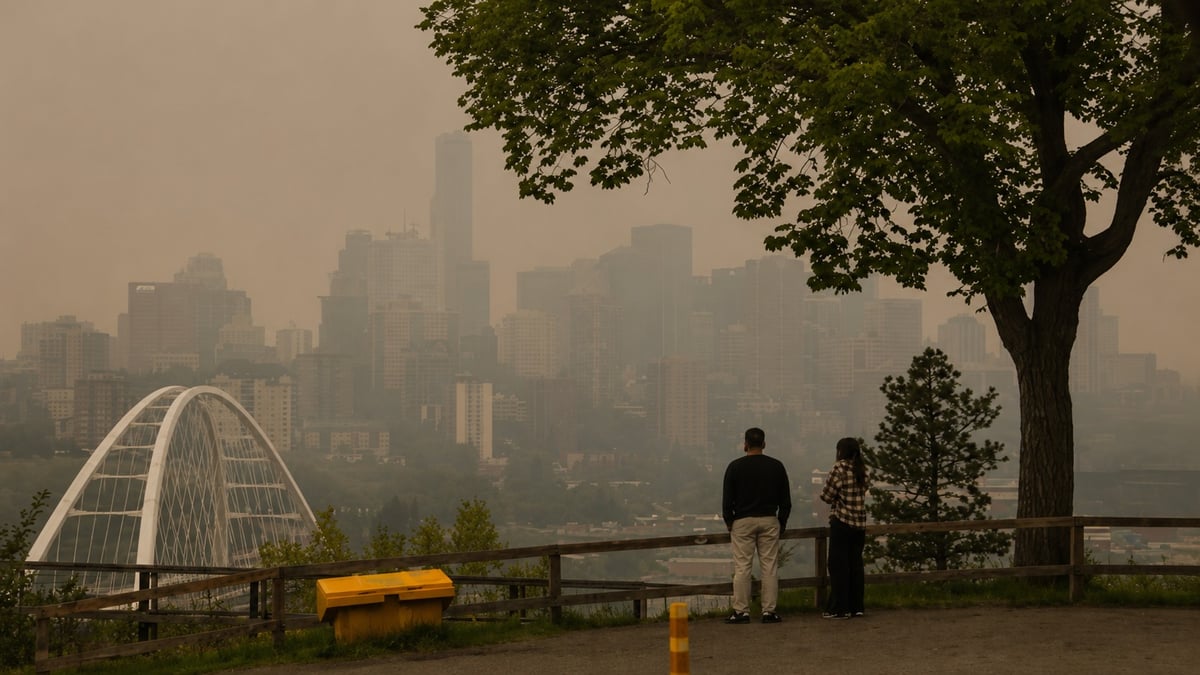
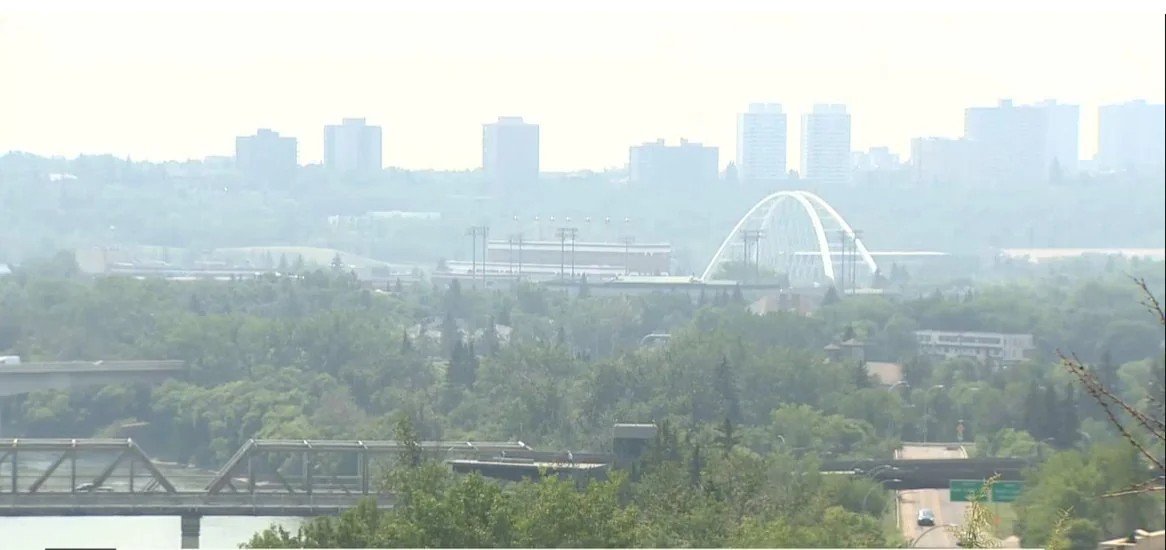
Edmonton's air quality hit the top of the scale Monday afternoon, and the city has opened its doors to anyone who needs out of it.
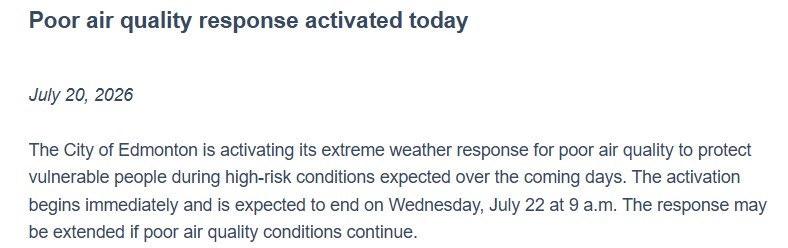
The City of Edmonton activated its extreme weather response for poor air quality on Monday, July 20. It runs until Wednesday, July 22 at 9 a.m., and could be extended if the smoke stays.
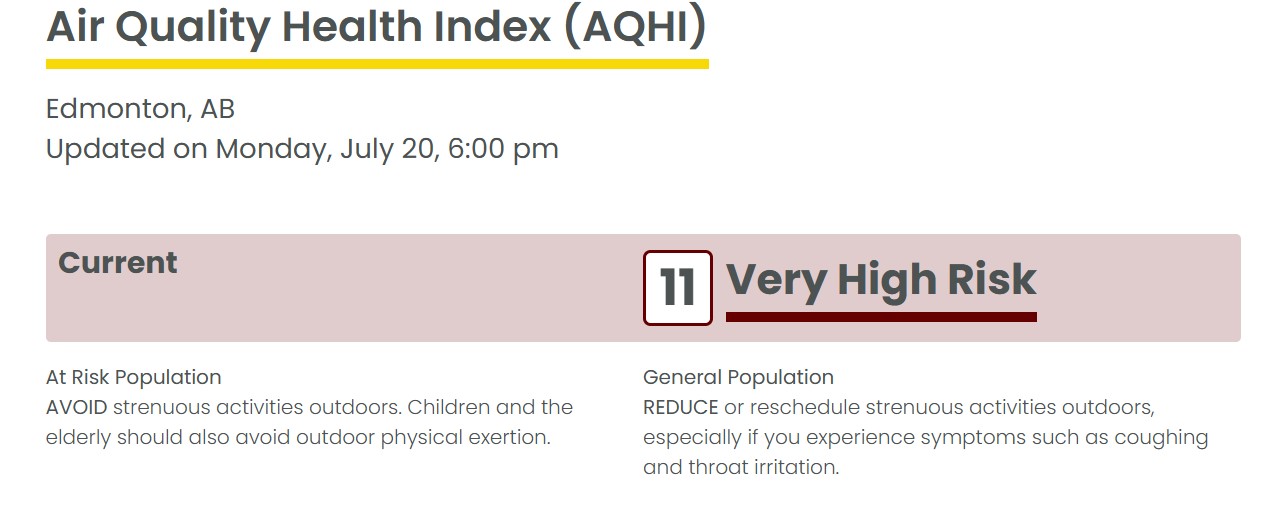
At 3 p.m. Monday, Edmonton sat at 10+ on the Air Quality Health Index. That's the top rating on a scale that only goes to ten, the point where the index stops counting and just calls it very high risk.
What the city is doing
City facilities, including libraries, are open as places to get out of the smoke. If you don't have air conditioning or any way to filter your air at home, that's a free option and a real one.
Officials are also asking people to check on older family members, friends and neighbours. That request gets skipped a lot. It shouldn't. Someone in their eighties with a lung condition, in a walk-up with the windows open because it's July, is exactly who this response exists for.
Edmonton triggers the response when the AQHI is forecast to hit seven or higher two days running.
Where the smoke is coming from
This isn't Alberta's smoke.
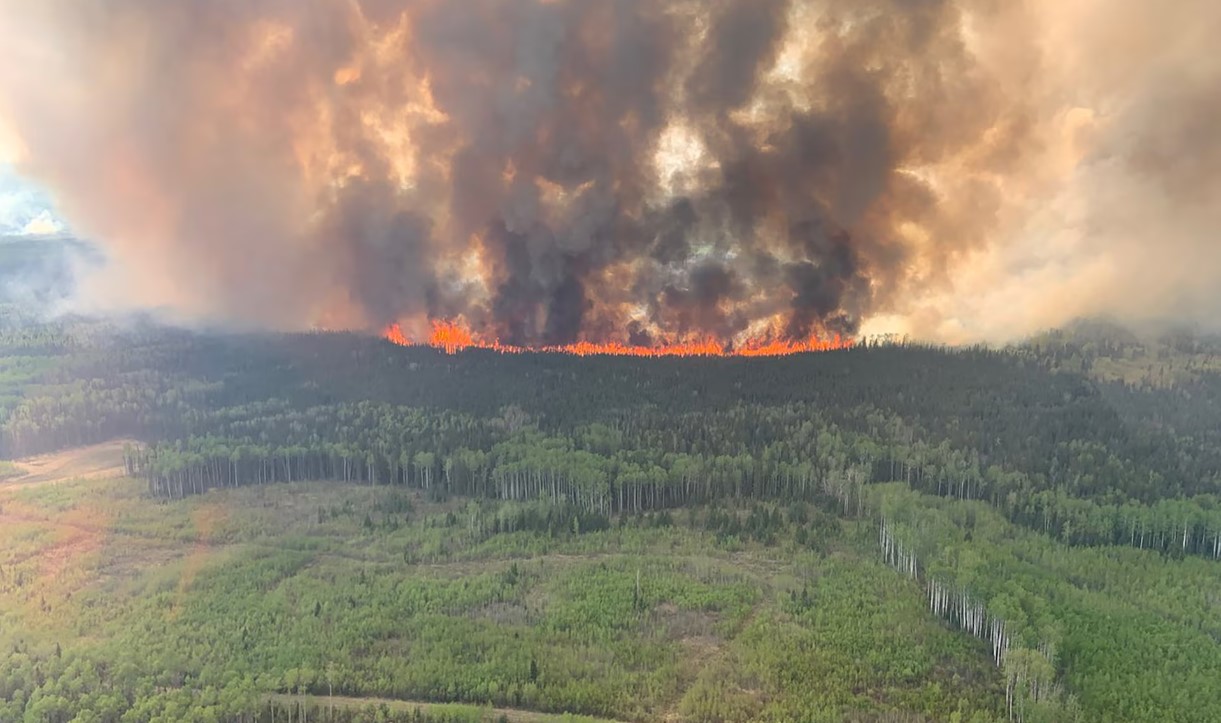
It's drifting south from the Northwest Territories, where more than 200 wildfires are burning. N.W.T. Fire listed 202 active fires Monday afternoon, covering over 777,000 hectares. That's a bigger area than the city of Edmonton.
Environment and Climate Change Canada meteorologist Janelle Gergely, speaking to Postmedia, pointed to fires just west of Fort Smith, around Fort Simpson, near Wrigley, and north of Great Slave Lake. Her explanation for the timing is the part that stings: "Although it's wet through central Alberta, it's not wet in the Northwest Territories, and that's where the majority of the smoke is going to be coming from."
All the rain Alberta has taken this month, the flooding, the storms, the soaked ground, none of it matters here. The fires making this smoke are hundreds of kilometres north, in country that got none of it.
Grande Prairie and Fort McMurray have it worse
Edmonton isn't the hardest-hit part of the province.
Environment Canada has air quality warnings out for close to 140 Alberta communities. Monday morning, the worst of it sat in the north. Grande Prairie was rated very high risk, the top category. Fort McMurray was at high risk. The haze only reached the Edmonton region later in the day as it pushed south.
If you're in the Peace region or around Fort Mac, you're in the middle of this, not the edge.
Edmonton has topped the world rankings before
Here's some context for how bad a 10+ reading actually is.
In August 2018, smoke from B.C. wildfires pushed Edmonton to the worst air quality of any city over 250,000 people, anywhere in the world. Berkeley Earth's data had it beating cities in India, China and the Middle East, the places that normally own the top of that list. At its peak, Edmonton's air hit roughly 180 micrograms of fine particulate per cubic metre, about 18 times the city's average.
Berkeley Earth lead scientist Robert Rohde made a distinction worth knowing. In most of the world's worst-ranked cities, the pollution comes from industry, coal burning, factories, traffic. In Edmonton and most North American cities, it's wildfire smoke. Both wreck the number the same way, but the mix is different: wood smoke loads the air with organics, while coal smoke carries heavy metals on top. How much those differences change the health effects is still, as he put it, an active area of research.
Whether Edmonton cracks the global list again this week isn't clear yet. If you want to check for yourself, IQAir publishes a live world air quality ranking that updates through the day.
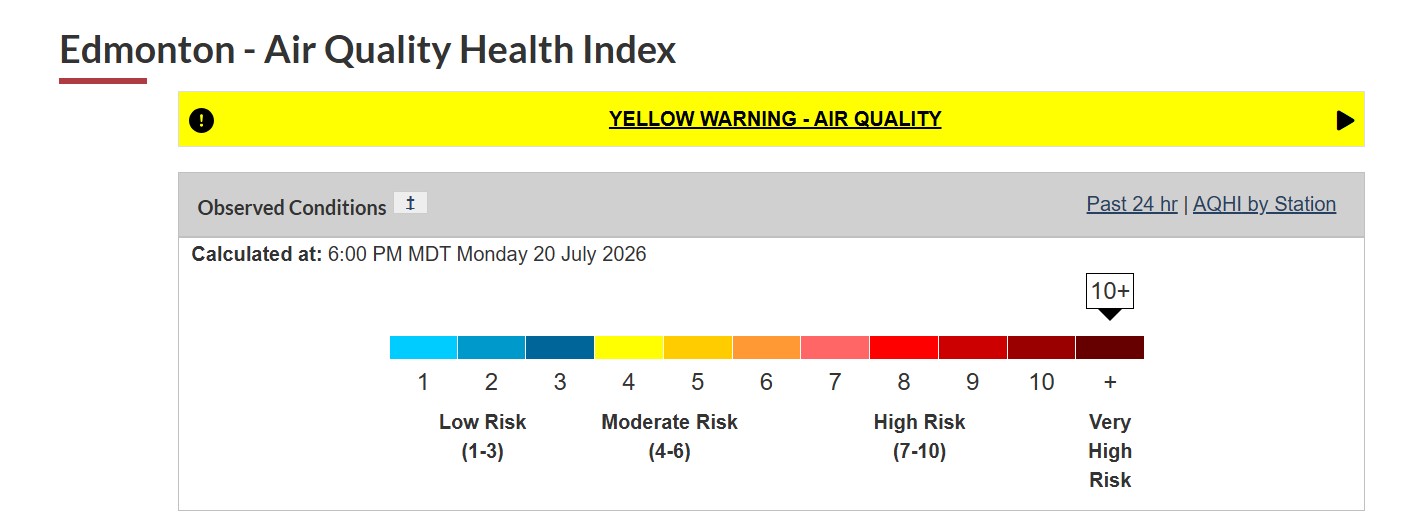
What the AQHI numbers mean
1 to 3 — low risk
4 to 6 — moderate risk
7 to 10 — high risk
10+ — very high risk
Edmonton hit 10+ Monday afternoon. It's forecast to fall to nine overnight, then seven Tuesday. Seven is still high risk. Tuesday isn't clear, it's just less bad.
Who's most at risk
Environment Canada flags people 65 and older, people who are pregnant, infants and young children, anyone with an existing illness or chronic condition, and people who work outdoors.
If that's you, cut back or reschedule hard outdoor activity, and get medical attention if symptoms show up.
Most people will notice the mild stuff: itchy eyes, runny nose, sore throat, headache, a light cough. The ones to take seriously are wheezing, chest pain, or a severe cough. Don't wait those out.
Indoors, keep windows and doors shut as much as you can. In a July heat wave that's miserable advice, which is part of why the libraries matter. Run a HEPA filter if you've got one. If you have to be outside for a stretch, a well-fitted mask genuinely helps, it filters the fine particles that do the damage.
How long it lasts
Environment Canada says the smoke sticks around through Tuesday. The city's response runs to Wednesday at 9 a.m., with the option to extend.
One caveat from Environment Canada is worth holding onto: air quality and visibility from wildfire smoke change fast, over short distances and hour to hour. What's out your window right now isn't a forecast. Check the AQHI for your own area before you decide the run is fine.
Sources:
City of Edmonton, extreme weather response activation for poor air quality, July 20, 2026
Environment and Climate Change Canada, air quality warnings and Edmonton forecast, July 20, 2026 (weather.gc.ca)
Air Quality Health Index (AQHI) ratings, Environment and Climate Change Canada
N.W.T. Fire, active wildfire counts
Berkeley Earth air quality data and statements from lead scientist Robert Rohde, August 2018
Statements from ECCC meteorologist Janelle Gergely, as reported by Postmedia






Comments
Conversation