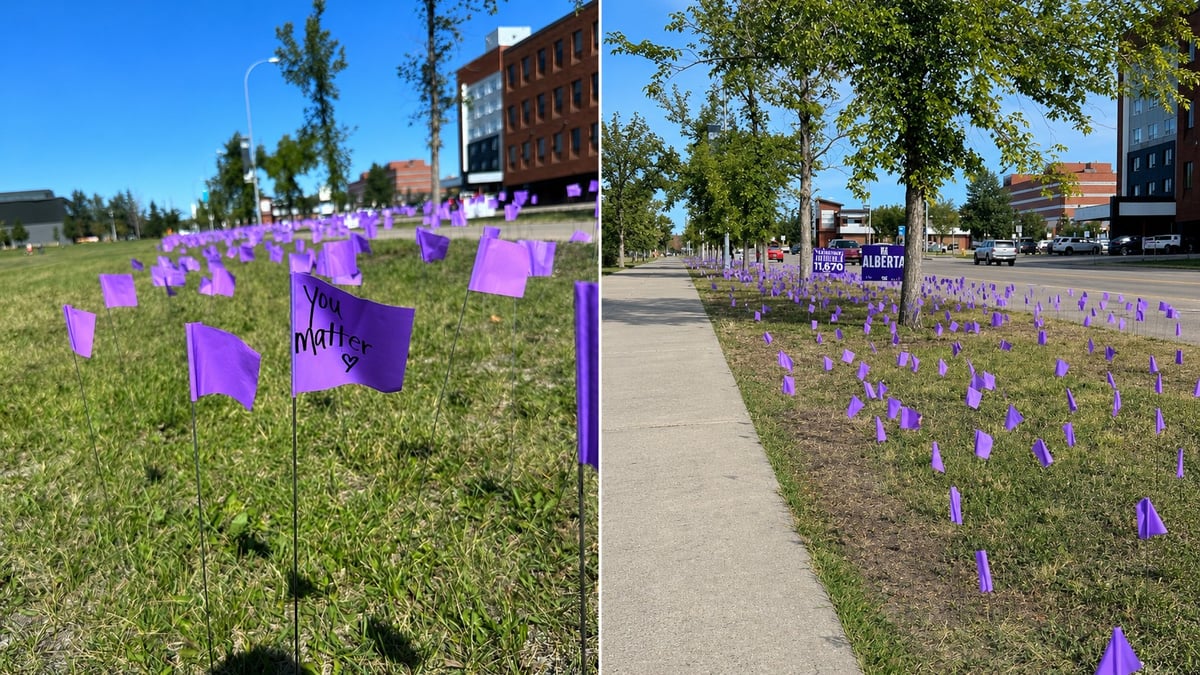
August 31 is International Overdose Awareness Day, and Grande Prairie marked it with 1,157 purple flags on the grass outside the Montrose Cultural Centre.
Each one is a person Alberta lost to accidental opioid poisoning in 2025.
Twenty-four of them were in Grande Prairie, according to the Alberta Substance Use Surveillance System.
What the day is
It started in 2001 in Australia, initiated by S.J. Finn while managing a needle and syringe program at the Salvation Army Crisis Centre in St Kilda, Victoria. Six thousand silver ribbons went out that first year across Australia and New Zealand.
It's now marked in more than 40 countries, coordinated globally by the Penington Institute since 2012. Purple and the silver ribbon are its symbols.
The slogan is "Time to remember. Time to act."
Displays like the one in Grande Prairie went up across North America on Monday. In Grand Junction, Colorado, more than 1,700 flags were planted for that state's 2025 dead, with 29 white flags in the middle for the county's own.
"As the number of lives goes up and down each year, we want to make sure that those lives have a space to be remembered because these were individuals," said Dr. Ryan Jackman, an addiction medicine physician who helped organize it.
That's the point of a flag rather than a statistic. A number on a page is one thing. Twelve hundred flags on a boulevard you drive past is another.
The other number on the sign
Among the flags in Grande Prairie is a second sign, and it carries a figure that deserves as much attention as the first.
Naloxone reversals in Alberta: 11,570.
That's roughly ten reversals for every death. Ten times as many people who were dying, and didn't, because somebody nearby had a kit and knew what to do with it.
Naloxone kits are free in Alberta
No prescription. No cost. No explanation required.
Take-home naloxone kits are available at hundreds of pharmacies and other distribution sites across the province, including in Grande Prairie. You don't need to have a substance use disorder to get one.
A kit contains naloxone, syringes, gloves and a breathing barrier, along with instructions.
Naloxone temporarily reverses an opioid overdose. It doesn't work on alcohol, stimulants or benzodiazepines, and it wears off, which is why calling 911 is necessary even after a kit works.
Alberta's Good Samaritan Drug Overdose Act protects people who call 911 for an overdose from charges for simple possession, including the person who overdosed. That protection exists because fear of arrest is the most common reason people don't call.
Find a distribution site at alberta.ca.
What an overdose actually looks like
Most people have never seen one, and the picture in their head is wrong.
It usually isn't dramatic. Someone becomes very difficult or impossible to wake. Their breathing slows, becomes shallow, or stops. Their skin goes pale or blue-grey, particularly around the lips and fingertips. Pupils constrict to pinpoints. There may be a deep snoring or gurgling sound, which is not sleep.
If you can't wake someone and their breathing is wrong, treat it as an overdose.
Call 911. Give naloxone if you have it. Start rescue breathing if you know how. Naloxone can be given again after two to three minutes if there's no response, and a kit contains more than one dose for exactly that reason.
Stay with them. Naloxone wears off before many opioids do, and someone who comes around can go back under.
Getting it wrong in the direction of caution costs nothing. Getting it wrong the other way is what the flags are.
What's changing in Grande Prairie
The region has treatment capacity coming.
Last week the province committed $3 million to Rising Above Ministries for a new 36-bed treatment centre for men, nearly complete and expected to accept clients this fall. Rising Above has consistently reported more applications than it can take, with over 1,400 people on its waiting list.
Planning is also underway for the Grande Prairie Recovery Community, which the province says will provide up to 50 long-term treatment beds.
Our coverage of the Rising Above funding is here.
None of that helps someone tonight. Which is what the naloxone number is about.
If you need help now
211 Alberta connects people to mental health and addiction supports, 24 hours a day, seven days a week. Dial 211.
The Virtual Opioid Dependency Program is at 1-844-383-7688, seven days a week from 8 a.m. to 8 p.m. It provides same-day access to addiction medicine specialists with no wait list, which is worth reading twice, because a wait list is the reason a lot of people never start.
The Addiction Helpline is 1-866-332-2322, 24 hours, free and confidential.
If someone is overdosing, call 911 and stay with them.
If you've lost someone
Grief after a drug poisoning death carries a weight that other grief often doesn't, because of how people react when you tell them what happened.
That's the stigma the day exists to address, and it's why the flags are in public rather than in a building.
Alberta's Mental Health Help Line is 1-877-303-2642, 24 hours.
Sources
Alberta Substance Use Surveillance System
Government of Alberta, take-home naloxone program and Good Samaritan Drug Overdose Act
International Overdose Awareness Day, Penington Institute
Colorado display details and comments from Dr. Ryan Jackman as reported by KJCT.





Comments
Conversation