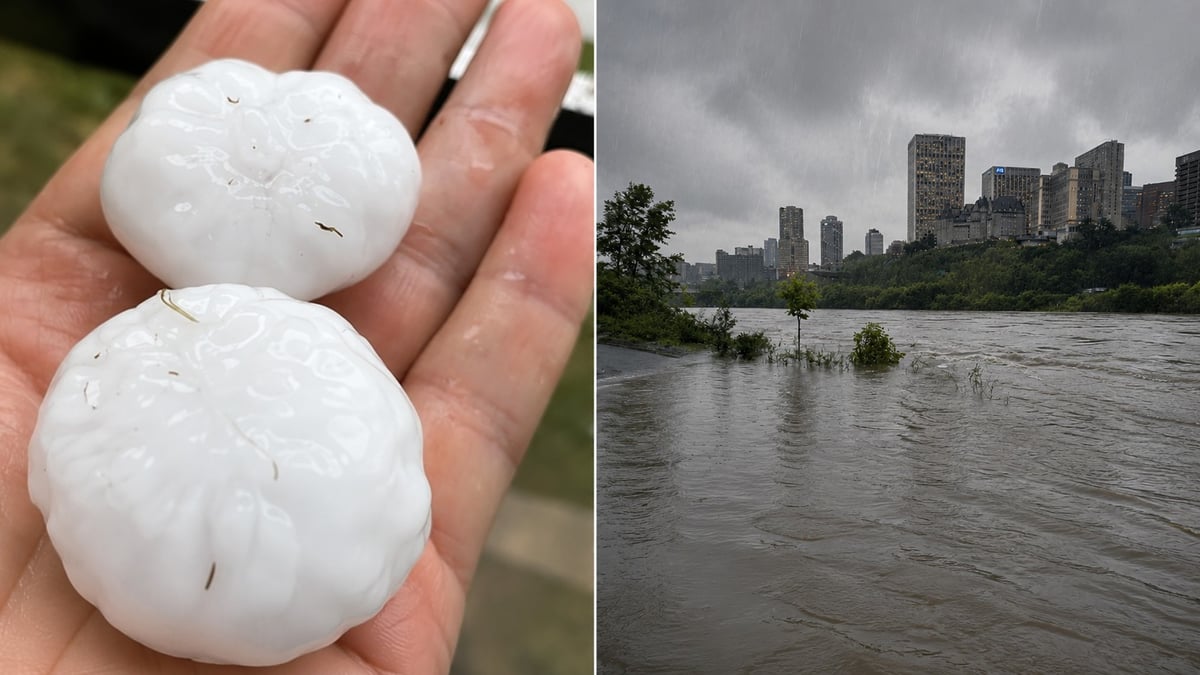
Edmonton got soaked again Monday.
Another severe thunderstorm rolled across the region, dropping loonie-sized hail and torrential rain on the southeast side and flooding roads as it moved through, with residents describing wind fierce enough that some thought a tornado might be forming. Environment Canada issued a severe thunderstorm warning at 1:16 p.m. covering Edmonton, Leduc, Sherwood Park and the Cooking Lake area. It ended for the City of Edmonton around 2:25 p.m. but stayed in effect for areas east of the city as the storm tracked northeast toward Fort Saskatchewan and cleared out.
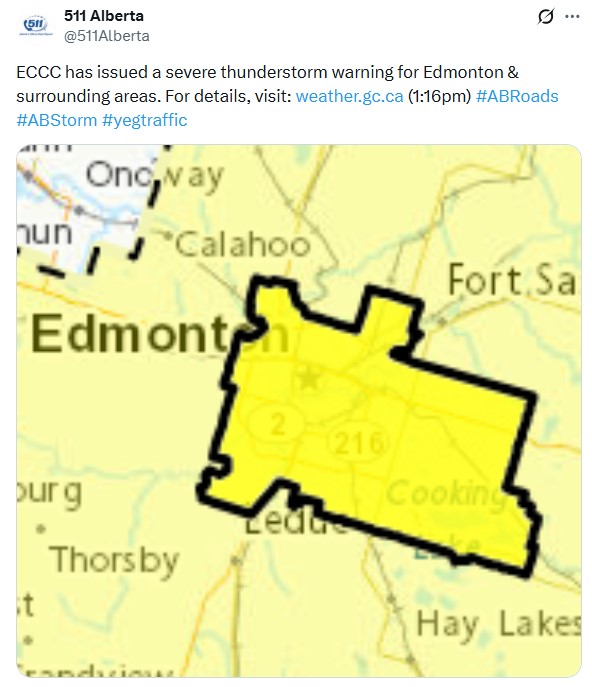
Flooding, again
The rain came fast, and Edmonton's roads did what they've done all summer, they filled with water. Flooding was reported across parts of the city and surrounding areas as the storm moved through, the newest entry in a season where a hard downpour and a flooded underpass have become routine.
Edmontonians know the drill by now, and it's worth repeating because it saves lives and vehicles: never drive into a flooded roadway. Water on a road is deeper and moving faster than it looks, it can stall an engine in seconds and float a car, and the underpasses that flood worst are exactly where drivers get trapped. If you reach water over the road, turn around. City drainage crews and EPCOR are left to deal with the aftermath, and every stranded car makes their work harder.
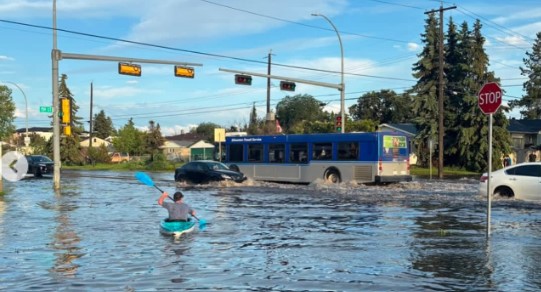
This weekend showed how bad it gets
Monday's flooding lands on a city still drying out from Saturday night, when a more violent storm turned roads into rivers.
That storm dumped more than 30 millimetres of rain in an hour and overwhelmed the drainage system across the west end. Whitemud Drive was closed between 156 Street and 178 Street, the 170 Street underpass filled deep enough that firefighters were deployed to help drivers stranded on the embankment between the overpass bridges, and video showed water shooting like geysers out of manholes. Three vehicles got stuck at the eastbound 170 Street off-ramp, where a dip in the road collected around two feet of water. The same storm forced thousands to shelter at K-Days and cut short Post Malone's concert at Commonwealth Stadium. Our coverage of that night is here: https://www.culturealberta.com/articles/post-malone-edmonton-concert-cancelled-storm-floods-commonwealth-stadium
A record-breaking wet summer
The storms are adding up to a number Edmonton has never hit. As of Monday, downtown Edmonton has recorded almost 500 millimetres of rain this summer, putting the city on course for its wettest summer on record, according to The Weather Network. That follows the wettest June ever recorded, 262 millimetres, breaking a mark that stood since 1914.
For a city whose summers are usually short and dry, this is a genuine outlier, and the ground shows it. Saturated soil can't absorb another downpour, so each new storm runs straight off into the streets, which is why the flooding keeps happening faster and worse with every round.
Why this keeps happening right now
There's a specific pattern behind the repetition. A powerful area of high pressure parked over the central United States has split the Prairies, according to The Weather Network. Its northern edge is pushing thunderstorm activity into central and northern Alberta while keeping the south hot and dry, which is why Edmonton keeps getting hit while Calgary bakes. Until that system shifts, the pattern holds. Wildfire smoke can cut the daytime heat that fuels storms, but when enough heat and moisture build anyway, they fire regardless.
The climate change question
It's fair to ask whether a summer like this is what climate change looks like, and the honest answer is careful but not evasive.
No single storm, and no single wet summer, can be pinned on climate change alone. Weather is variable, and Alberta has always had violent summer storms, the 1987 Black Friday tornado that killed 27 people is proof catastrophic weather here predates the current era. What scientists can say is about the pattern. A warmer atmosphere holds more water vapour, roughly seven per cent more per degree Celsius of warming, so when it rains, there's more moisture available to fall. That tilts the odds toward heavier downpours and more intense rainfall over time.
So the accurate framing isn't that climate change caused this storm. It's that a warming climate loads the dice toward exactly this kind of summer, more frequent heavy-rain events, more water dumped in short bursts, more flash flooding. Whether this specific summer is a preview or just a bad year, it's consistent with where the science points.
Infrastructure feeling the strain
Each storm is also a stress test the city keeps partly failing. The stormwater systems, built decades ago, are designed for a certain amount of rain, and this summer keeps exceeding it. Older neighbourhoods with aging pipes and exposed power lines have flooded and lost power more than newer areas built with modern drainage, a gap residents have started raising with the city, especially as density increases in exactly those older areas.
Edmonton is years into a multi-decade stormwater upgrade and a neighbourhood renewal program, but the work is slow and expensive, and the city is carrying a maintenance backlog measured in the billions. The rain is the event, but the drainage is the story that lasts, and this summer is the loudest argument yet for spending on it.
What to do when the next one hits
Because there will be a next one. When a severe thunderstorm warning is issued, get inside, away from windows, and off the road if you can. Never drive through a flooded roadway, and don't shelter under an overpass. The live warning for your area is at weather.gc.ca, on the WeatherCAN app, or through Alberta Emergency Alert. Warnings in this pattern change fast, a clear sky can turn in twenty minutes.
To report severe weather, email ABstorm@ec.gc.ca, call 1-800-239-0484, or post with #ABStorm.
Sources:
Environment and Climate Change Canada, severe thunderstorm warning for Edmonton and area, July 27, 2026: https://weather.gc.ca
The Weather Network, Edmonton wettest summer on record, July 27, 2026
Global News and CBC News, Edmonton storm flooding and road closures, July 25–27, 2026




Comments
Conversation