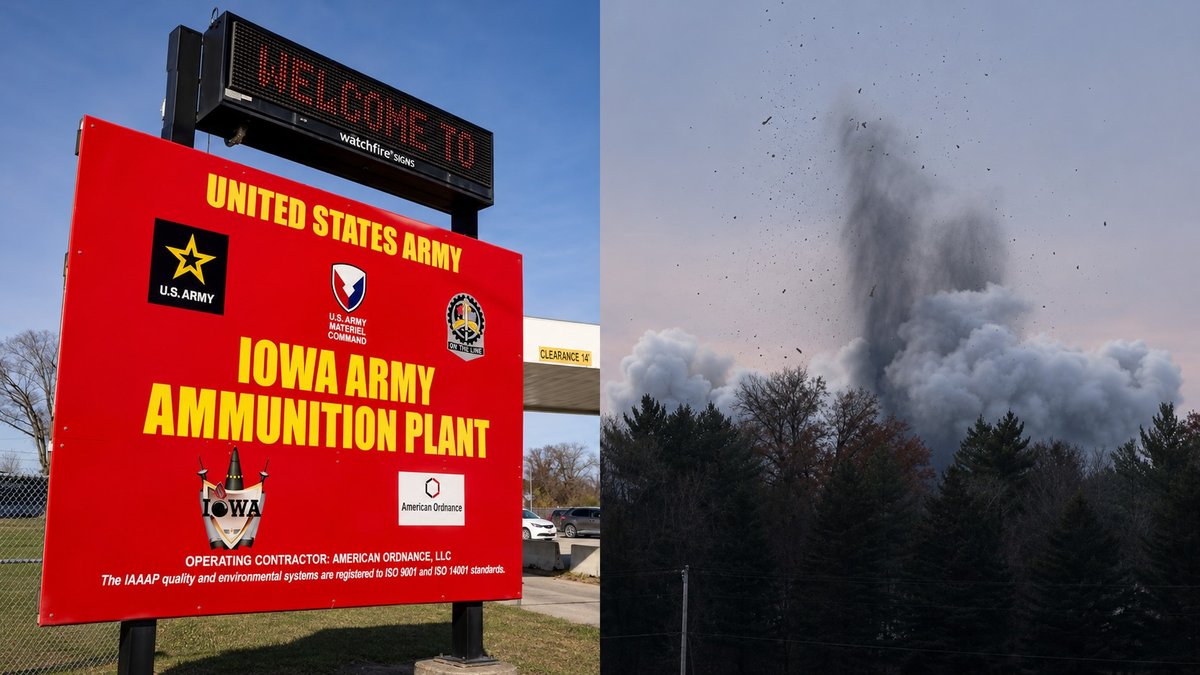
The U.S. Army has destroyed its entire stockpile of lead azide, a degraded bomb-making chemical, in a controlled explosion in southeastern Iowa.
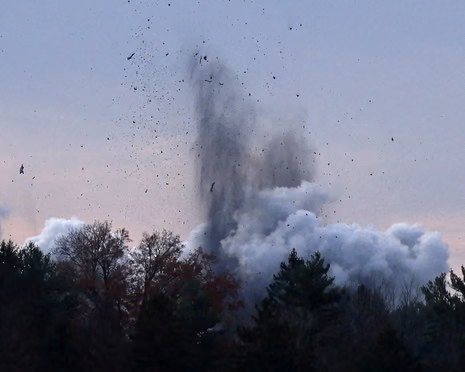
Two booms went off around 9 a.m. local time on Wednesday, Nov. 25, at the Iowa Army Ammunition Plant in Middletown, near Burlington. Two white plumes rose and quickly faded.
Maj.-Gen. Eric Shirley, who led the operation, told reporters that all the material was destroyed, with "no secondary explosions or damage to infrastructure," The Associated Press reported.
An hour later, the U.S. Environmental Protection Agency said its real-time monitors across the region had detected no airborne lead.
What is lead azide?
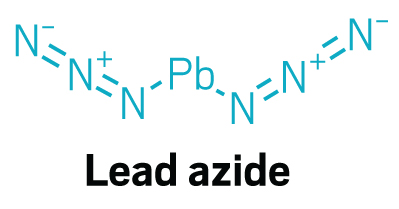
Lead azide is a highly sensitive explosive used to trigger bigger explosions in military munitions. As the name suggests, it contains lead. Lead is a toxic heavy metal that isn't safe at any level, and it's especially dangerous for children and pregnant women.
The U.S. brought its entire stockpile to the Iowa plant from bases across the country in 2009, and kept it there in case the military needed it again.
Why it couldn't wait
During an inspection in March, staff found the lead azide had deteriorated and crystallized. That made it far more unstable and sensitive to friction and cold. As temperatures dropped, the risk was that it could go off on its own.
How much: The Army says it filled about 68 drums and weighed more than 9,700 pounds, roughly 4.4 metric tonnes.
Federal agencies looked at other options, like moving it, burning it or neutralizing it chemically. The Army concluded that handling, moving or treating it was too risky, and that destroying it where it sat was the safest choice.
"Inaction is no longer an option," Shirley said.
How they tried to contain it
The Army surrounded the two bunkers with:
Concrete and sand barriers two storeys high
Ballistic gels and foams to absorb lead dust
More than 100,000 gallons (about 380,000 litres) of water to keep the plume down
Officials urged people within about eight kilometres to leave. Schools cancelled classes, a nearby gas station closed and some residents sealed their windows and doors.
A week of delays and a court fight
The detonation was first set for Nov. 20. The Army pushed it back several times, citing the weather and time to finish preparations. CNN also reported that President Donald Trump briefly paused the plan.
Environmental groups tried to stop it. The Iowa Environmental Council and the Sierra Club, represented by Earthjustice, asked a federal appeals court for an emergency pause. They argued residents had too little notice, and that the EPA permit needed stronger protections against lead dust settling on homes, yards and other outdoor surfaces.
On Monday, the U.S. Court of Appeals for the Eighth Circuit turned down their request, clearing the way for Wednesday. The groups say they'll keep challenging the EPA permit.
What the early tests tell us, and what they don't
What we know: The EPA says its air monitors collected data through the whole detonation, and found no airborne lead in the first hour.
What we don't know yet: Whether lead settled on land or water beyond the site. Air readings can't answer that. Follow-up soil, surface dust and water samples will.
The EPA took about 1,200 samples before the blast, so it has a baseline to compare against.
The forecast changed as the date moved. An Illinois advisory on Nov. 18 flagged possible effects in Mercer County. By Wednesday, Illinois officials said they no longer expected the plume to reach the state. Winds were forecast to carry it southwest toward Missouri, and Missouri's governor's office later said the EPA found no detectable lead heading that way.
Water plants on the Mississippi and Missouri rivers are testing for any spikes.
"It was nothing"
For some people watching from the roadside less than a mile away, the blast was a letdown.
"It was nothing," Burlington resident Tim Brandt told AP. "It seemed like the government put fear in a lot of people over nothing."
Others are waiting for the test results.
"I don't think lead danger goes away any time soon," said Lucy Giehl of West Burlington. "It seems someone might have thought about all of this a little sooner before it came to this."
Was Canada affected?
No. The advisories covered Iowa, Missouri and Illinois. As of Nov. 25, there was no Canadian advisory and no reported impact in Canada.









Comments