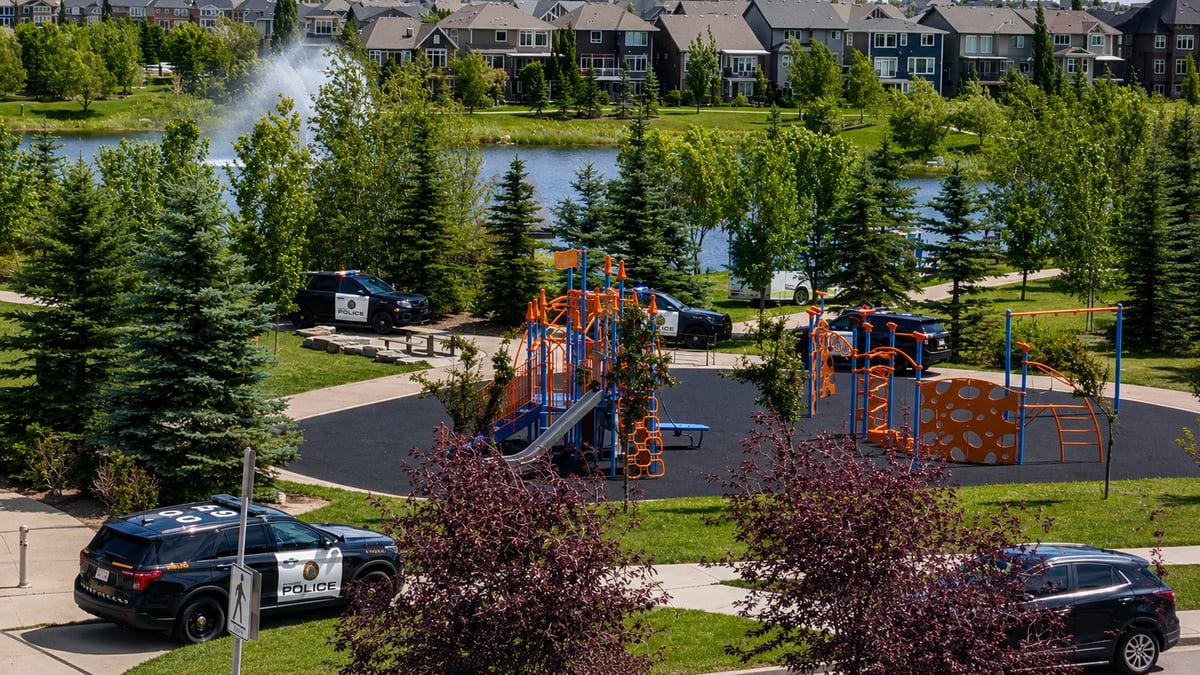
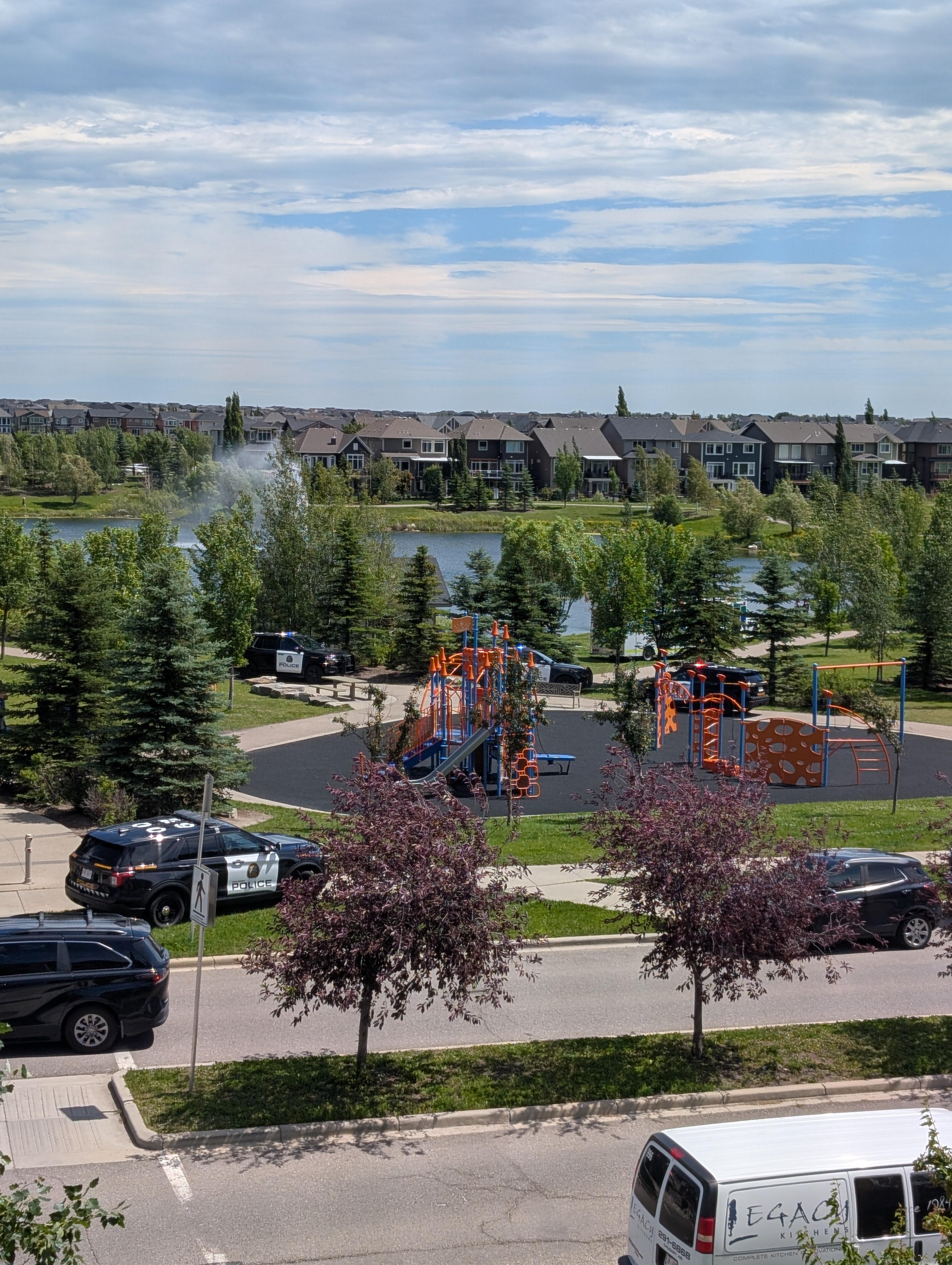
A six-year-old girl has died after drowning in a pond in southeast Calgary.
Calgary Fire Department crews were dispatched just after 1 p.m. on Sunday, July 12, for reports of a person submerged in water along Legacy Main Street S.E., Battalion Chief Bruce Barrs said. A family member had already pulled the girl from the water by the time they arrived. She was in critical condition.
Firefighters began CPR and kept assisting with resuscitation after paramedics took over patient care. It wasn't enough.
"Unfortunately, the patient was declared deceased at the scene," Barrs said.
STARS air ambulance was called but did not transport anyone. Crews used sonar equipment and a surface scan of the pond to confirm no one else had gone under. Nobody had.
Police have not released her name.
Why the ponds in these neighbourhoods are so dangerous
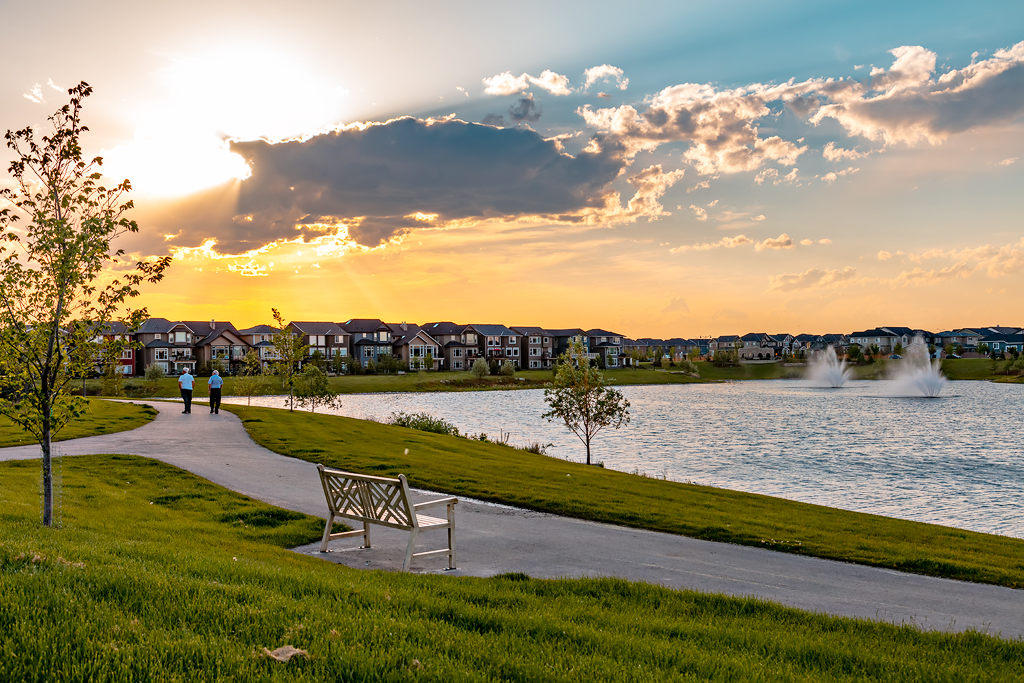
Calgary has more than 350 storm ponds, most of them in newer communities like Legacy. They look like water features. They are drainage infrastructure.
What makes them lethal isn't obvious from the bank. The Lifesaving Society has been blunt about it: these ponds can have steep drop-offs and sludge at the bottom that a person sinks into. The edges are often thick with reeds and vegetation. Someone who goes a few steps in can find the bottom drop away, or find their legs held. Wet ponds are typically engineered to sit about three metres deep, and levels rise fast after a storm.
Alberta has lost children to this exact hazard before. In 2017, 14-year-old Khrystyna Maksymova drowned in an Edmonton stormwater pond after going in to get her dog. She got caught in the mud and reeds and couldn't get out. Edmonton launched a safety review of more than 180 ponds afterward. Two years before that, a toddler drowned in a drainage pond in Morinville.
Under Calgary's Stormwater Bylaw, water contact of any kind, swimming, wading, boating, is prohibited in storm ponds. The fire department's message is three words: stay out, stay off, stay back.
The Calgary Fire Department has not said what type of pond this was.
Three drownings at Mahogany Lake in less than a year
Legacy's loss lands in a corner of the city that has been burying its young people since last summer.
Mahogany, the community lake about ten minutes away, has seen three drownings in under a year. In August 2025, two 20-year-old men, Yagazie Ike-Peters and Caelan Escalante, died there.
Then on May 3, a 12-year-old boy jumped off a dock and didn't come back up. Damilola Khalid Afolabi had been playing basketball with friends minutes before. His family had moved to Calgary from Kumasi, Ghana, weeks earlier. Crews found him roughly 43 minutes later, more than six metres down, in cold and murky water.
"When we were about to leave Ghana, Dami said, 'Thank you for the good life you are going to give us in Canada,'" his father, Jubreel Afolabi, said at his funeral. "I never prayed that I would be the one to bury my son."
Less than 48 hours after Damilola died, a green flag was flying over Mahogany's beach. The lake was open.
The lifeguard gap nobody has closed
Most Calgarians don't know this: the community lakes have no lifeguards. Not Mahogany, not any of them.
Mahogany is the largest freshwater lake in the city, 25 hectares, nine metres deep in spots, with more than 180,000 people through the gates last year. Nobody is watching the water.
It isn't negligence so much as a hole in who's in charge. Community lakes are privately owned and run by homeowners associations, which means the City of Calgary cannot mandate lifeguards or standardize signage the way it does at municipal pools. The provincial rules that set lifeguard ratios at public pools don't reach them.
Peters Ike, whose son Yagazie was one of the men who died in August, spent the year meeting with the homeowners association, the mayor, the councillor, lake operations. He described a collaborative spirit. He did not describe much change.
"The season is just about starting," he said in May, after Damilola. "My view would be perhaps not timely enough."
Mahogany's homeowners association has since made a water safety course mandatory. New members signing up from July have to take it. Existing members have until July 2027. Some residents think it's thin. The association has been candid that lifeguards would mean higher fees, and that Alberta has a lifeguard shortage regardless.
Cold water is what people underestimate
Even in July, Alberta water is cold enough to disable a strong swimmer within a minute.
"Cold water shock is a real thing, and it happens very frequently, even in the summer," Madison Lalonde of the Lifesaving Society's Alberta and Northwest Territories branch told CBC News. "It can affect your limbs, your cognition, so you would not be able to self-rescue as well as you normally would be able to in, like, a pool setting."
How fast it happens
Drowning is not what people picture. It is usually silent, and it is fast.
The City of Calgary's own guidance: a child can drown in five centimetres of water. Two inches. The city's recommendation is that small children stay within arm's reach of an adult around any water at all, ponds, lakes, rivers, wading pools, bathtubs.
The Calgary Fire Department has attended 30 fatalities on aquatic rescue calls since 2016. Three Calgarians drowned in 2025.
If you see someone in the water
Call 911 first. If you can do it safely from shore, throw something that floats, or reach out with something they can grab. Do not go in after them. Rescuers drown too.
If you can't reach them, keep them in sight, memorize their location and what they're wearing, and give that to 911. A landmark, an address, a pathway marker, anything that puts crews in the right place faster.
Where to get help
Anyone struggling after this news can reach free, confidential support through 211 Alberta, by phone, text, or chat, any hour.
Culture Alberta will update this story if police or the Calgary Fire Department release more.
Sources:
Calgary Fire Department, statements from Battalion Chief Bruce Barrs, July 12, 2026
Alberta Health Services / Emergency Health Services
Lifesaving Society of Alberta and the Northwest Territories
Mahogany Homeowners Association, water safety course announcement, May 2026
Statements from Jubreel Afolabi and Peters Ike
City of Calgary, water safety and storm pond safety guidance (calgary.ca/watersafety)
City of Calgary Stormwater Bylaw 37M2005



Comments
Conversation