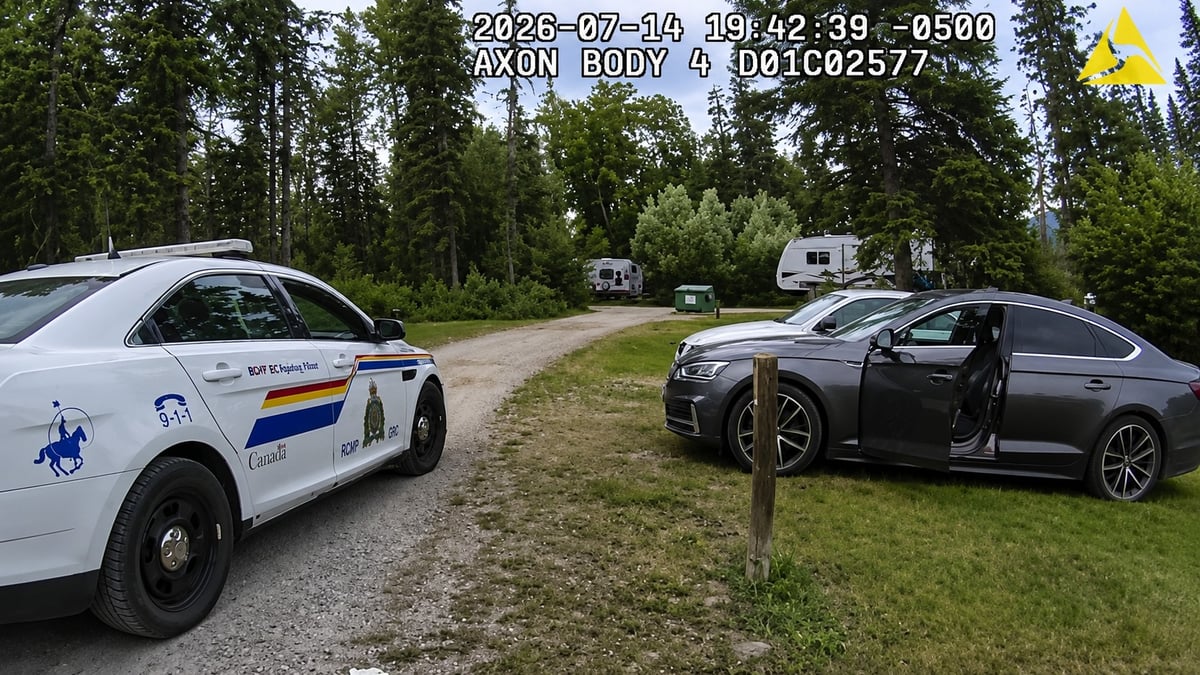
A 20-year-old Alberta man has been fined and had his vehicle impounded after BC Highway Patrol clocked his Audi at 230 km/h near Fairmont Hot Springs, then tracked him to a campground.
Officers were on patrol on Highway 93/95 on July 14 when the Audi passed at nearly three times the posted 80 km/h limit. Police said the speed made an immediate traffic stop unsafe, so they didn't attempt one. Instead, officers converged on the area they believed the car was headed. Tips from the public pointed them to a nearby campground, where they found the Audi parked and unoccupied.
Officers then identified and located the driver. Suspecting he had been drinking, they demanded a roadside breath sample, which returned a WARN reading, a blood alcohol content between .05 and .08.
The penalties
The driver received a three-day immediate roadside prohibition, a ticket for excessive speeding, a ticket for driving without a driver's licence, a seven-day vehicle impoundment, and $959 in fines plus towing and impound costs.
He was also referred to Alberta's administrative body that reviews driving sanctions. B.C. and Alberta share driving records, so sanctions issued in B.C. follow a driver back to their home province, where Alberta's review process decides any further consequences for his licence.
"Not every investigation ends with flashing lights and a traffic stop," said Sgt. Brett Reiben, unit commander for BC Highway Patrol Cranbrook. "This is a great example of persistent police work and good information from the public that held a driver accountable for his dangerous driving behaviour."
The RCMP thanked the members of the public who helped locate the vehicle.
Sanctions start at .05, not .08
The WARN reading fell below the .08 criminal threshold. Both B.C. and Alberta run administrative sanction programs that start at .05.
In B.C., a first WARN reading brings a three-day driving prohibition, the sanction this driver received. The program escalates for repeat readings within a five-year window, with second and third readings bringing longer prohibitions, mandatory remedial programs and steeper costs. A reading over .08, or a refusal to provide a sample, jumps to a 90-day prohibition and a 30-day impoundment regardless of whether criminal charges follow.
Alberta's Immediate Roadside Sanctions program works on the same structure, with licence suspensions and vehicle seizures issued at the roadside starting at .05 and escalating for repeat occurrences. In both provinces, the sanctions are issued on the spot, with no charge or court date involved.
No traffic stop, no criminal charge
The release doesn't say how officers connected the parked Audi to its driver. Vehicle registration, witness information and the conversation at the campground are the standard routes in a file like this.
The penalties issued are administrative, under B.C.'s Motor Vehicle Act, rather than criminal. They're issued on an officer's grounds at the roadside and don't require a court process. Dangerous driving is a separate Criminal Code offence that speeds like this sometimes draw, but police announced tickets and roadside sanctions only in this case and didn't say why.
The driver can contest the penalties. Roadside prohibitions can be reviewed through RoadSafetyBC, with short deadlines to apply, and the tickets can be disputed like any violation ticket.
What counts as excessive speeding in B.C.
Excessive speeding in B.C. is a defined offence: more than 40 km/h over the posted limit. It triggers vehicle impoundment on a first offence, separate from any alcohol reading, with longer impoundments for repeat offences. This driver was 150 km/h over.
B.C. police publicize a handful of 200-plus readings each summer, and they tend to involve resort-corridor highways and drivers in their teens or twenties in performance cars.
The licence question
One line in the penalty list is unexplained: the ticket for driving without a driver's licence. The release doesn't say whether the man holds no licence at all or simply couldn't produce one when officers found him.
The difference matters for what comes next. Alberta's graduated licensing system puts stricter conditions on new drivers, including a zero-alcohol requirement for anyone still in the graduated program, and Alberta's review of the B.C. file will land differently depending on what kind of licence, if any, he holds. Police haven't released further detail.
Reporting dangerous drivers
The file started with officers' own radar, but it closed on public tips, and both provinces ask for exactly that. Dangerous driving happening in real time, a vehicle at extreme speed, a suspected impaired driver, is a 911 call in B.C. and Alberta alike. Non-urgent reports with a plate, location and direction of travel go to local police lines. In this case, the callers' information was the difference between a radar reading with no name attached and the penalty list above.
The highway
Highway 93/95 through Fairmont is the main route between southern Alberta and the Columbia Valley, carrying heavy Alberta traffic to Invermere and Radium through the summer. The posted limit on the stretch where the Audi was clocked is 80 km/h.
Sources:
BC Highway Patrol, news release, July 23, 2026: https://rcmp.ca/en/bc/bchp/news/2026/07/4355328







Comments
Conversation