Minimum wage went up in five provinces today. Alberta wasn't one of them.
New rates took effect Oct. 1 in Ontario, Prince Edward Island, Nova Scotia, Manitoba and Saskatchewan.
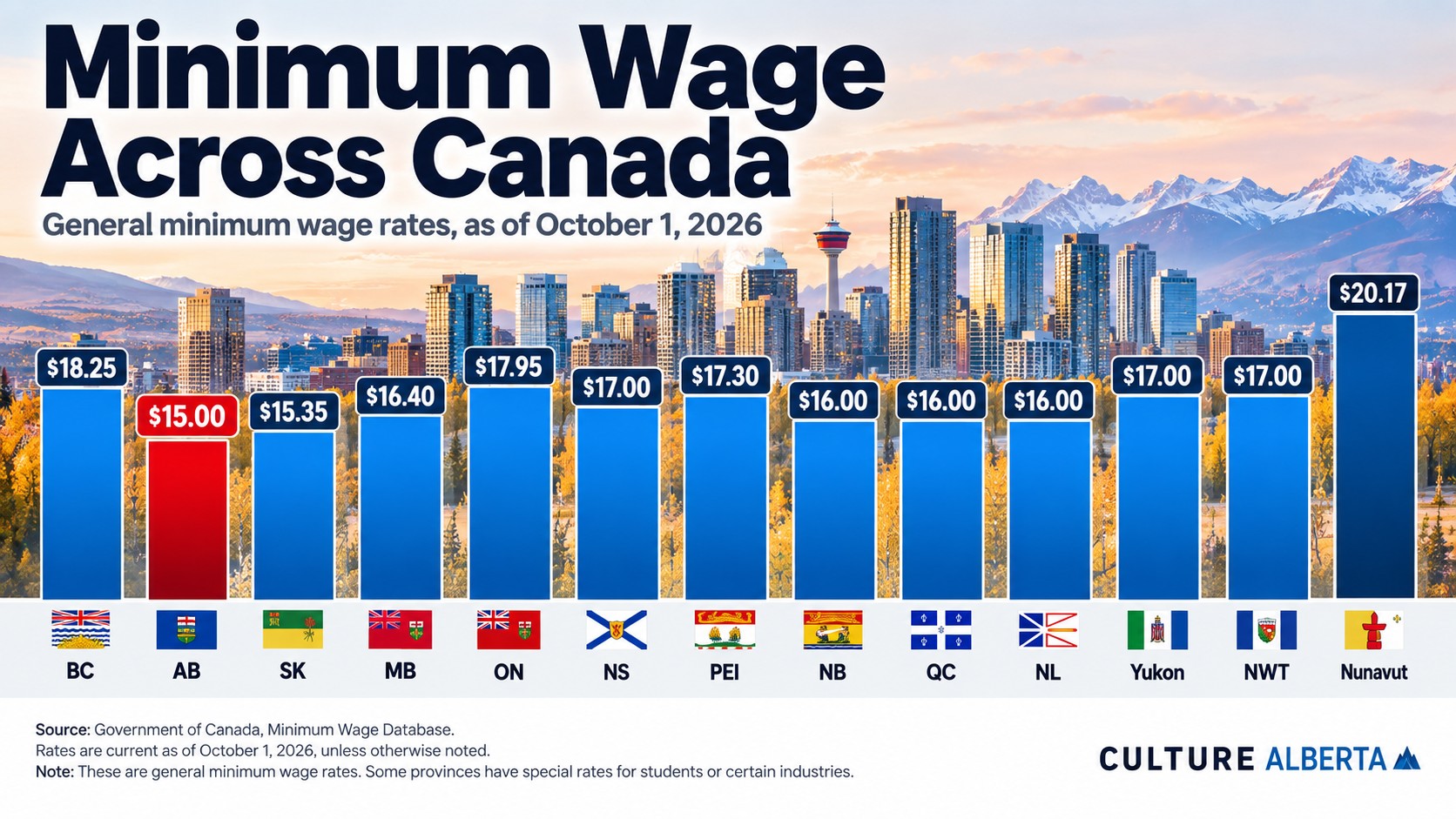
Alberta's general minimum wage stays at $15 an hour, the lowest in Canada.
It hit $15 on Oct. 1, 2018. That's exactly eight years ago today.
What changed today
Ontario went from $17.60 to $17.95. The increase is tied to inflation, and the province says it affects more than 700,000 workers.
Saskatchewan went from $15.35 to $15.70, using a formula that weighs both inflation and the province's average hourly wage.
Manitoba rose 40 cents to $16.40, based on the province's 2025 inflation rate.
Nova Scotia is now at $17, its second increase this year. Its rules use inflation plus one percentage point.
Prince Edward Island moved to $17.30, and already has another raise scheduled, to $17.60 on April 1, 2027.
Alberta stays at $15.
Where Alberta ranks
British Columbia has the highest provincial minimum wage, at $18.25 since June.
Nunavut has the highest in Canada, at $20.17 since Sept. 1.
The federal minimum wage, which covers workers in industries like banking, telecom and airlines, rose to $18.15 on April 1. Where a provincial rate is higher, the higher one applies.
Alberta became the country's lowest last October, when Saskatchewan moved past it.
What the gap looks like in a year
At 40 hours a week for 52 weeks, a worker earning Alberta's $15 makes $31,200 before taxes.
At Ontario's new $17.95, the same hours pay $37,336. That's $6,136 more a year.
At B.C.'s $18.25, the difference is $6,760.
Even next door in Saskatchewan, the 70-cent gap adds up to $1,456 a year.
These are simple before-tax comparisons. They don't factor in taxes, benefits, hours or the cost of living in each province.
Alberta used to lead the country
Eight years ago, it was the other way around.
Rachel Notley's NDP government raised Alberta's minimum wage in steps: to $11.20 in 2015, $12.20 in 2016, $13.60 in 2017, and $15 on Oct. 1, 2018. At the time, that was the highest in Canada.
The general rate hasn't changed since.
What changed in 2019 is sometimes mixed up with that. After the UCP took office, it created a separate $13 rate for students under 18, starting June 26, 2019.
During the school year, that rate applies to a student's first 28 hours a week. Anything over 28 hours has to be paid at least $15. The $13 rate can also apply during school breaks, including summer.
The argument over $15
Alberta's NDP wants the rate raised.
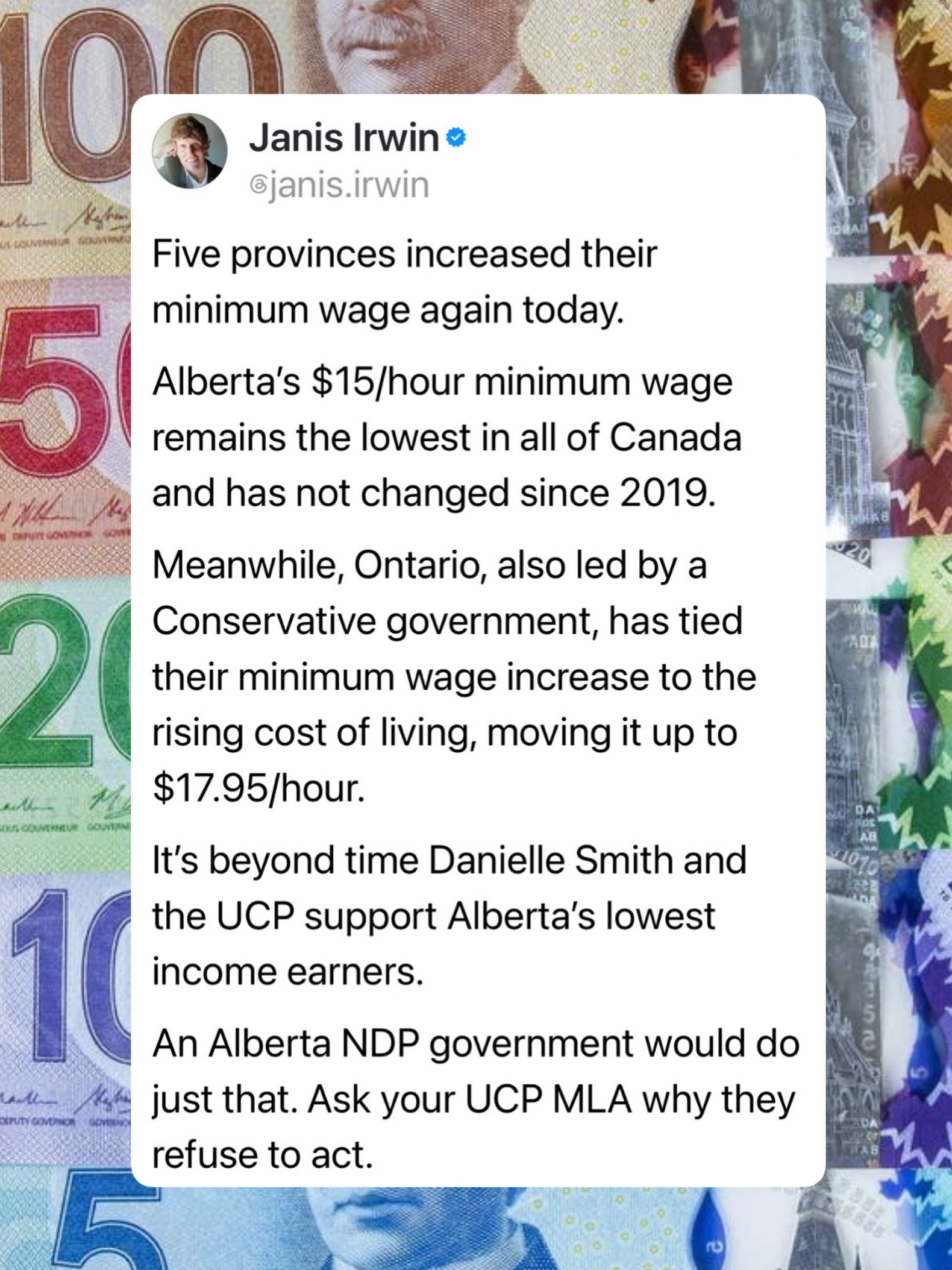
NDP MLA Janis Irwin pointed to today's increases. "Alberta's $15/hour minimum wage remains the lowest in all of Canada," she wrote. "Meanwhile, Ontario, also led by a Conservative government, has tied their minimum wage increase to the rising cost of living."
"It's beyond time Danielle Smith and the UCP support Alberta's lowest income earners."
The Alberta Federation of Labour has called for a $20 minimum wage.
Premier Danielle Smith has defended keeping it at $15. When Alberta fell to last place in Canada last fall, she pointed to the province's lack of a provincial sales tax, and said a higher minimum wage wouldn't help with youth unemployment.
"I don't want to put any more barriers in place to employers hiring young people," Smith said at the time.
A jobs ministry spokesperson said last year the government is "committed to balancing workforce needs while also ensuring small businesses are not forced to raise costs or be unable to pay their employees."
How other provinces raise theirs
Much of the gap comes down to how the rate gets set.
Ontario, Manitoba, Saskatchewan and Nova Scotia all adjust their minimum wages every year using a formula, mostly tied to inflation. Nunavut brought in its own annual formula in 2025.
That means those governments don't have to make a fresh decision each year. The rate rises on its own.
Alberta has no formula. Its rate only changes if the government decides to change it.
So when will Alberta's minimum wage go up?
There's no increase scheduled.
The province's official minimum wage page still lists $15 as the general rate and $13 for eligible students under 18. The government hasn't announced any plans to change either.
Compare that with P.E.I., where workers already know their minimum will rise again next April.
In Alberta, the rate stays at $15 until the government decides otherwise.
More on Alberta's minimum wage
We looked at what Alberta's $15 minimum wage means for workers in 2026, including who earns it and how far it goes. Read it here.
Looking for better pay?
Many Alberta employers pay well above minimum wage, and more are now listing pay right in the job posting.
Our job board lets you filter for jobs with published pay, so you can see what a role pays before you apply.
Browse Alberta jobs with posted pay →
Sources
Minimum wage, Government of Alberta
Minimum wage expert panel, Government of Alberta
Minimum wage, Government of Ontario
Minimum Wage and Reporting for Duty Pay, Government of Saskatchewan
Provincial Minimum Wage to Increase to $16.40 on Oct. 1, Province of Manitoba
Minimum Wage Rises to $17, Government of Nova Scotia
Feedback wanted on annual minimum wage review, Government of Prince Edward Island
Nunavut's minimum wage increases September 1 to $20.17 per hour, Government of Nunavut
Pay and minimum wage, Government of Canada
Janis Irwin, social media post, October 1, 2026
Comments
Conversation