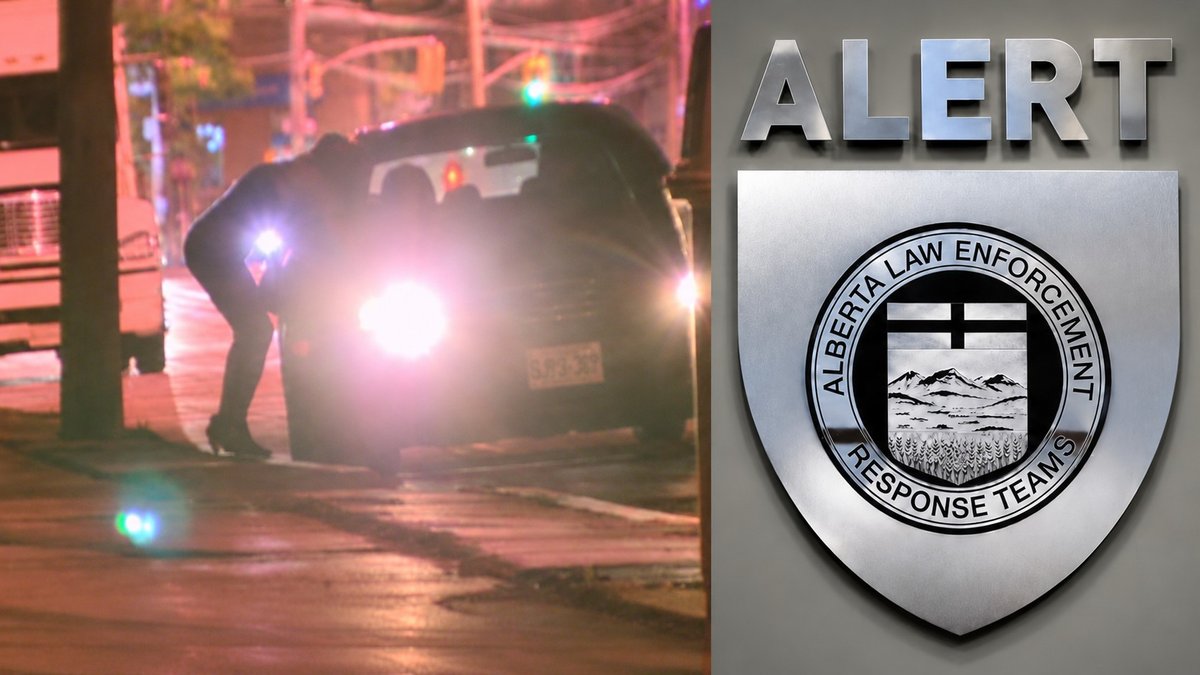
Thirty-five adult men have been arrested in Alberta over the past nine months in enforcement operations targeting the purchase of sexual services, ALERT says.
The Alberta Law Enforcement Response Teams (ALERT) Human Trafficking Unit ran the operations with the RCMP. In its Nov. 13 announcement, ALERT said the arrests also showed a gap in what people understand about Canada’s laws.
“Many people are unaware that paying for sexual services is illegal in Canada,” said Staff Sgt. Travis Kerr of ALERT.
What ALERT has and hasn’t released
ALERT says the arrests involved offences related to purchasing sexual services. It hasn’t released:
Names of the men
The specific charges each one faces
Where the arrests happened
Court dates
Police say the operations aimed to reduce the demand behind sexual exploitation and human trafficking. At the same time, investigators worked to identify and support people at risk of being exploited.
“These arrests demonstrate our commitment to enforcing the law, but they also highlight the need for greater public education,” Kerr said. “Demand is a driving force behind human trafficking and sexual exploitation.”
ALERT hasn’t said that any of the 35 men is charged with human trafficking. The allegations have not been proven in court.
Is paying for sex illegal in Canada?
Yes.
Under Section 286.1 of the Criminal Code, it’s an offence to obtain sexual services for payment. It’s also an offence to communicate with anyone for that purpose, so a deal doesn’t have to go through for someone to be charged.
The offence came in with the Protection of Communities and Exploited Persons Act, which took effect on Dec. 6, 2014. Ottawa said the goal was to protect people who sell sexual services and to reduce demand.
Selling your own services is treated differently
The law generally protects people who sell their own sexual services from prosecution. That includes receiving money from their own services and advertising them.
But it isn’t a free-for-all. Under Section 213, it’s illegal to communicate to offer or provide sexual services in a public place, or in public view, next to a school, playground or daycare. Stopping vehicles or blocking traffic to offer, provide or buy sexual services is also an offence.
Other people profiting from someone’s sex work is more tightly controlled. Section 286.2 bans most of it, with narrow exceptions such as legitimate living arrangements.
What penalties does buying sex carry?
How a case is prosecuted affects the penalty.
Indictable conviction: up to five years in prison
Summary conviction: up to two years less a day, a fine of up to $5,000, or both
The law also sets mandatory minimum fines:
| Prosecution | First offence | Repeat offence | First offence, near children | Repeat offence, near children |
|---|---|---|---|---|
| Summary | $500 | $1,000 | $1,000 | $2,000 |
| Indictable | $1,000 | $2,000 | $2,000 | $4,000 |
“Near children” means a public place, or one in public view, at or next to a park, school, religious institution or anywhere children can reasonably be expected to be.
These are the general rules in the Criminal Code. ALERT hasn’t released enough detail to say which apply to any of the 35 men.
Buying sex and human trafficking aren’t the same crime
It’s easy to blur these together, especially when a human trafficking unit makes the arrests.
Human trafficking means recruiting, transporting, harbouring or controlling someone’s movements in order to exploit them, sexually or through forced labour. It doesn’t require crossing a border. It can happen entirely within Alberta.
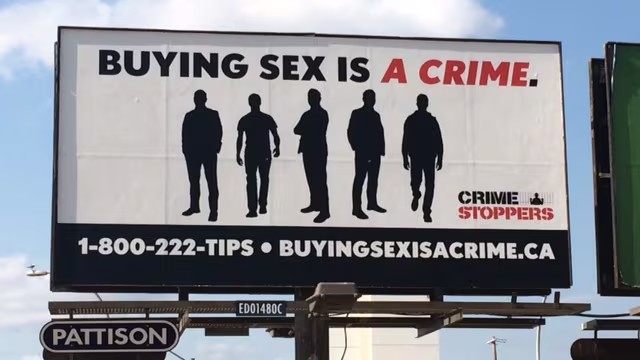
Buying sexual services is a separate offence. It doesn’t require proof that anyone was trafficked. That’s why police target buyers: they say demand is what makes trafficking profitable.
What the national numbers show
Statistics Canada recorded 608 police-reported human trafficking incidents in 2024, about three times as many as in 2014.
From 2014 to 2024:
93 per cent of identified victims were women and girls
82 per cent of people accused were men and boys
In 2024, 83 per cent of incidents happened in large urban centres.
Statistics Canada cautions that the rise doesn’t necessarily mean trafficking itself has tripled. Better awareness, more reporting and more police resources all push the numbers up, and many cases never reach police.
Warning signs of exploitation
The Canadian Human Trafficking Hotline lists possible signs of sex trafficking, including someone who:
Is being pressured, threatened or forced into selling sex
Doesn’t control their own ID, phone or money
Has someone else controlling where they go or who they see
Has pulled away from friends and family
Shows injuries, fear or other signs of abuse
One sign on its own doesn’t prove someone is being trafficked. It’s the combination that matters.
ALERT’s other recent cases
This is the latest in a string of ALERT investigations we’ve covered this fall:
An ALERT investigation led to charges against a 19-year-old from the Grande Prairie area accused of luring a B.C. girl he allegedly met on Roblox.
A Spruce Grove man was charged with child luring after an undercover investigation in Calgary.
ALERT made the largest cash seizure in its history in an Edmonton and Calgary drug investigation.
A Calgary bust brought in $1 million in cash and $1.2 million in drugs, including fentanyl.
Charges in those cases have also not been proven in court.

How to get help or report it
Someone in immediate danger: Call 911.
Canadian Human Trafficking Hotline: 1-833-900-1010. It’s free, confidential and available 24 hours a day, for victims and for anyone worried about someone else.
Crime Stoppers: 1-800-222-8477, or report online anonymously.
ALERT: Share information at alert-ab.ca/report.
ALERT was set up and is funded by the Alberta government to take on serious and organized crime.
Sources






Comments