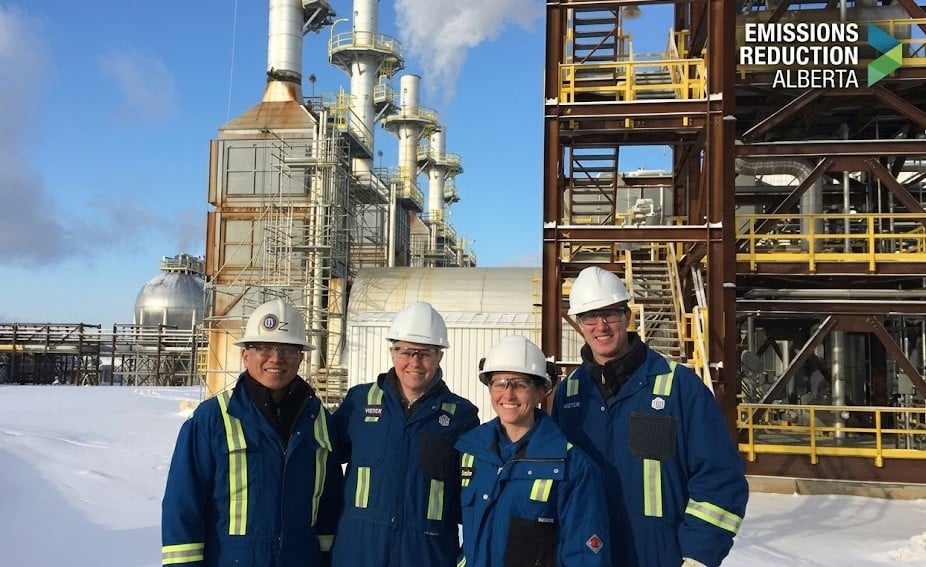
The largest single award in Alberta's newest round of clean technology funding is going to a company that wants to make fabric out of hemp stalks.
Zylotex Inc. received $3.75 million of the $15.7 million Emissions Reduction Alberta announced Tuesday for five Edmonton-area projects, and its own project value is $20.4 million, the biggest of the group.
The material it's working with is hemp bast, the fibrous outer layer of the stalk. Alberta grows a substantial amount of hemp, mostly for seed and oil, and the stalk is largely a waste stream. Zylotex is scaling up production of lower-emissions cellulose from that residue, aimed at commercial textiles now and what ERA describes as frontier materials later.
Regenerated cellulose is what viscose and rayon are. The global version of that process is chemically intensive and mostly happens in Asia. Doing it from Alberta agricultural residue is a different proposition, and it's the project in this group with the least obvious connection to the province's industrial base.
The rest of the money
Quantiam Technologies got $3.4 million on an $11-million project, developing technology to convert captured carbon dioxide and clean hydrogen into low-emissions methanol. Methanol is a feedstock for plastics and low-carbon fuels, which is the route by which captured CO2 ends up in everyday products rather than underground.
Mangrove Lithium got $3.075 million on a $12.3-million project, demonstrating delithiated beta spodumene as a low-carbon supplementary cementitious material in concrete. Delithiated beta spodumene is what's left after lithium is extracted from spodumene ore. Two industries, one waste stream.
"This project brings together critical minerals processing and cement manufacturing to address emissions in two important industrial sectors," said Saad Dara, founder and chief executive of Mangrove Water Technologies. "The support of the Government of Alberta through Emissions Reduction Alberta allows us to validate this technology at a meaningful scale and accelerate the path toward commercial deployment of low-carbon cement and battery materials."
Azolla Hydrogen got $3 million on a $12.5-million project, deploying a methanol-to-hydrogen fuelling system and a rapid deployment station to expand access to affordable high-pressure refuelling. Commercial hydrogen vehicles need 700-bar dispensing, and Alberta has very little of it.
VulcanX Energy got $2.5 million on a $10-million project for a next-generation methane pyrolysis reactor producing low-emission hydrogen and high-value solid carbon. Pyrolysis splits methane with heat instead of water, so there's no water input, no CO2 output, and the carbon comes out as a saleable solid.
Total project value across all five is roughly $66 million, meaning the province is covering just under a quarter.
On the numbers
Two figures in this announcement need reading carefully.
ERA says the projects will generate 504 person-years of employment. The province's release describes that as "more than 500 jobs." Those aren't the same thing. A person-year is one person working for one year, so the figure measures total labour across the life of the projects rather than positions created.
The emissions estimate is 4,700 tonnes of CO2 equivalent by 2030. Against ERA's own portfolio, which projects 28 million tonnes over the same period, that's negligible.
Which is what you'd expect from demonstration and scale-up funding. The case for these projects rests on whether the technologies get commercialized afterward, not on what the pilots themselves avoid. ERA is straightforward about this: recipients must publicly report outcomes including emissions reductions, job creation and lessons learned, and the final reports are published.
ERA also estimates $81 million in GDP contribution.
The part that isn't announced
ERA funding is milestone-based rather than a cheque handed over at announcement. Companies draw against agreed technical and commercial targets, and money stops if a project doesn't hit them.
Which means the $15.7 million figure describes what's been committed, not what will necessarily be spent. Some of these projects won't finish, and that's the design rather than a failure of it. Early-stage technology funding assumes a portion of the portfolio doesn't reach commercial deployment.
ERA has committed $1.19 billion across 364 projects since 2009. It publishes the outcomes of completed ones, including the disappointing ones, which is more than most public funding programs do.
Where the money comes from
TIER is Alberta's industrial carbon pricing system. Large emitters exceeding their benchmarks pay into the fund, and the province directs that revenue into emissions-reduction work.
ERA has administered it for 17 years, committing $1.19 billion across 364 projects with a combined value over $10.8 billion since 2009. Its portfolio-wide estimate is 28 million tonnes of CO2e reduced by 2030 and 82.6 million tonnes by 2050.
It's the same fund Alberta is drawing $400,000 from for its 100-year water security white paper, announced two weeks ago.
Environment and Protected Areas Minister Grant Hunter framed the announcement around the region rather than the technology. "The Edmonton region is already a powerhouse for innovation, manufacturing and industry," he said, adding that the projects advance hydrogen, advanced manufacturing and sustainable materials while attracting investment and creating jobs.
ERA chief executive Justin Riemer put it in terms of commercialization, saying decades of industrial expertise have made Edmonton a hub for turning innovation into action and that the projects help Alberta companies bring made-in-Alberta products to new markets.
Whether they do is answered in the outcome reports, which are public.
Sources
ERA Invests $15.7 Million in Five Edmonton Technology Projects — Emissions Reduction Alberta, August 25, 2026
Big ideas being built in Edmonton — Government of Alberta, August 25, 2026







Comments
Conversation