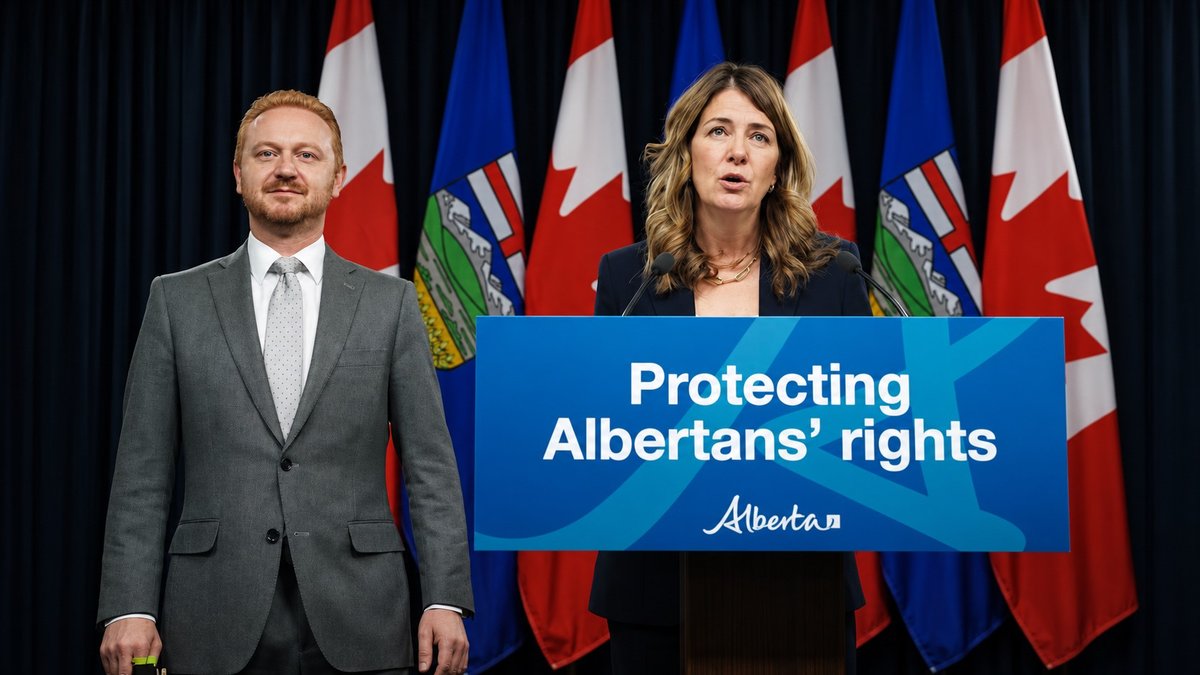
Alberta plans to use the Sovereignty Act to push back against a federal law that removed a decades-old defence for good-faith religious opinions in certain hate speech cases.
Premier Danielle Smith and Justice Minister Mickey Amery announced the motion Tuesday, Nov. 24. It targets Bill C-9, the Combatting Hate Act.
"I don't think anyone wants to see their pastor or their rabbi or their imam monitored in their sermons or arrested and prosecuted," Smith said.
It's the first time Alberta has used the Sovereignty Act against the hate law. The fight over the bill's religious defence started in December 2025, but until now, the province had only lobbied against it and issued guidance to police and prosecutors.
Ottawa says the Charter already protects religious expression. Prosecutors still have to prove that someone wilfully promoted hatred to get a conviction.
So the real question is what the motion would add to the rules Alberta's prosecutors already follow.
What the motion says
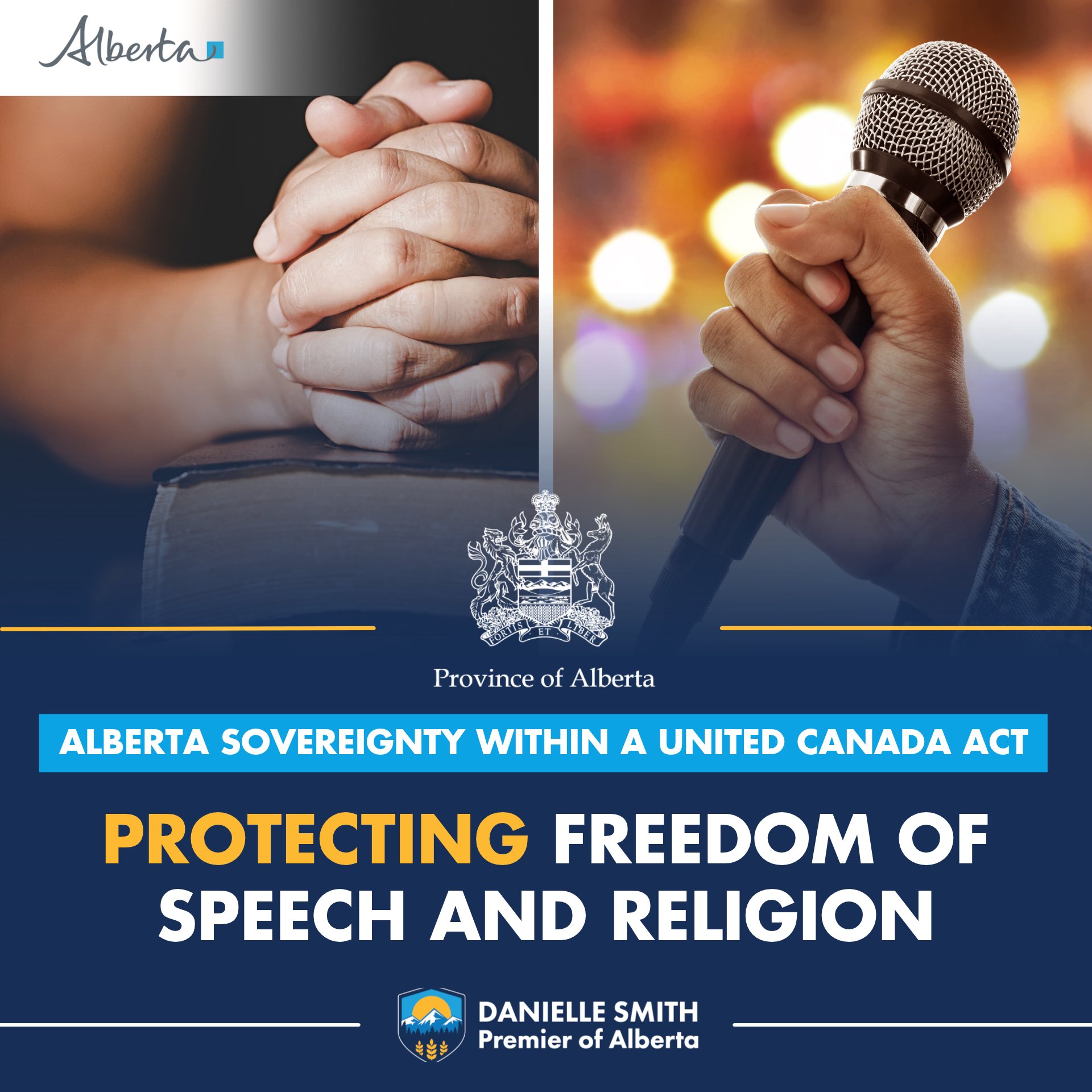
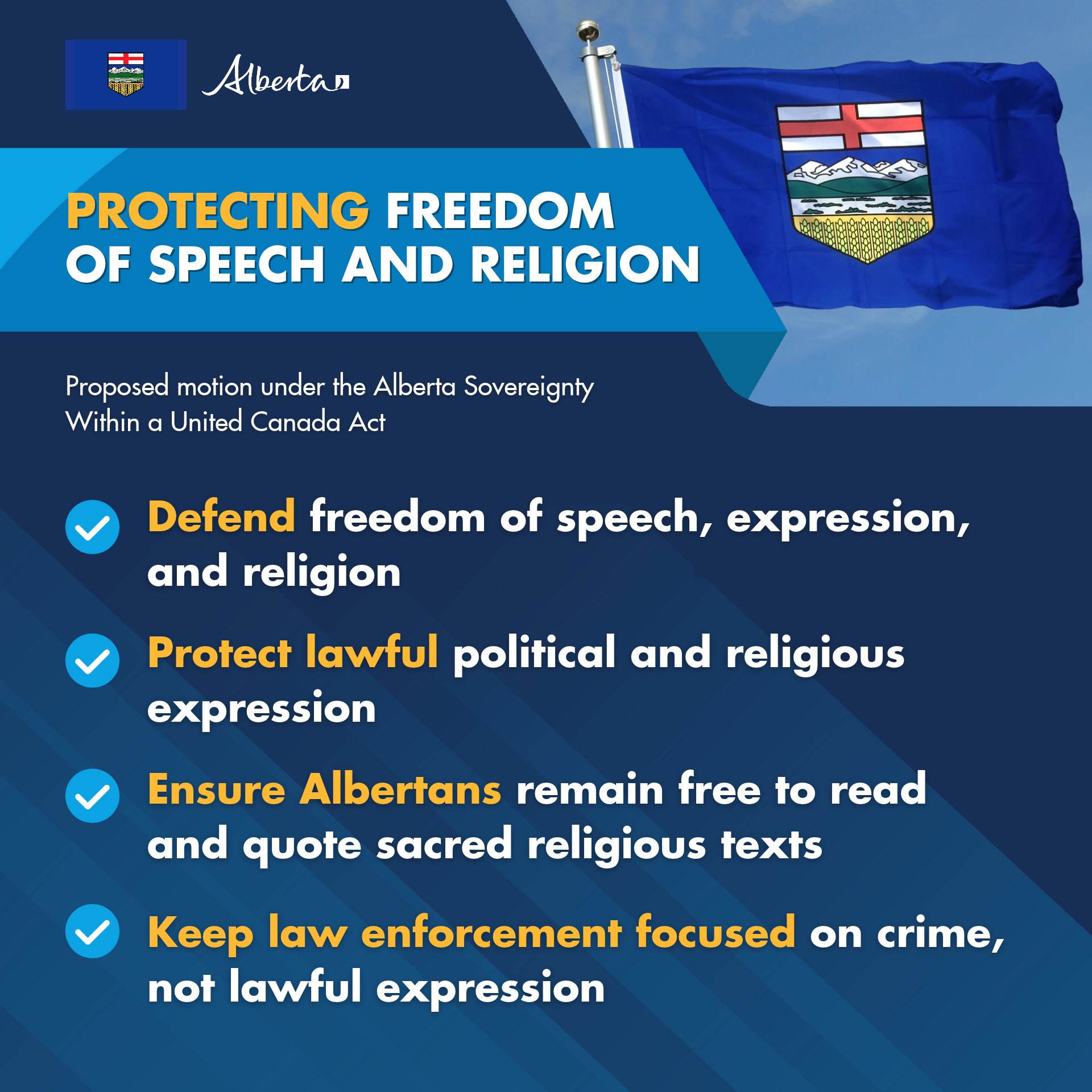
The government says it has introduced a motion under the Alberta Sovereignty within a United Canada Act. The motion affirms Alberta's commitment to fundamental freedoms and "urges lawful steps to protect Albertans from the impacts of the federal Combatting Hate Act."
"Removing this protection creates uncertainty and risks chilling lawful religious expression," the government said in a social media post. "Alberta will not police nor prosecute opinions."
The province says the motion takes into account the Alberta Bill of Rights, the Charter and the Criminal Code. It also says it will keep prosecuting hate propaganda, violence and other crimes.
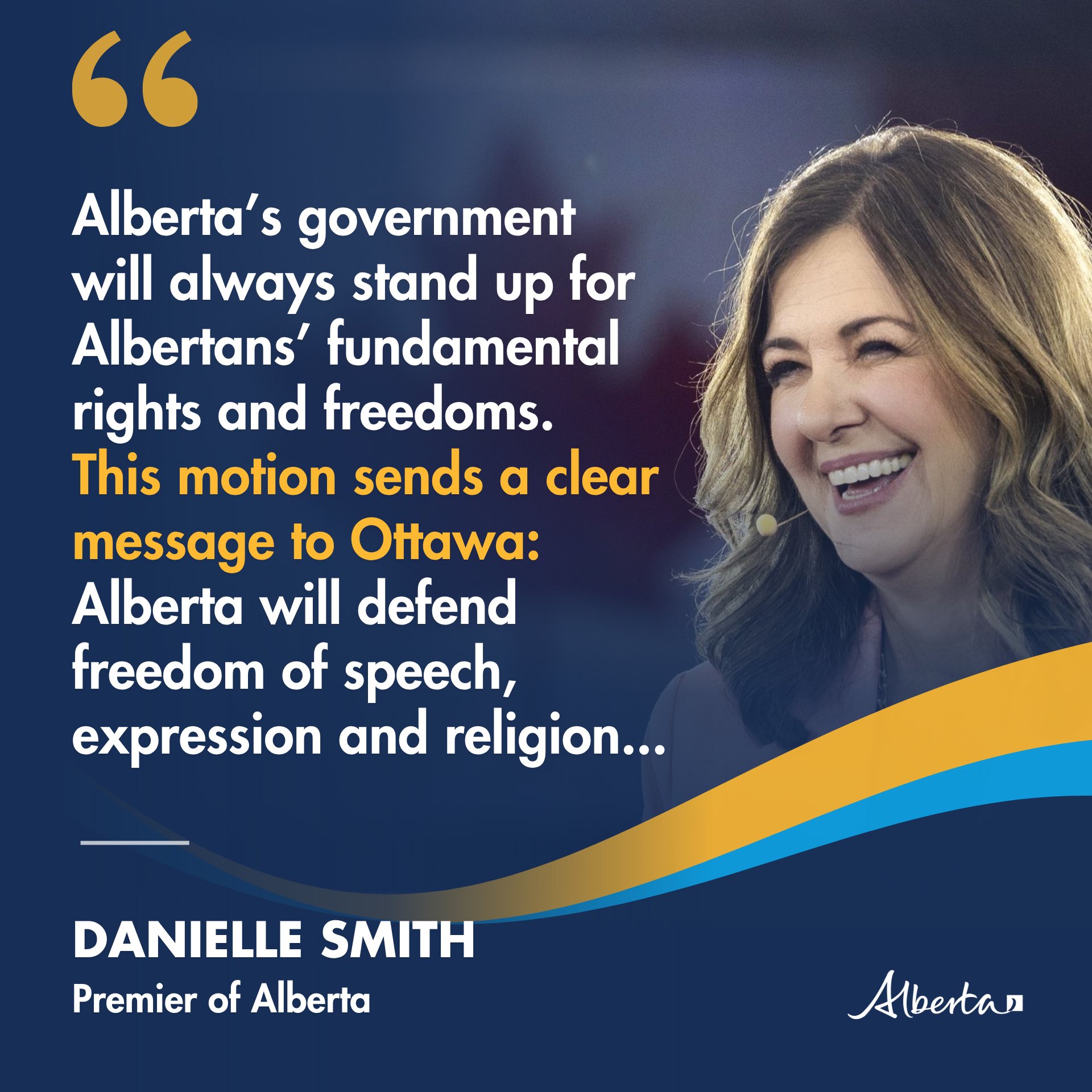
"You do not have to share someone's faith to defend the freedom to practice it or the freedom to speak about it," Smith told reporters.
MLAs still have to debate the motion and vote on it.
What Bill C-9 changed
C-9 received royal assent on June 18, 2026, and took effect on July 18.
The religious defence
Since 1970, the Criminal Code had protected someone who, "in good faith, ... expressed or attempted to establish by an argument an opinion on a religious subject or an opinion based on a belief in a religious text."
C-9 removed that defence from two offences:
Wilfully promoting hatred against an identifiable group
Wilfully promoting antisemitism by condoning, denying or downplaying the Holocaust
The original bill didn't include the change. It came from a Bloc Québécois amendment. The Bloc made it a condition of its support, and Liberal MPs voted for it at the House of Commons justice committee in December 2025.
The rest of the law
C-9 also:
Makes it a crime to intimidate people to keep them away from, or to block access to, places of worship, schools, community centres and other spaces mainly used by an identifiable group
Creates a hate crime offence for crimes motivated by hatred based on traits like religion or race
Bans wilfully promoting hatred by publicly displaying two Nazi symbols, a noose or the symbols of listed terrorist groups
What prosecutors still have to prove
Removing the defence didn't lower the bar for a conviction.
Intent. Prosecutors must prove the person wilfully promoted hatred.
A new legal definition of "hatred." It's "an emotion of an intense and extreme nature that is clearly associated with vilification and detestation." Speech that only humiliates, hurts or offends doesn't meet it.
A new public-interest clause. Nothing in these offences stops someone from "communicating a statement on a matter of public interest, including an educational, religious, political or scientific statement," unless they're wilfully promoting hatred.
Consent. Proceedings for these offences require the attorney general's consent.
"The repeal of this defence does not criminalize religious expression, which is protected under the Canadian Charter of Rights and Freedoms," the federal Department of Justice says.
A spokesperson for federal Justice Minister Sean Fraser said that Ottawa agrees Canadians should be free to practise their faith and read scripture. "Those freedoms are protected by the Charter," the statement said.
What can Alberta actually do?
Parliament writes the Criminal Code. The federal law applies in Alberta no matter how MLAs vote. But provinces run most prosecutions, and Alberta has already used that power.
In August, after the Edmonton Police Service faced a free speech backlash over a campaign encouraging residents to report hate, Alberta's public safety minister directed police to focus on stopping crime, not policing opinions.
In September, Amery issued guidance telling Crown prosecutors to give significant weight to freedom of expression. Prosecutors were told not to lay charges just because someone expressed controversial, provocative or unpopular political or religious beliefs.
That guidance already covers a lot of what the motion promises. And because hate propaganda charges need the attorney general's consent, Alberta's prosecutors already have a gatekeeping role.
University of Alberta constitutional law professor Gerard Kennedy told CBC the motion will likely take the form of guidance to police and prosecutors, since an order would go too far. He also said there's a limit. If Alberta declines to enforce the law, Ottawa could step in and enforce it itself if it chose to.
Asked about the timing, Amery said Alberta spent months trying to stop Ottawa from removing the defence, then had to wait until the law took effect.

The Sovereignty Act's track record
The UCP passed the Act in 2022. MLAs have since used it against:
Federal clean electricity regulations, adopted February 2024
Ottawa's proposed oil and gas emissions cap, adopted December 2024
The federal firearms buyback program, adopted December 2025
University of Calgary law professors Nigel Bankes and Martin Olszynski called the first two motions a "paper tiger" and "political theatre." In their view, the motions did little to change Alberta's legal position, especially where Ottawa could apply its rules without provincial help.
The Act itself is being challenged in court. Onion Lake Cree Nation argues it conflicts with Treaty 6. Alberta has asked a judge to dismiss the case, and he has reserved his decision.
Faith leaders are divided
Many religious groups fought the change in Ottawa:
The Canadian Conference of Catholic Bishops warned it could have "a chilling effect on religious expression."
Toronto's Cardinal Frank Leo asked senators to clarify that reading, teaching and preaching religious texts isn't hate promotion.
ARPA Canada, a Christian advocacy group, criticized the government's "insistence on removing the religious defence clause."
In Edmonton, Rabbi Ari Drelich of Chabad Lubavitch told CBC he supports the general idea behind the federal law, but it has to strike a balance. Open disagreement is healthy, he said, but speech with "a sinister motive" that could lead to violence is "a very big problem."
Nenshi: "Red meat to the base"
Alberta NDP Leader Naheed Nenshi said the threat the motion targets hasn't happened.
"We've never seen any pastors hauled away on criminal charges for what they say at the pulpit, and it's not going to happen," he said.
He pointed out that C-9 passed in June after a long public debate, and that the motion comes days before the UCP annual general meeting in Calgary.
"They need to throw some red meat to the base," Nenshi said. "So they're trying to open yet another chapter in the culture wars."
Closer to home
Alberta has had its own debates about where free speech ends and hate begins.
Besides the Edmonton police campaign, a racist banner on Highway 779 northwest of Edmonton prompted calls this summer for a hate speech investigation.
What happens next
MLAs will debate the motion in the legislature. If it passes, cabinet can act on the steps it lists. Its wording will show whether Alberta wants to go beyond the guidance prosecutors already follow.
We'll update this story after the vote.








Comments