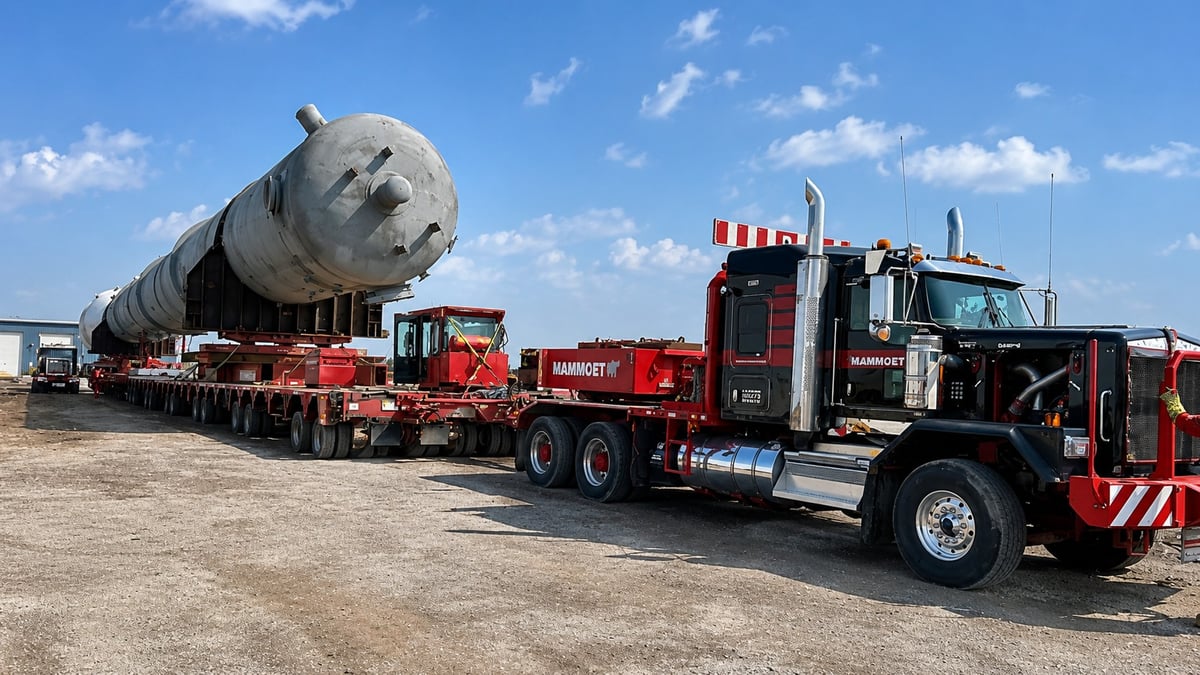
Sometime around 4 a.m. Thursday, a machine longer than a CFL field will pull out of a yard in Tofield and start crawling toward Fort Saskatchewan at the speed of a bicycle.
The province put out a formal travel advisory for it, and once you see the numbers, you understand why. The load is a C3 splitter, a distillation column bound for the Dow site northeast of Edmonton, and it measures 138 metres long, 7.2 metres wide and 10 metres high. With its support equipment it weighs 897,992 kilograms, just shy of 900 tonnes, roughly two fully loaded Boeing 747s. The trailers underneath it carry 544 wheels.
It will travel at a maximum of 30 km/h, with guide vehicles, using the entire width of the highway including the shoulder. If you're anywhere on its route Thursday, you're not passing it. You're waiting.
The route and the timing
The move runs as a single day trip, July 23, from about 4 a.m. to a planned 2 p.m. arrival. From Dacro's facility at 6204 46 Avenue in Tofield, the load takes Airport Road eastbound, 46 Avenue southbound, then Highway 14 eastbound, Highway 834 northbound, Highway 15 westbound, and Range Road 220 northbound into the Dow site.
The practical translation for drivers: Highway 14 east of Tofield in the early morning, Highway 834 through mid-morning, and Highway 15 through the corridor toward Fort Saskatchewan as the day goes on are the stretches to avoid or budget serious extra time for. Live conditions are on 511.alberta.ca, the 511 app, or by dialling 511 in Alberta, and crews will be flagging and escorting the whole way.
Notice the route itself is a small puzzle solved. It heads east to go north to go west, because a load this size can't take just any road. Every bridge, overpass, powerline crossing and corner along the way had to be checked and cleared in advance, and the winding path is the one that fits.
What a C3 splitter actually is
The cargo is more interesting than "industrial equipment" suggests. A C3 splitter is a fractional distillation column, a tower that separates propylene from propane by boiling point, producing the high-purity propylene that petrochemical plants turn into plastics. The polypropylene in your car's bumper, your yogurt containers and half the packaging in your house starts its life in a column like this one.
The reason it moves in one enormous piece instead of sections is precision. Distillation columns are built, tested and sealed as complete units because the internals have to be exact, so the whole tower travels assembled, lying on its side across a train of trailers.
And those 544 wheels aren't showing off. Spread across that many contact points, the weight per axle drops low enough that the highway underneath survives the trip. It's the same reason snowshoes work.
The move took months before the wheels turned
A trip like Thursday's is measured in hours, but it was planned in months.
A load this far past normal legal dimensions moves under a special provincial permit, and earning one means proving the trip is survivable, by the load and by the province. Route surveys walk every kilometre in advance: bridge load ratings checked against 898 tonnes, overhead powerlines measured against 10 metres of height, intersection turning radii tested against 138 metres of length, which is why the route zigzags east and north before coming west. Somewhere along Thursday's path there are likely powerlines being temporarily lifted and signs coming down ahead of the load, then going right back up behind it.
The 4 a.m. start is part of the same engineering. Ten hours at 30 km/h covers the distance with margin, and every hour before the morning rush is an hour the guide vehicles aren't managing traffic. By the time you see it inching along Highway 15, the interesting part is mostly over. The convoy is just executing a plan that's been driven, measured and signed off long before the wheels ever turned.
Why 4 a.m., and why this keeps happening here
Super loads move at dawn to burn the emptiest hours of the road, and they move in summer because frost-softened spring roadbeds and heavy loads don't mix, Alberta's road ban season exists for exactly that reason.
This corridor sees more of these moves than almost anywhere in Canada. The heavy industrial belt running through to the refineries and petrochemical plants of Alberta's Industrial Heartland means gigantic vessels, towers and modules regularly crawl these highways at walking speed, and Thursday's is a big one even by that standard. The destination is the Dow site near Fort Saskatchewan, home to one of the largest industrial expansions in the province, which is why hardware on this scale keeps arriving.
There's a quiet made-in-Alberta note in the route, too. The load isn't coming off a ship. It's leaving a yard in Tofield, which means a 900-tonne piece of world-scale petrochemical equipment was completed by Alberta hands about an hour from where it will spend its working life.
If you want to see it
Plenty of people will. A 138-metre load on 544 wheels is the kind of thing central Alberta pulls over lawn chairs for, and the 30 km/h pace makes it easy to catch. The ask from the crews is the obvious one: watch from well off the highway, don't stop on the shoulder, that's the load's lane Thursday, and give the guide vehicles room to work. The 2 p.m. arrival at Range Road 220 will be the slow-motion finale.
Sources:
Government of Alberta, Super-heavy load impacts travel in central Alberta, July 22, 2026: https://www.alberta.ca/release.cfm?xID=965427211251D-A5C7-4E89-E69A49F6C2F6C8AA
Alberta 511: https://511.alberta.ca







Comments
Conversation