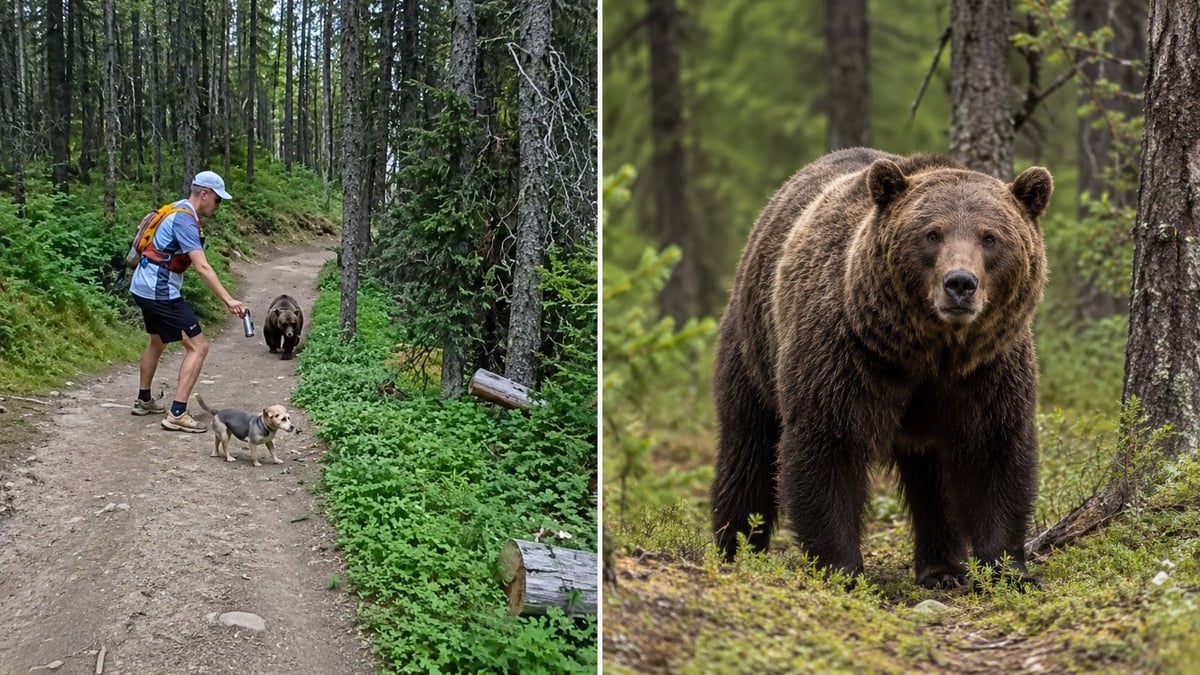
The video looks like a bear stalking two hikers. Parks Canada saw something else: a dog off its leash, and a grizzly that did nothing wrong.
Two hikers have been charged after their roughly 90-second video, filmed July 19 on the Taylor Lake trail west of Castle Junction, spread across social media. In it, a grizzly ambles down the trail toward them as they back away, one holding bear spray, the other filming and calling for their small dog, Lola, who runs between the people and the bear, barking. The clip ends with the hikers still retreating and the bear moving off.
Parks Canada wardens identified the hikers and charged them under Section 5 of the National Parks of Canada Domestic Animal Regulations, for having an off-leash dog. The fine for that offence can reach $25,000.
The bear has a number, and a hard year
The grizzly in the video isn't anonymous. Parks Canada believes it's Bear 142, a productive breeding female well known in the region, and one who lost a cub to a train back in May.
That matters to how you watch the footage. Despite the dog barking and running at her, and two people in her path, No. 142 showed no aggression toward the hikers or the dog. She walked the trail she was on. A breeding female with a rough year, doing nothing but existing on her own habitat, became the co-star of a video framed as a terrifying encounter, and she's the one with the most to lose from it.
Why a breeding female matters more than most bears
Grizzlies reproduce slowly, which is the biological fact underneath why Parks Canada tracks bears like No. 142 so closely. Females don't breed until they're four to six years old, produce small litters only every few years, and invest years raising each set of cubs. A single productive breeding female is worth far more to a threatened population than her numbers suggest, and Alberta's grizzly bears have been listed as a threatened species provincially since 2010.
That's the quiet stakes in this story. Losing a cub to a train in May was already a hit to the region's slow-growing bear population. A conflict sparked by an off-leash dog, the kind that can get a bear relocated or destroyed, would compound it. The leash rule is, in part, grizzly conservation policy wearing the clothes of a pet bylaw.
Why the dog is the whole problem
The charge lands on the off-leash dog for a reason that runs opposite to most people's instinct. The danger in that video wasn't mainly to the hikers. It was to the bear, and to any dog reckless enough to bark at a grizzly.
Parks Canada's explanation is direct: bears and other wildlife may react aggressively toward dogs they see as threats, and that can end with the dog injured or dead, and a bear that's now been in a conflict. Off-leash dogs also stress wildlife into avoiding the habitat and food they need. A dog running loose at a grizzly is the fastest way to turn a calm bear into a dangerous one. The leash rule protects the animal in the video as much as the people.
Dogs must be on a leash of three metres or less at all times in Canada's national parks. Not a backcountry guideline, everywhere, all the time.
What the hikers did right, and the one thing they didn't
The video shows some real presence of mind. They backed away rather than ran. They kept facing the bear. One had bear spray out and ready. Those are the correct instincts, and they're the difference between a scary video and a tragedy.
The single failure is the leash. Every other good decision in that clip was made harder by a dog loose in the middle of it, splitting the hikers' attention, agitating the bear, turning a manageable encounter into a viral one. The charge isn't about the fear in the video. It's about the choice that created the situation.
How to actually handle a bear on the trail
Since the video will have people picturing themselves in it, the guidance is worth stating plainly. If you encounter a bear, don't run, running can trigger a chase and you can't outrun a grizzly. Stay calm, speak in a low voice, and back away slowly while keeping the bear in sight, which is close to what these hikers did. Keep bear spray accessible, not buried in a pack, and know how to use it before you need it.
The prevention list Parks Canada and Alberta Forestry and Parks repeat every summer is short: hike in groups, stick to official trails, make noise so you never surprise a bear, keep dogs leashed at all times, and carry bear spray. It's also illegal to feed, entice or disturb wildlife in a national park, again with fines up to $25,000.
The theme connecting all of it is simple. The rules exist less to protect you from the bear than to protect the bear from us, because in a conflict, the animal is usually the one that pays. No. 142 walked away from this one. Not every bear in her position does.
Sources:
Parks Canada, statement on Taylor Lake trail charges, July 24, 2026
Parks Canada, National Parks of Canada Domestic Animal Regulations and dog leash rules
Alberta Forestry and Parks, bear safety guidance and grizzly bear status







Comments
Conversation