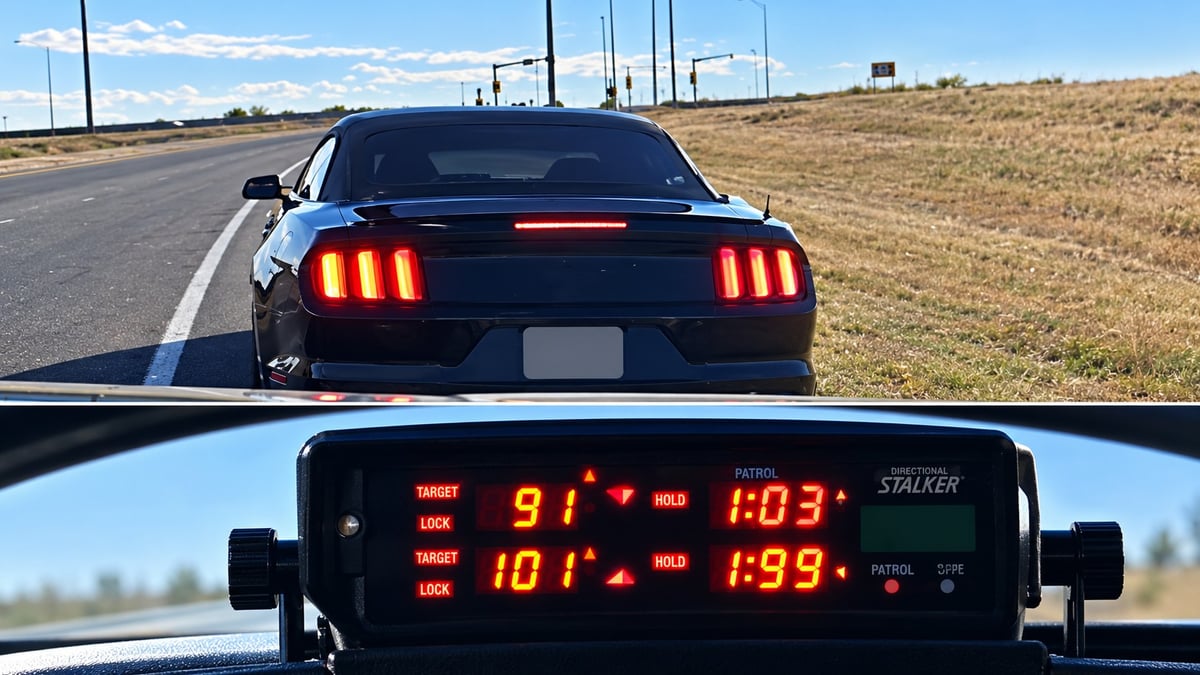
Calgary police caught the same driver speeding twice in the same stretch of Stoney Trail.
The first radar reading was 189 km/h in a 100 km/h zone, near Glenmore Trail S.W., just before 6 p.m. on Saturday, Oct. 17. That’s 89 km/h over the limit.
The driver slowed down, but not by much. Police say radar caught them again at 165 km/h while changing lanes, still 65 km/h over.
Now they’re headed to court.
The charges
Police say the driver was summoned to court for:
Careless driving
Speeding
Failing to produce a driver’s licence
Police haven’t released the driver’s age or details about the vehicle. The charges haven’t been proven in court.
“Excessive speed puts everyone on the road at risk,” Calgary police wrote on X. “Slow down & make safe choices behind the wheel.”
Why there’s no ticket to pay
Most Alberta speeding tickets come with a set fine. That stops at 50 km/h over the limit, where the ticket costs $744.
At 51 km/h over or more, there’s no set fine. The driver has to go to court, and a judge decides the penalty.
The first reading put this driver 89 km/h over. Even the second, at 165 km/h, would have meant a court date on its own.
Could the driver lose their licence?
If the driver is convicted on both speeding and careless driving, that’s six demerit points for each, or 12 in total.
A fully licensed driver in Alberta is suspended at 15 points within two years. Twelve points would leave them three short, unless they already have points on their record.
A driver on a graduated licence is suspended at eight points. For them, 12 would be over the line.
Police haven’t said what kind of licence this driver holds.
Second time this fall on Stoney Trail
This isn’t the fastest driver police have caught on the ring road this fall.
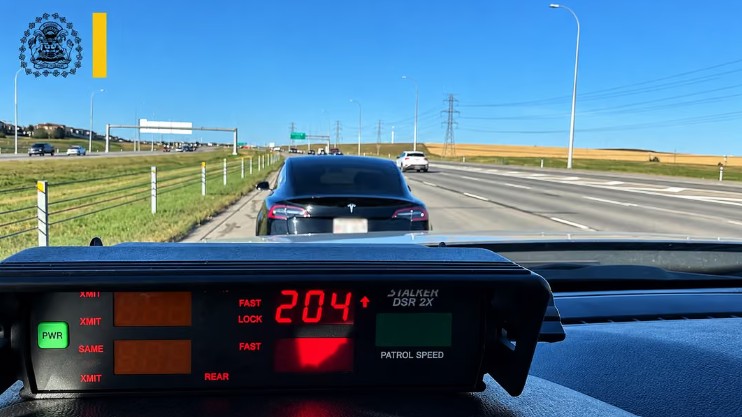
On Sept. 20, Calgary police clocked a driver at 204 km/h on Stoney Trail N.E. near Deerfoot Trail, 104 km/h over the limit. That driver faced speeding, careless driving and illegally tinted windows. Read more about the 204 km/h Stoney Trail driver.
It hasn’t stopped there.
On Oct. 4, police caught a driver going 90 km/h in a 50 km/h construction zone with road crews on site. Police said the driver was impaired by cannabis. The driver faces $2,320 in fines, a 30-day vehicle seizure and up to 15 months of licence restrictions. Read more about the construction zone case.
On Oct. 7, police say a learner driver was clocked at 146 km/h in an 80 km/h zone on Glenmore Trail with no qualified supervisor in the car. Read more about the Glenmore Trail learner driver.
That’s four extreme speeding cases in Calgary in about a month.
What is Vision Zero?
Calgary police ended their post with a link to the City’s “Drive to Zero” campaign. That’s the public face of Vision Zero.
The idea is simple: no one should be killed or seriously hurt on Calgary roads. The goal is zero.
The City says the need is urgent. In 2025, 15 pedestrians were killed on Calgary roads. That’s the most in 11 years, and a 225% jump from the year before. Another 20 motorists died.
“That is more than one person a month dying in a collision on Calgary roads,” the City says. Fatal collisions involving drivers and pedestrians have been rising since 2017.
The plan behind it
For the first time, the City and Calgary police are working from one shared plan: the Safer Mobility Plan for 2024 to 2028.
Its target is to cut major injuries and deaths on Calgary roads by 25% over those five years.
The plan follows what’s called the Safe System Approach. It treats road safety as four connected parts: safe roads, safe speeds, safe road users and safe vehicles. It starts from a few principles:
Deaths and serious injuries are unacceptable.
People make mistakes, and the system should leave room for that.
Safety is everyone’s responsibility.
Speed is the part drivers control directly.
What Calgary is actually doing
The City says it made progress in 2025 on several changes:
A new Traffic Safety Team: trained peace officers working with Calgary police. They target speeding near schools and in playground zones, noisy vehicles, unsecured loads and vehicles with blocked visibility.
Leading pedestrian intervals: walk signals that turn on a few seconds before drivers get a green light, so pedestrians are already in the crosswalk and easier to see.
In-street crosswalk signs: signs placed in the middle of the road to slow drivers at crossings.
Corridor safety improvements: redesigns on roads like Kensington Road.
Community Speed Watch: volunteers who track speeds in playground zones and residential streets.
The City also asks drivers to take a pledge: obey the limit every time, slow to 30 km/h in playground zones from 7:30 a.m. to 9 p.m. even when no kids are around, and put the phone away.
Why speed matters so much
At 189 km/h, a car covers about 52 metres every second. At 100 km/h, it’s about 28 metres.
That’s an extra 24 metres every second before a driver even reacts to a brake light, a merging car or debris on the road.
“The time you ‘save’ is tiny compared to the danger you create,” the City says.
For the driver on Stoney Trail, the next stop is court.
Sources
Calgary Police Service on X, Oct. 22, 2026:
City of Calgary, Vision Zero / Drive to Zero: https://www.calgary.ca/VisionZero
Government of Alberta, Fines for speeding: https://www.alberta.ca/speeding-fines-in-alberta.aspx
Government of Alberta, Demerit driving suspension: https://www.alberta.ca/demerit-driving-suspension.aspx




Comments
Conversation