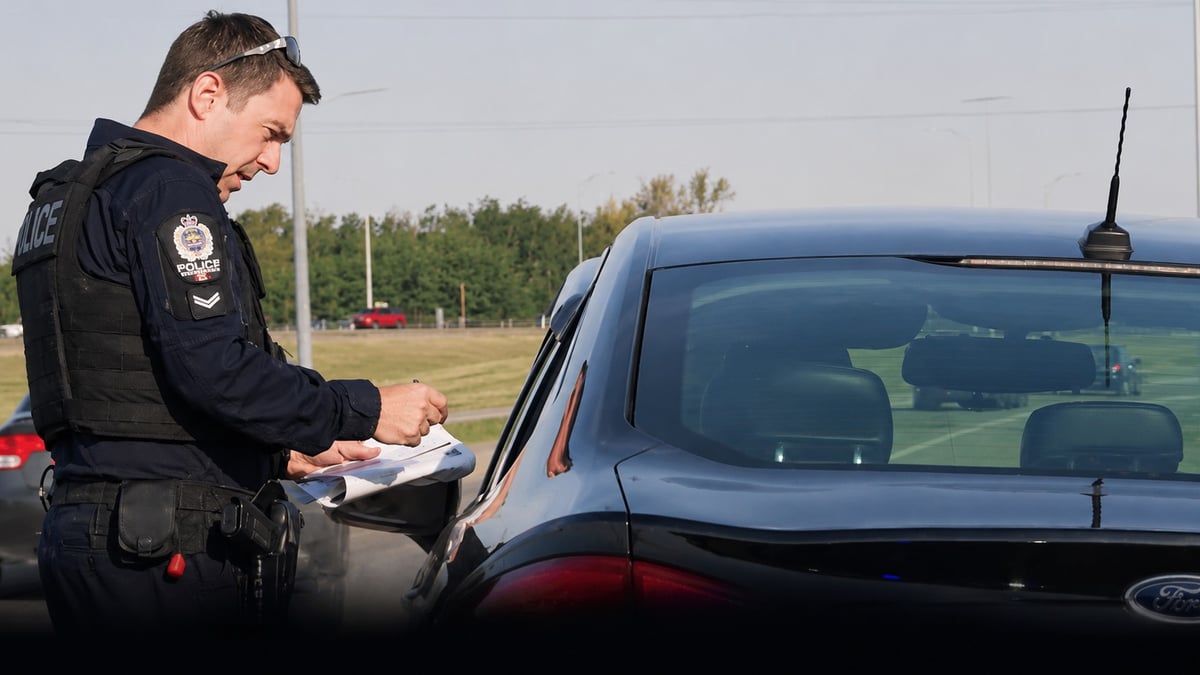
The officer expected to find a young driver behind the wheel.
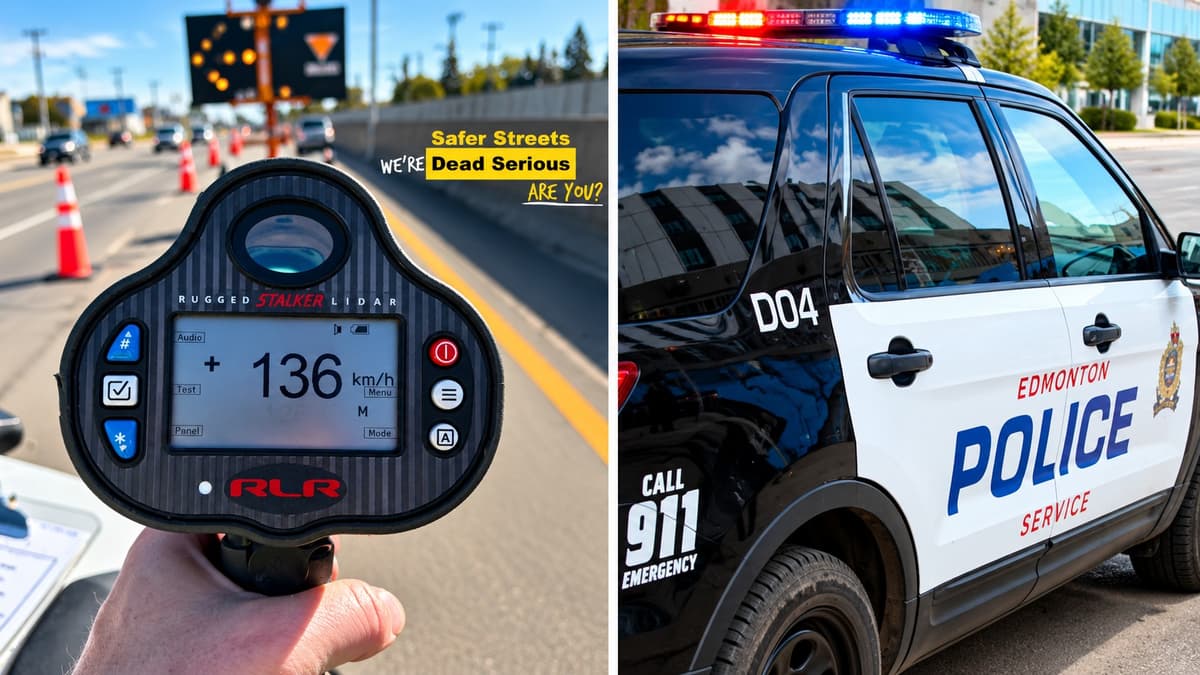
"Oh, 128, 130, 133, 134, 147," he says in the video as the radar reading climbs. The posted speed limit on that section of Whitemud Drive is 80 km/h, meaning the vehicle was allegedly travelling 67 km/h over it.
Edmonton police released footage of the traffic stop as part of its High Flyer Friday series. After pulling the vehicle over, the officer checked the driver's licence.
"Born in 1947. So he's 79 years old."
Why the driver received two charges
The officer says the speed alone was not the only concern. "I don't do this often, but he is going to get careless driving and the speed today," he says. "There were several near misses."
The two charges address different parts of the alleged conduct. The speeding charge relates to the recorded speed of 147 km/h in an 80 zone, while the careless driving charge relates to how the vehicle was allegedly being operated, including the near misses and the officer's allegation that the driver cut off other vehicles.
"You are being charged under the Traffic Safety Act for careless driving and speeding," the officer tells him. "Two separate offences."
Neither allegation has been proven in court.
There is no preset ticket amount
The officer also explains why the driver cannot simply pay a standard speeding ticket. "The speed in which you were travelling and the manner in which you were driving require you to attend court," he says. "There is no fine associated to this."
More precisely, there is no preset voluntary-payment amount written on the ticket. In Alberta, travelling 51 km/h or more over the limit results in a mandatory court appearance, and any fine or other penalty is determined by the court rather than by the province's regular speeding-fine schedule. A judge may impose a fine and can consider additional consequences available under provincial law.
At 147 km/h in an 80 zone, the alleged speed was 16 km/h beyond that mandatory-court threshold.
The gap between what these charges sound like and what they produce is something we examined earlier this year, after a driver was clocked at 212 km/h on Anthony Henday Drive and was able to keep driving: A Driver Was Clocked at 212 km/h on Edmonton's Anthony Henday Drive. Alberta Law Let Him Drive Away.
The possible demerit consequences
Careless driving carries six demerit points upon conviction, and speeding at the upper end of Alberta's schedule carries its own points on top of that.
Demerit points are not added when a charge is issued. They are applied on the date of conviction and remain on a driver's record for two years. A fully licensed Alberta driver receives a cautionary notice after accumulating at least eight but fewer than 15 points, and reaching 15 points within two years results in an automatic one-month suspension for a first demerit suspension.
What penalties this driver may ultimately face will depend on what happens in court. EPS has not disclosed his existing driving record.
What travelling at 147 km/h means
At 147 km/h a vehicle travels approximately 40.8 metres every second, roughly 18.6 metres farther each second than a vehicle travelling at the posted limit of 80.
Speed also changes the severity of a potential collision. For the same vehicle, kinetic energy increases with the square of speed, so at 147 km/h the vehicle carries approximately 3.4 times the kinetic energy it would at 80. That doesn't mean every crash would produce exactly 3.4 times the damage, since collision angle, braking, vehicle design and what gets struck all matter. But the additional speed gives a driver less time to react and substantially increases the energy that has to be dissipated in a crash.
Whitemud Drive adds another concern, because drivers there regularly encounter merging traffic, changing lanes and vehicles entering from closely spaced interchanges.
Why Edmonton police released the video
The officer ends the interaction with a warning. "If you continue to drive like that, you're going to injure or kill yourself or someone else, and I would hate to see that happen," he says. "It's just, this is the unacceptable behaviour that we need to deter and stop."
That message is the point of the series. EPS publishes a recurring feature called High Flyer Friday across its social media accounts, highlighting traffic stops, unusual enforcement cases and safety messages, with the stated purpose of showing the consequences of dangerous driving and encouraging safer behaviour. Speeding is among what police describe as the Fatal Four driving behaviours, alongside impaired driving, distracted driving and failing to wear a seatbelt.
The footage offers more detail than the brief summaries police normally release after excessive-speed stops, capturing both the radar reading and the officer's reaction after learning the driver's age.
Why the driver's age stands out
The unusual part of the stop is not that an older driver was charged, since traffic laws and speed limits apply regardless of age. What makes it noteworthy is the officer's recorded reaction, having initially expected a young driver before seeing a birth year of 1947 on the licence.
Alberta requires drivers with a regular Class 3, 5, 6 or 7 licence to submit a medical examination report at age 75, again at 80 and every two years after turning 80. The requirement does not automatically restrict anyone from driving and is intended to identify medical or functional conditions that may affect driving ability. A dangerous driving allegation also does not, by itself, establish that a driver has a medical condition.
Police, physicians, family members and members of the public can report a driver-fitness concern to the province where there is a specific medical or physical safety concern, and a review can lead to requests for medical information, functional assessments or a road test. EPS has not said whether the driver in this case was referred for one.
What happens next
The driver was issued mandatory-court charges for speeding and careless driving. The court will determine whether the charges are proven and, if there is a conviction, what penalties should follow. There is no standard fine he can pay in advance to resolve the speeding allegation.
No collision was reported in connection with the stop.
Sources
High Flyer Friday — Edmonton Police Service
Speeding fines — Government of Alberta
Demerit driving suspensions — Government of Alberta
Driver medical fitness — Government of Alberta





Comments
Conversation