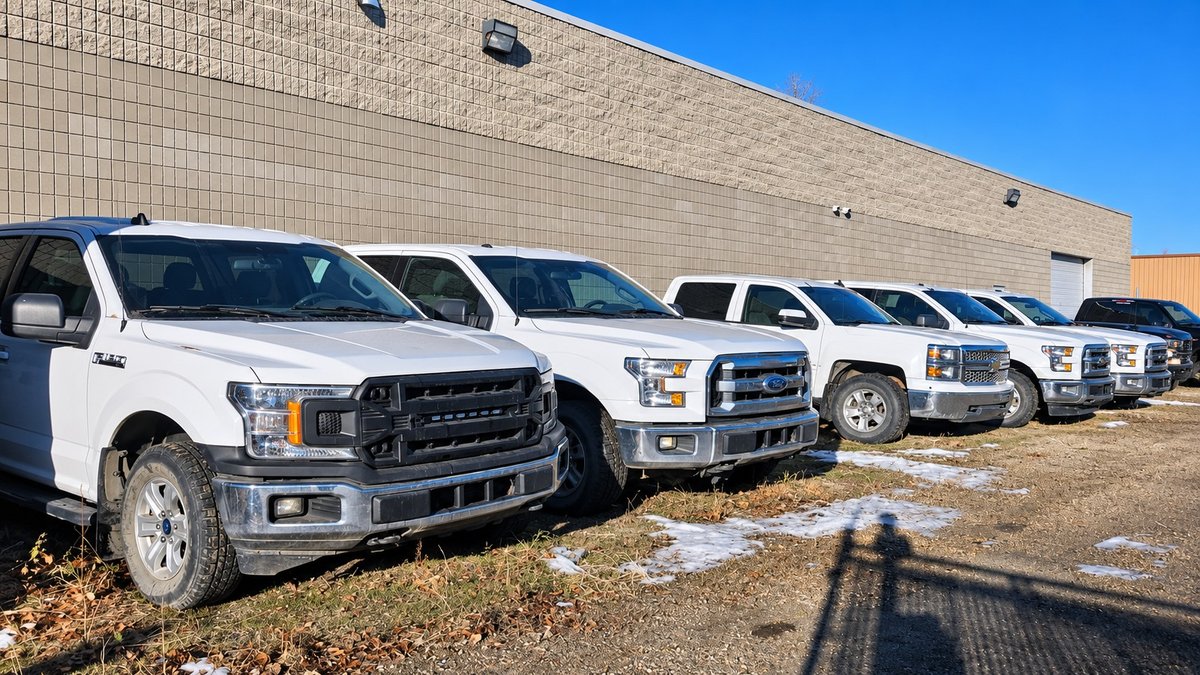
Ottawa paid an Edmonton scrap yard to destroy 950 retired RCMP vehicles.
Police say hundreds of them were never destroyed. They were sold across Canada or loaded up and shipped overseas instead.
Alberta RCMP announced the result Wednesday after a two-year investigation into what they call one of the biggest players in the province’s stolen vehicle market. Five men from Edmonton and St. Albert are charged. One of them has been identified as the president of the recycling company that held the federal contract.
“This group was responsible for driving a significant portion of the market for stolen vehicles in Alberta,” Staff Sgt. Luke Halvorson said.
Investigators also linked more than 80 other stolen or illegally exported vehicles to the group, worth about $6 million. They found four million illegal cigarettes in an Edmonton warehouse.
None of the charges has been proven in court.
How 950 police cars ended up at a scrap yard
Starting in spring 2025, GC Surplus, the federal program that disposes of government property, awarded contracts to Penny Metal Recycling in northwest Edmonton. The job was to scrap 950 decommissioned RCMP vehicles.
The vehicles were supposed to be destroyed and sold for parts, never put back on the road. Police haven’t said which RCMP divisions they came from.
Halvorson said the contracts went through “normal procurement processes,” and nothing at the time suggested a problem. There were “checks and balances,” he said.
In November 2025, investigators found that hundreds of the vehicles had been obtained under false pretences. Police allege someone connected to the recycling company committed fraud to make it look like the vehicles had been crushed.
Police haven’t said exactly how many of the 950 were diverted, how much money changed hands or how many are still unaccounted for. Halvorson was blunt about the ones that went overseas: tracking them down is “a lost cause.”
Why the cars were supposed to be crushed in the first place
Until 2021, the RCMP sold its old cruisers at government auction like any other fleet.
That changed after former police vehicles started turning up in the wrong hands. In April 2020, the gunman in the Nova Scotia mass shooting drove a replica RCMP cruiser built from a retired police car. He killed 22 people. In January 2021, after two incidents of people using former police vehicles to impersonate officers, the federal government suspended sales of decommissioned RCMP vehicles.
The RCMP’s own review in July 2022 found the safeguards weren’t consistent. Procedures varied between divisions. Oversight got murky once vehicles went to third-party contractors. Records showing whether police markings and equipment had been removed were often incomplete. Reviewers looked at sale photos for 11 vehicles, and eight still showed at least one sign they’d been police cars.
The RCMP runs about 12,000 vehicles and retires roughly 1,500 a year. After the freeze, most of those had one destination: the crusher.
The Edmonton contract was supposed to be part of that safeguard. Police now allege it was where the safeguard broke.
That 2022 review doesn’t prove the same weaknesses caused what happened in Edmonton. But it shows Ottawa knew this was a risk years before these contracts went out.
Police haven’t said whether any of the diverted vehicles were used to impersonate officers.
The company is barred from federal work until 2034
Penny Metal Recycling Ltd. is on Public Services and Procurement Canada’s list of ineligible suppliers. Its ban runs from April 7, 2026, to April 7, 2034. That’s eight years.
The listing gives the company’s address as St. Albert. The yard that handled the RCMP contracts is in northwest Edmonton.
Jamal Andy Ghnaim, 34, of St. Albert, has been identified in Edmonton Journal reporting as the company’s president. He’s charged with theft over $5,000, fraud over $5,000, trafficking in property obtained by crime and obtaining property under false pretences.
The federal listing confirms the ban. It doesn’t say why, and it doesn’t establish criminal wrongdoing on its own. Nobody from the company has commented publicly.
$6 million in other stolen vehicles
The RCMP cars were only one piece. Police say the same network stole vehicles across Alberta, changed their identification numbers, resold them in Canada and shipped them overseas.
The method is called re-VINing. The VIN from a legitimate vehicle, often a wreck, gets put on a stolen one. To a buyer or a registry, the stolen car now looks clean.
“Historically, Alberta has been a province that sees auto crime used as a conveyance,” Halvorson said. In other words, cars got stolen to commit other crimes. “More and more, we’re seeing auto theft being used as a commodity.”
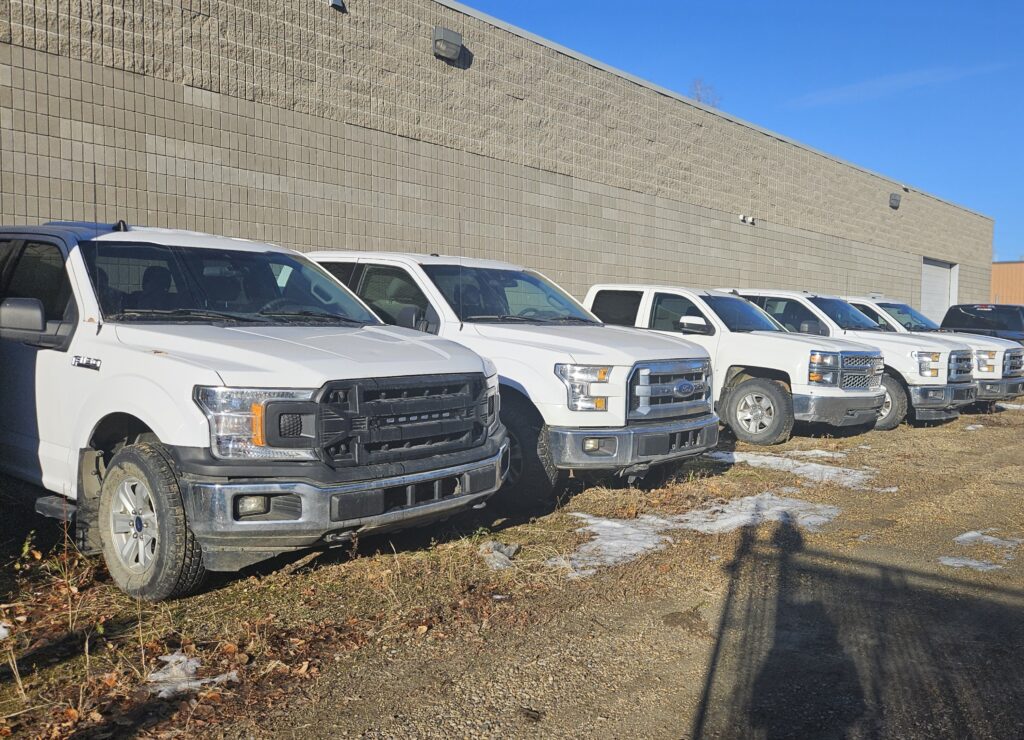
Not counting the RCMP vehicles, police tied more than 80 stolen, fraudulently obtained or exported vehicles to the group. Search warrants between December 2025 and March 2026 recovered several, including former RCMP pickups found at an impound lot. Most of the rest are believed to be overseas or already resold under new numbers.
Inside Canada, police can flag suspect VINs to registries and other forces. Once a car leaves the country, getting it back is much harder.
Four million cigarettes in a warehouse
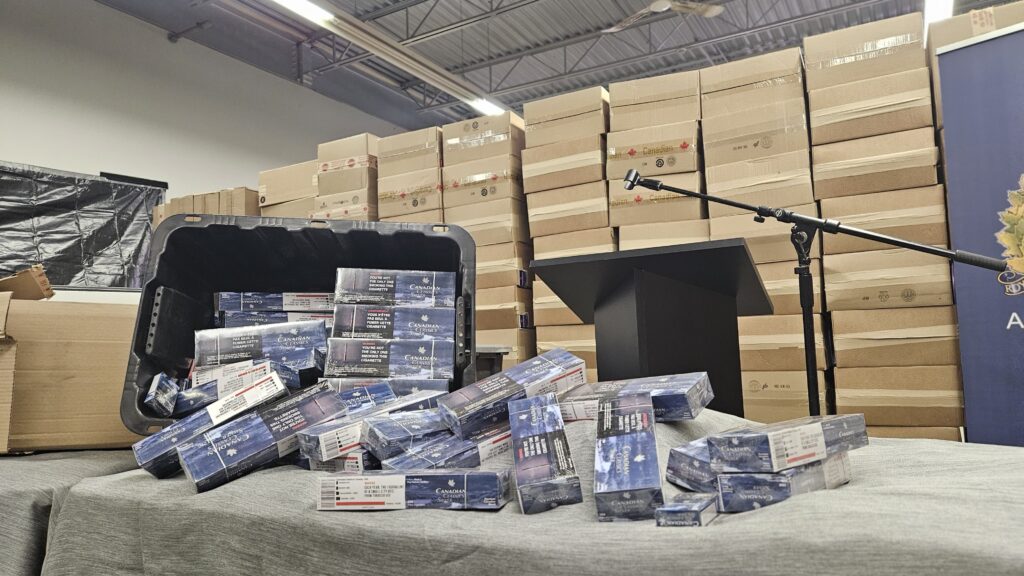
The investigation also led police to an Edmonton warehouse stacked with pallets of contraband cigarettes, more than four million of them.
RCMP put the legitimate retail value at $3.7 million. On the black market, they’re worth more than $1 million, with about $400,000 in unpaid tax.
Two of the five men are charged only in the tobacco case.
Who’s charged
Mohamed Mark Hajar, 41, Edmonton: 11 counts of trafficking in property obtained by crime and eight counts of smuggling under the Customs Act.
Peter Huy Nguyen, 41, Edmonton: possession of stolen property over $5,000.
Jamal Andy Ghnaim, 34, St. Albert: theft over $5,000, fraud over $5,000, trafficking in property obtained by crime, obtaining property under false pretences.
Ghassan Fayad, 47, Edmonton: possession of unstamped tobacco.
Hamzee Fayad, 41, Edmonton: possession of unstamped tobacco.
Hajar and Nguyen are due in Alberta Court of Justice in Edmonton on Nov. 16. The Fayads have been released and will appear later.
The man at the centre won’t see court
The investigation started in June 2024. That’s when RCMP’s auto theft unit zeroed in on a man they believed had been involved in organized vehicle crime in Alberta for more than a decade.
Following him led investigators to the wider network. Police say they gathered enough evidence for fraud, smuggling and money laundering charges.
They never got to lay them. He died before charges could be laid, Halvorson said, “as a result of criminality.” Police won’t name him.
Edmonton police, the Canada Border Services Agency and B.C.’s auto crime team worked the case with RCMP. Halvorson said the investigation is ongoing and more charges are possible.
What’s still missing
This is the part that should bother people.
Police have recovered some vehicles. They haven’t said how many of the 950 were actually destroyed, how many were sold in Canada or how many left the country. They haven’t said where the exported ones went, or whether any are driving on Alberta roads today.
These weren’t ordinary used cars. They were government property under a destruction order written because of what happened the last time former police cars got loose.
It’s also the second major VIN fraud case out of Alberta RCMP in 16 months. In July 2025, seven people faced nearly 100 charges for allegedly using the province’s registry system to put fake VINs on stolen cars.
For now, five men are charged, the company is shut out of federal work until 2034, and police are still trying to account for cars that were never supposed to drive again.






Comments