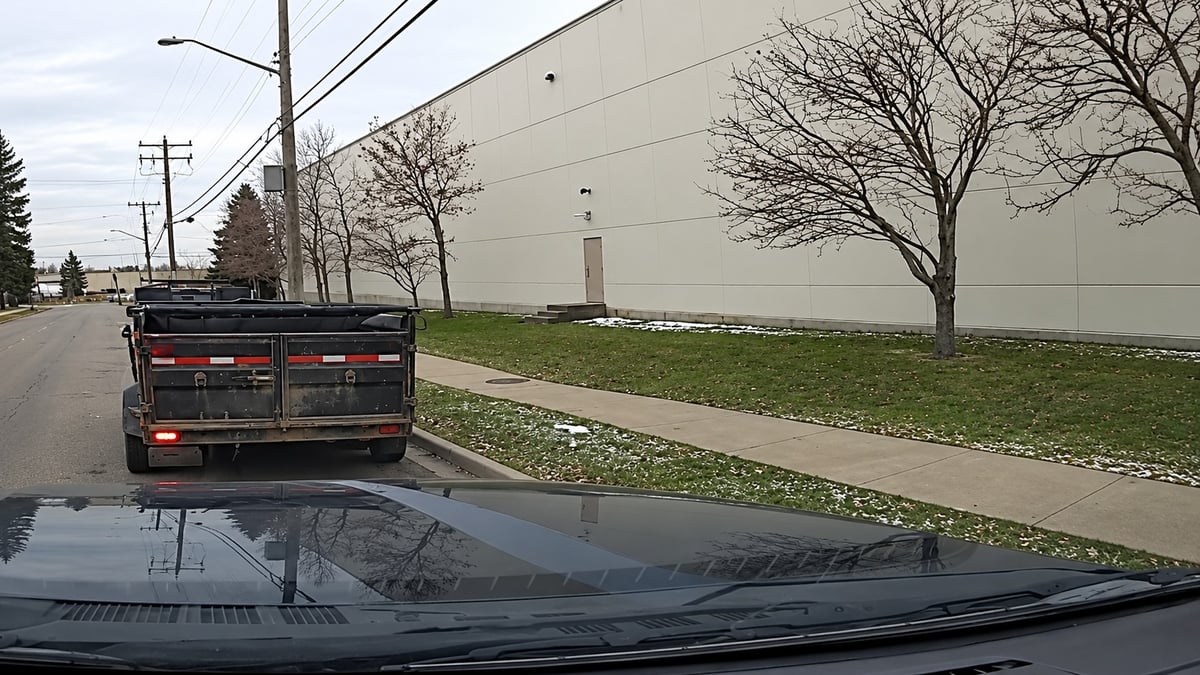
The truck was allowed to carry 4,500 kilograms. It was carrying 7,800.
Calgary police pulled over a commercial truck and trailer at 1:15 p.m. on Friday, Oct. 30, and the inspection went downhill from there. The trailer wasn’t registered. Three tires were defective. The parking brake didn’t work. The cargo was loose. A hub seal was missing. And the trailer’s breakaway system, the backup that’s supposed to stop the trailer if it comes off the hitch, wasn’t properly connected.
Both the truck and the trailer were towed. The driver was issued five tickets.
“Properly maintained, safely loaded commercial vehicles are essential to keeping everyone on our roads safe,” police wrote on X.
Police didn’t say where the stop happened, what the truck was hauling, or who it belonged to. None of the tickets has been proven in court.
Why 4,500 kg is the number that matters
That weight limit isn’t random. In Alberta, 4,500 kg is the line where a vehicle stops being a pickup and becomes a commercial vehicle in the eyes of the law.
Anything registered above it falls under the National Safety Code. That means an annual mechanical inspection, a carrier safety rating, and for heavier units, a pre-trip check the driver is supposed to do every day. Stay under 4,500, and most of that doesn’t apply.
Police didn’t say why this truck’s limit was 4,500. But a vehicle registered under the line and running at 7,800 kg is 73 per cent over its own limit, and carrying the kind of weight that the inspection rules exist for.
Extra weight shows up in the brakes and tires first. Which is where this truck was already failing.
What each defect means
Three defective tires. A blowout on a loaded trailer at highway speed is how trailers end up in the ditch, or in the next lane.
Parking brake didn’t work. On a loaded unit, that’s the difference between a truck that stays put on a grade and one that rolls.
Loose cargo. Unsecured loads are a leading cause of debris on Alberta highways. Police can ticket for it even when nothing has fallen off yet.
Missing hub seal. The seal keeps grease in the wheel bearing. Without it, the bearing runs dry and can seize or burn.
Breakaway system not connected. If the trailer separates from the truck, the breakaway cable is supposed to lock the trailer’s brakes. Unhooked, a detached trailer just keeps going.
Unregistered trailer. No registration usually means no insurance, either.
Any one of those gets a vehicle pulled out of service. This truck had all six, plus the weight.
Most trucks police target like this fail
Calgary police run a commercial vehicle unit that goes out most days looking for exactly this, and twice a year it runs three-day blitzes with Alberta Sheriffs and the Commercial Vehicle Safety Alliance.
The results are consistent. When the unit targets trucks it expects to fail, the out-of-service rate runs in the mid-to-high 80s, a Calgary police traffic sergeant who’s also a CVSA inspector has said. The most common failures are brakes and loose steering joints.
In February, a joint operation at the Airdrie inspection station north of the city checked 23 trucks. Twenty failed. Fifteen couldn’t be fixed on site and were pulled off the road for good.
Province-wide, Alberta Sheriffs ran more than 15,000 commercial inspections in 2025 and removed more than 4,000 vehicles from the road.
“These are killing machines if they’re not being paid attention to,” the co-owner of a Calgary heavy-truck repair shop said after the Airdrie operation.
Part of a busy fall for Calgary traffic police
The truck stop is the latest in a string of enforcement posts from Calgary police this fall.
Five days earlier, on Oct. 25, a Kia was clocked at 111 km/h in a 60 zone on 96 Avenue N.E., one kilometre an hour past the point where a ticket becomes a court summons. On Oct. 17, a driver hit 189 km/h on Stoney Trail near Glenmore Trail, then got caught again at 165 while changing lanes. On Oct. 14, a learner driver was clocked at 146 km/h on Glenmore Trail with nobody supervising.
The speeders get the headlines. The overloaded truck is the one with six separate ways to hurt somebody else.
Drive to Zero
Police ended the post, as they usually do, with a link to the City’s Drive to Zero campaign, the public face of Calgary’s Vision Zero strategy. The goal is no deaths or serious injuries on city roads.
In 2025, 15 pedestrians were killed on Calgary streets, the most in 11 years, and 20 motorists died. Under the 2024 to 2028 Safer Mobility Plan, the City and police are aiming to cut major injuries and deaths by 25 per cent.
A truck with no parking brake and three bad tires, carrying nearly double its limit, is the kind of thing that plan is written for.









Comments