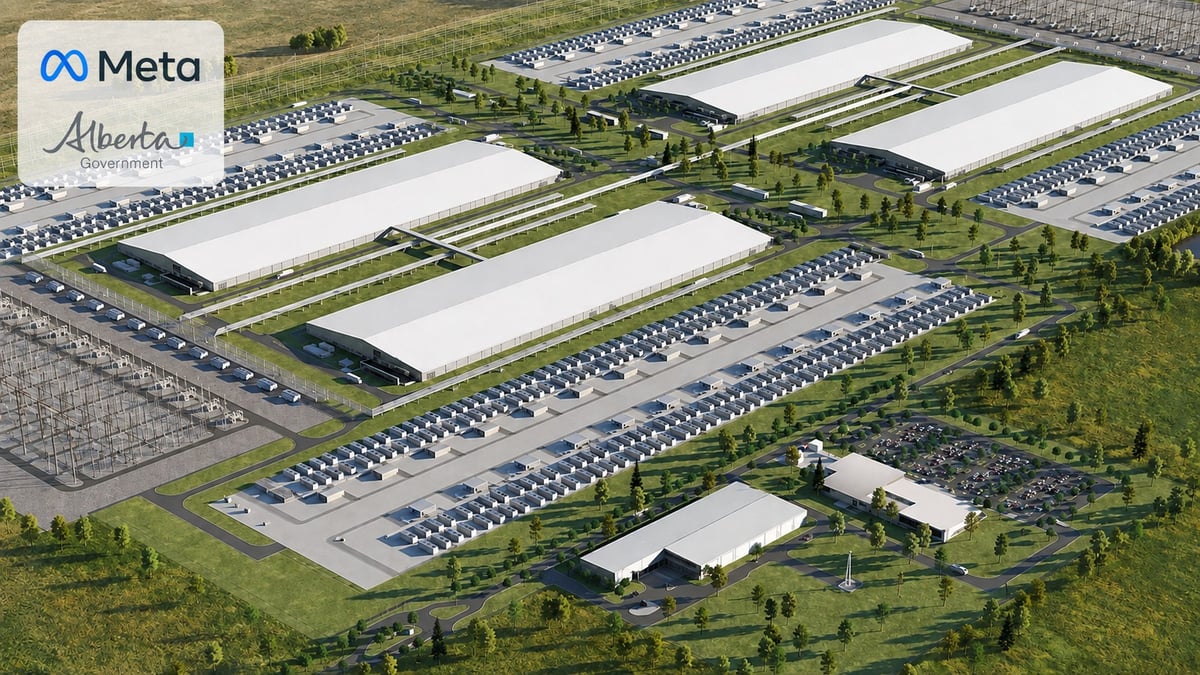
Alberta's government said its first hyperscale data centre would lower what households pay.
New analysis says your bill could go up by as much as $39 a month.
What the numbers actually are
The Pembina Institute estimates Meta's Sturgeon County facility could add $267 to $462 a year to a typical Alberta household's electricity bill between 2027 and 2031. That's 15 to 25 per cent.
The components explain how it gets there.
Pembina calculates the project would lower transmission fees by about $13 a year, while energy costs rise by $282 to $477, depending on how often the Meta facility runs during peak demand hours.
The province has pointed to a six per cent reduction on the transmission portion of bills. Pembina confirms that figure is real. It works out to roughly a dollar a month.
"What the government said is kind of technically true, but it misses part of the story," said David Pickup, Pembina's director of electricity.
Where the money sits on your bill
An average Alberta household spent about $1,700 on electricity in 2025.
Energy made up 40 per cent of that. Distribution 23 per cent. Transmission 18 per cent. Rate riders and administration 14 per cent. Taxes five per cent.
The six per cent cut applies to the transmission slice. The projected increase hits the energy slice, which is more than twice as large.
Why one customer moves everyone's price
Alberta buys power hour by hour, and the price in each hour is set by the last and most expensive plant needed to meet demand.
Add a customer using nearly as much power as the city of Calgary, Pickup said, and more expensive plants get called on. Everyone pays more until new ones are built.
That's the market design working as intended, not a malfunction.
The gap between the data centre and its power plant
The timing is the mechanism.
Under Alberta's data centre regulation, in force since June 9, a large project can connect to the grid before the power plant meant to supply it is built.
Meta signed a long-term agreement with Capital Power in July, which will let it draw from the Alberta grid as early as summer or fall 2028. Capital Power sold Meta 250 megawatts.
Its own plant, the Greenlight Electricity Centre, isn't expected in service until 2030.
For at least its first year, Pembina's report says, the data centre will draw entirely on the Alberta grid.
"The main reason why this kind of cost spike exists is because there's a time lag between when the data centre comes online and when the power plant comes online in order to sort of meet that new supply," Pickup told CTV News Edmonton.
Greenlight is a $4.6-billion, 932-megawatt gas plant being built by a consortium of Pembina Pipeline Corp., Morgan Stanley and Calgary's Kineticor Asset Management. Pembina Pipeline and the Pembina Institute are unrelated organizations.
Meta and the province call it speculation
Meta rejected the analysis directly.
"This is a speculative report based on hypothetical and assumptions," spokesperson Stacy Yip said in a statement to the Edmonton Journal.
"Here's the truth. Meta pays the full cost of energy upgrades and electricity that our Sturgeon County data centre will use," Yip said, adding those costs would not be passed on to Albertans. "We are fully funding new generation and grid infrastructure to support our data centre, which will improve reliability across the entire Alberta grid and drive downward pressure on costs for Albertans."
The Ministry of Affordability and Utilities went further.
"Pembina Institute's analysis is designed to intentionally fearmonger and divide Albertans," a statement said, arguing the report conflates the wholesale price with the retail rates households actually pay.
"Their analysis deliberately ignores our government's ongoing work to enhance consumer protections, like stabilizing the default rate, which shields Albertans from wholesale market volatility."
The ministry said every Albertan has guaranteed access to a rate fixed for two years, with increases capped by regulation, and that a consumer would have to opt out of it to be exposed to wholesale swings. It also said the report failed to account for a competitive market where increased demand attracts new generation, which lowers prices.
Premier Danielle Smith defended the framework at a virtual town hall Thursday. "The first thing is we want to make sure it doesn't impact your electricity bills," she said. "What we said is, if you want to come to Alberta, you've got to have a plan to build your own power."
Pickup agreed fixed rates protect against short-term spikes, but added that "even those fixed prices over time are going to shift as well."
The grid operator's position
The Alberta Electric System Operator says it doesn't approve or regulate data centres, and that its role is ensuring safe and reliable connection.
On prices, it wrote: "Alberta's electricity market naturally creates an ebb and flow of prices through the fundamental principle of supply and demand; higher demand from new load is expected to raise pool (wholesale) prices, which is anticipated to attract new supply, thereby lowering pool prices."
The AESO added that large new loads contribute additional revenues to the transmission system, offsetting costs for existing customers, and that Albertans aren't billed at wholesale prices since retail rates are set by retailers.
It said the BYOG process is still being developed and that more information will come this fall.
What the utilities told the AESO
The concern isn't only Pembina's.
During AESO stakeholder consultations, EPCOR wrote that letting large energy users start up without their own power source would "almost certainly increase electricity prices."
"The AESO is essentially putting all other customers in the position of paying for the bridging option for large loads that take advantage of it through the BYOG process, through higher electricity prices," EPCOR wrote. "This is contrary to Government of Alberta messaging that data centres are bringing their own power and will not increase electricity costs for Albertans."
Direct Energy Marketing Limited wrote that the AESO hasn't demonstrated how the proposed limit was assessed from an affordability perspective, adding: "During stakeholder discussions, the AESO indicated affordability was not considered when determining the bridging limit."
Capital Power chief executive Avik Dey told analysts he could envision prices reaching $80 or $90 per megawatt hour by early 2028. TransAlta has forecast as high as $100 by 2029.
Capital Power also told shareholders on July 29 that clearer provincial rules on large loads have made investors more optimistic about Alberta.
Thirty-nine more are lined up
Meta isn't the end of it.
Thirty-nine large projects have requested connection to Alberta's grid, seeking roughly 20,000 megawatts between them. The AESO says the rules for connecting them are still being written.
Quebec and Ontario are considering a separate rate class for data centres. British Columbia is implementing a competitive bid process for new connections.
NDP Leader Naheed Nenshi called Thursday for the province to pause new applications until a robust impact assessment framework is complete.
What it means for your bill
Nothing yet. The estimate covers 2027 through 2031, and the data centre isn't operating.
Impacts will vary by provider and rate plan. Fixed-rate contracts insulate you for their term. Variable and regulated rates don't.
Alberta's Utilities Consumer Advocate publishes rate comparisons at ucahelps.alberta.ca.
Pickup's own framing on where this lands: "There are cases in which data centres can be an asset to the grid and reduce costs. The real difference is policy design."
Sources
New Meta data centre could add up to $460 a year to Albertans' electricity bills due to government policy — Pembina Institute, August 26, 2026
Pembina Institute, Footing the Bill
Alberta Electric System Operator, written statement
Ministry of Affordability and Utilities, statement
EPCOR and Direct Energy Marketing Limited, AESO stakeholder submissions
Meta's response and Greenlight consortium details as reported by the Edmonton Journal. AESO statement, Smith's town hall remarks and Nenshi's comments as reported by CTV News Edmonton.







Comments
Conversation