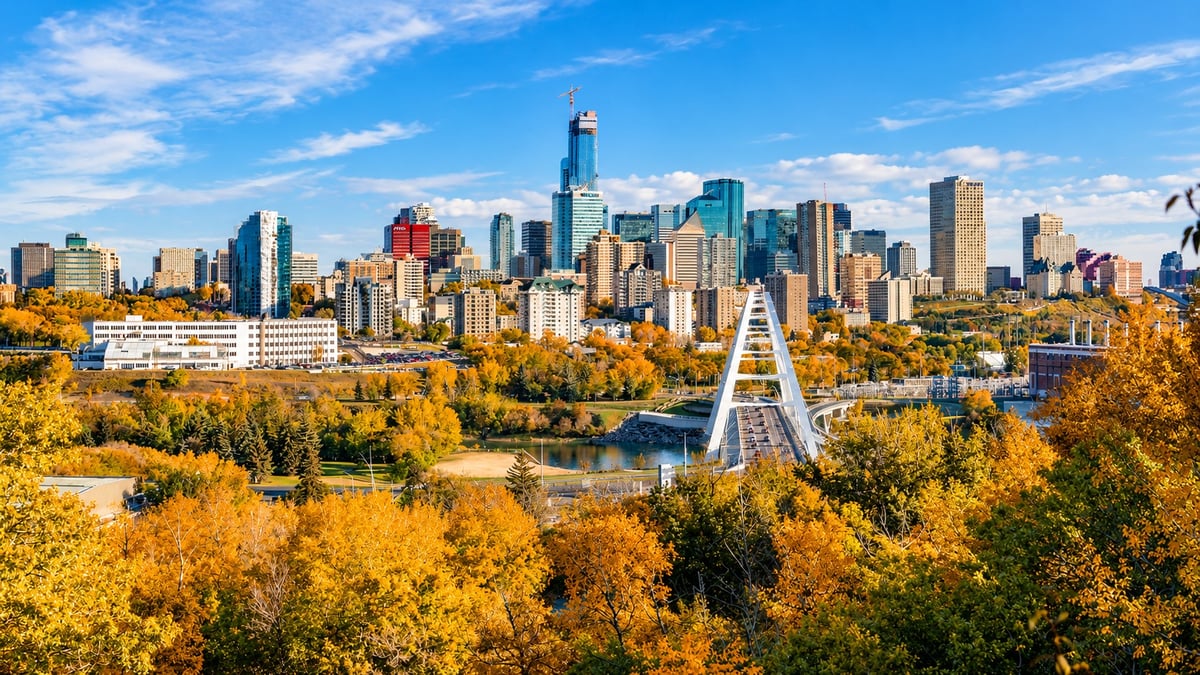
Calgary finished 56 places ahead of Edmonton in a new ranking of 1,000 cities around the world.
But when Oxford Economics picked the North American cities it expects to climb, Edmonton made the list. Calgary didn't.
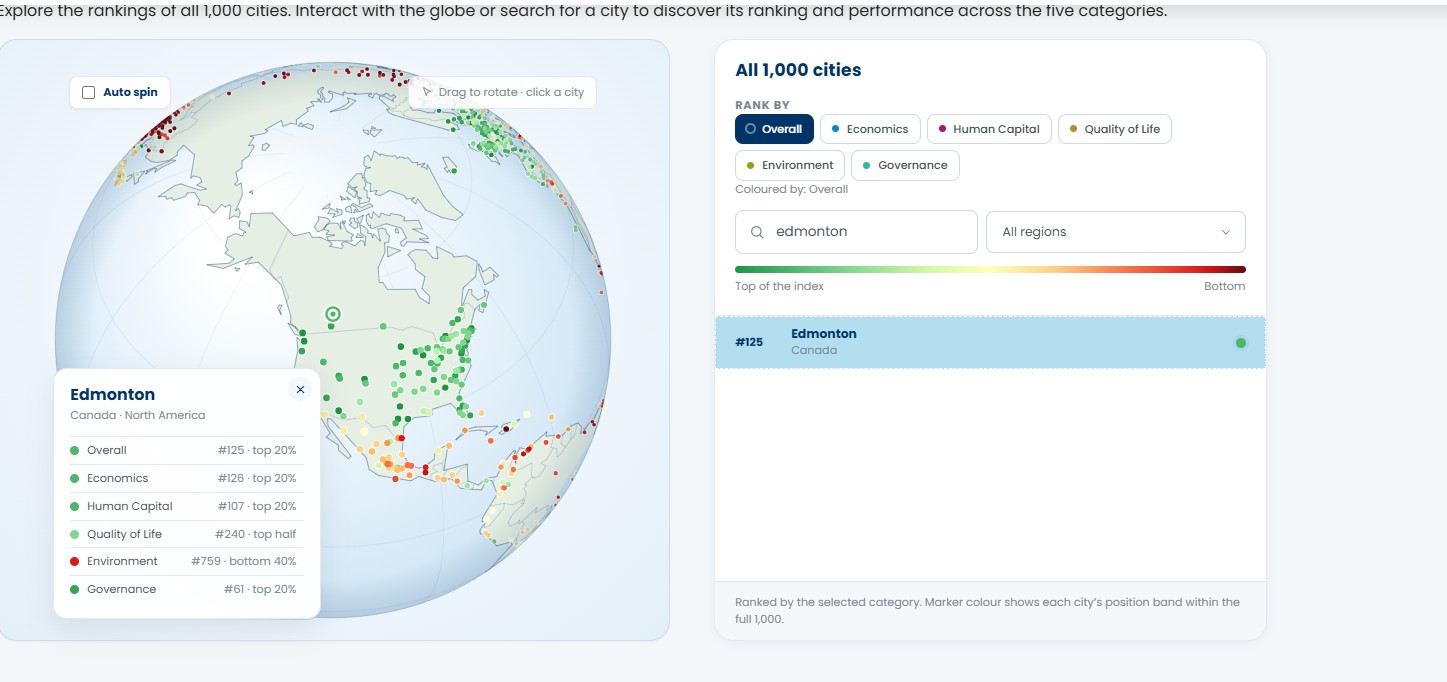
The 2026 Global Cities Index ranks Edmonton 125th. Calgary is 69th, Montreal 62nd, Vancouver 24th and Toronto 20th.
This year Oxford added a new section called Cities to Watch: five picks per region where it believes economic and demographic momentum will push cities up the rankings.
For North America, those are Edmonton, Boise, Durham, Jacksonville and San Antonio. Edmonton is the only Canadian city.
"These cities each have distinct strengths but are united by their productivity-led growth, an ability to move up the value chain, and their increasing strength in attracting innovative businesses and the highest-skilled workers," said Liam Sides, a director at Oxford Economics and the report's lead author.
What the mayor said
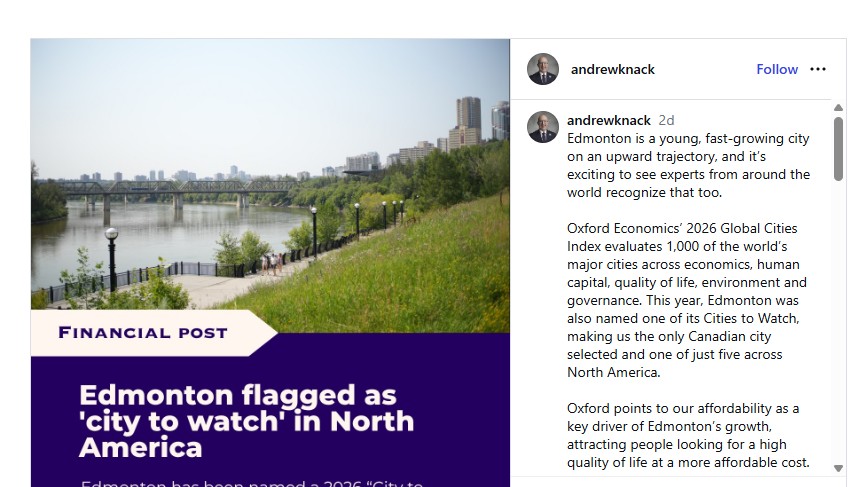
Mayor Andrew Knack welcomed the designation in a post on Instagram.
"Edmonton is a young, fast-growing city on an upward trajectory, and it's exciting to see experts from around the world recognize that too," Knack wrote.
He pointed to the same factor Oxford did.
"Oxford points to our affordability as a key driver of Edmonton's growth, attracting people looking for a high quality of life at a more affordable cost," he wrote. "We have incredible talent, expansive natural spaces and opportunities that continue to bring people here from across Canada and around the world."
Two different questions
The ranking and the watch list measure different things, which is how Edmonton can sit at 125th and still make the list.
The overall ranking asks where a city stands today. Cities to Watch asks where it's heading.
Oxford isn't calling Edmonton one of the world's top cities, or even Alberta's top-ranked one. It's saying Edmonton's current position may not capture its trajectory.
The growth behind the forecast
Oxford expects Edmonton's population and workforce to grow at the second-fastest rate of any city in Canada or the United States over the next five years.
That forecast sits on top of growth that's already happened.
Between July 2024 and July 2025, the Edmonton region grew by 3 per cent, the fastest of any census metropolitan area in Canada, according to Statistics Canada data analyzed by Edmonton Global.
That was 50,717 people in one year, and the third consecutive year the region added more than 50,000.
People are moving here from the rest of Canada
This is the number that stands out.
For the first time in a decade, the Edmonton region attracted more interprovincial migrants than any other metro in Canada.
That's growth from people already living in Canada choosing Edmonton, not only international immigration. International arrivals were strong too, with the region drawing almost 40 per cent more international residents than Vancouver over the same period.
Oxford also expects disposable incomes, already above the national average, to rise at one of the fastest rates in the country.
Edmonton's scores
Oxford grades cities across five categories. Edmonton's overall score is 68.0 out of 100.
Governance: 90.0. Its strongest category by a wide margin, ranking 61st of 1,000 cities.
Quality of life: 70.7.
Human capital: 61.6.
Economics: 59.6.
Environment: 49.0. Its weakest.
That 90.0 isn't a report card on City Council. Oxford's governance category covers institutional and political conditions across levels of government.
It's the region, not the city
When Oxford says Edmonton, it means the metropolitan economy, not the City of Edmonton's boundaries.
Oxford puts the region at about 1.7 million people, with GDP of roughly US$81 billion, or about US$48,200 per person. It classifies Edmonton as an industrial hub.
That matters because much of the region's industrial base sits outside city limits, in Strathcona County, Sturgeon County and the Industrial Heartland.
Oil is still central
Oxford doesn't pretend Edmonton has moved past energy.
"Recent developments, such as the expansion of the Trans Mountain Pipeline to transport more oil from Edmonton to the Port of Vancouver and proposed carbon capture projects by Alberta-based oil producers, suggest the city remains firmly invested in the future of fossil fuels," the report says.
"But as the world transitions to more sustainable energy sources, the city is well positioned to leverage its increasing dynamism for long-term growth."
The report calls oil and gas volatile, and credits the University of Alberta and the provincial public sector with providing a steadier research and employment base alongside it.
The affordability catch
Affordability was the first thing Knack highlighted, and Oxford does credit it as a reason people are arriving.
But in the same report, Oxford lists "high housing expenditure" as one of the city's weaknesses.
Both are true. Edmonton is far cheaper than Toronto or Vancouver, and housing still eats a large share of local household budgets.
For someone who bought a decade ago, "affordable Edmonton" still rings true. For a first-time buyer now, less so. And if Oxford's population forecast is right, that pressure increases.
The festival city counted too
Oxford also points to Edmonton's reputation as Canada's festival city, with food and cultural events running year-round.
It's part of the quality-of-life score, which covers what keeps people in a city as well as what brings them there.

Who topped the world
New York ranks first, followed by London and Paris, then Seattle, San Francisco, Dublin, Boston, San Jose, Tokyo and Zurich.
Europe and North America hold 78 of the top 100 spots, though Oxford expects much of the next few decades' growth to come from Asia. Shanghai, Beijing and Delhi all sit outside the top 100 today.
What it means
Edmonton isn't being called one of the world's best cities. It's being called one of the most likely to climb.
The case rests on things already visible: fast population growth, people moving here from elsewhere in Canada, high incomes, an industrial economy and a large research university.
The risks are visible too. Housing costs are rising. The economy still leans on energy. The environment score is the lowest of the five. And adding 50,000 people a year puts pressure on housing, transit, schools and hospitals that has to be absorbed somewhere.
Whether Edmonton converts growth into the climb Oxford is predicting depends largely on how well it handles that.
Sources
2026 Global Cities Index — Oxford Economics
Global Cities Index 2026 key findings — Oxford Economics
Canada's fastest-growing metro: the Edmonton region — Edmonton Global
Mayor Andrew Knack, Instagram, September 2026







Comments
Conversation