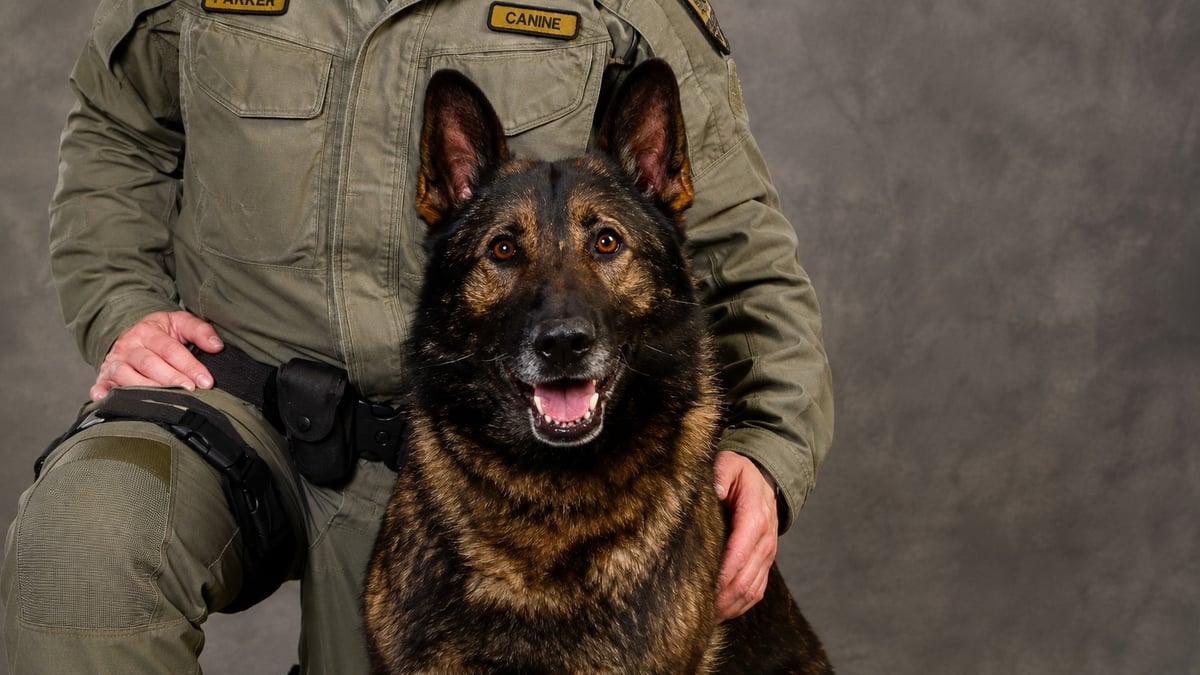
Larry came to Edmonton because his handler changed careers.
He was a patrol dog with the Medicine Hat Police Service, young and working, when the officer he was paired with became an NHL referee. Larry needed a new handler and a new city.
He found both with the Edmonton Police Service, and spent the rest of his working life with Sergeant Brian Parker.
The EPS Canine Unit announced this week that PSD Larry has died. He was 15.
The numbers
Larry and Parker attended more than 1,400 calls for service together. They were responsible for over 130 arrests.
In 2018 they competed at the Canadian Police Canine Association National Trials in Vancouver, where Larry placed first overall in the agility competition.
The team retired in 2019. Larry spent the years since with his family.
"Together, PSD Larry and Sergeant Parker served the Edmonton community with courage, integrity, resilience, and honor," the unit said.
They signed off the way police services do for their dogs: "PSD Larry (2011-2026): Forever Watchful, Never Forgotten."
What a general duty dog actually does
Fourteen hundred calls over roughly six working years is a heavy caseload, and most of it isn't what people picture.
Police service dogs on general duty work tracking above everything else. Fleeing suspects, missing people, evidence discarded in a hedge or a snowbank at three in the morning. A dog finds in minutes what a line of officers would need hours and daylight to cover, and often finds things people would walk straight past.
The arrests follow from that. A dog that tracks a suspect three blocks and holds them until officers arrive is the reason a file closes that night rather than sitting open.
Agility isn't decorative either. It's obstacle work, and it's the difference between a dog that can follow a track over a fence, through a culvert and across broken ground, and one that loses it at the first obstacle. Placing first nationally in that says something about how the dog worked in the field, not just in a ring.
Edmonton's canine unit
EPS has run police dogs since 1954, one of the older continuous canine programs in the country.
Handlers apply from within the service and compete for a small number of spots. The dog and handler train together for months before they hit the street, and they stay paired for the dog's entire working life. There's no reassignment, no rotation. One officer, one dog, until retirement.
Working dogs usually start around 18 months and retire somewhere between seven and nine years old, depending on how their joints hold up. Larry retired at eight.
The unit posts these announcements every time one of its retired dogs dies, which happens a few times a year and always draws more attention than the service expects.
Handlers and dogs
Police dogs live with their handlers. Larry went home with Parker every night for years, and when they retired, he stayed.
That's the part that makes these announcements land the way they do. A retired police dog isn't a decommissioned piece of equipment that goes back to a kennel. He becomes somebody's dog full time, which he already was.
Larry got seven years of that. For a working shepherd, that's a long and good retirement.
Sources:
Edmonton Police Service Canine Unit, public statement, August 2026




Comments
Conversation