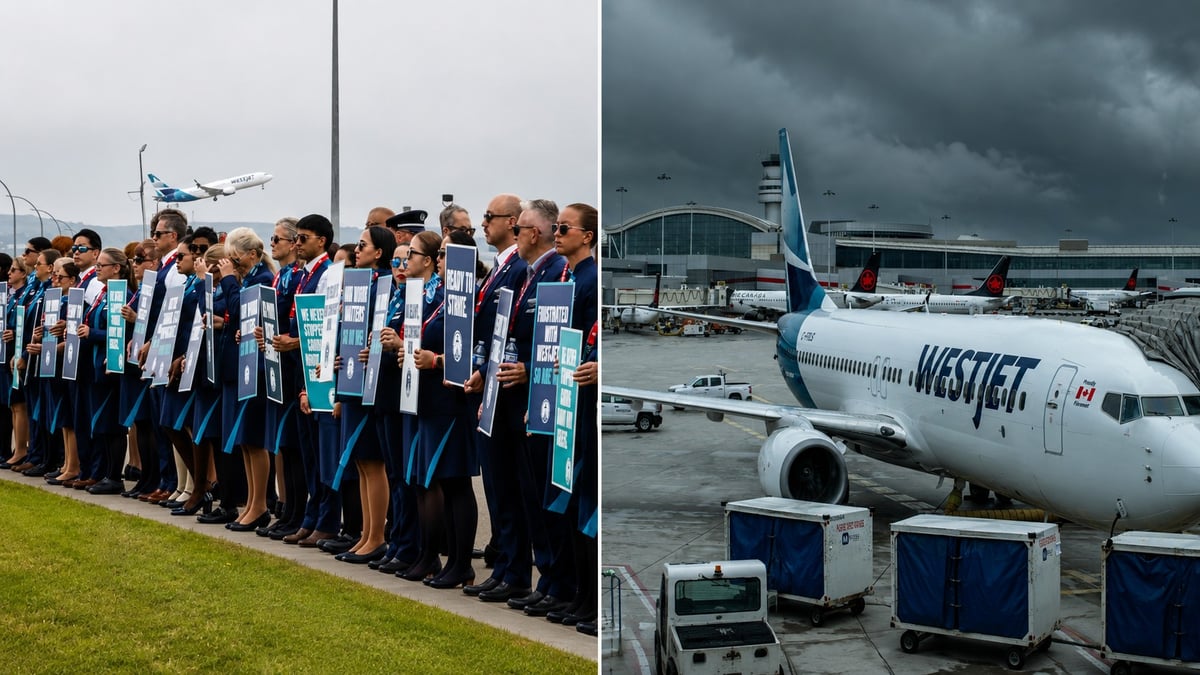
Carissa Fontaine and Karissa Sehn spent Saturday night on the floor at Toronto Pearson. They had just come back from Amsterdam and needed to get to Saskatoon, and they had been told it would be at least a couple more days.
"People were not helpful at all, unfortunately," Sehn said Sunday morning, standing at a WestJet check-in area that was noticeably emptier than it had been the day before. The two weren't sure where they were going to sleep, or what to do with themselves in a city neither of them lives in.
"I don't know," Fontaine said. "Is there a Jays game?"
WestJet's 4,400 flight attendants went on strike just after midnight, grounding the airline's mainline fleet on the busiest travel weekend of the summer. Roughly 600 flights were cancelled by the end of Sunday. Bookings are suspended through August 5, and longer if there's no deal. Encore flights, the Q400 turboprops, are still going.
At Vancouver International, 88 cancellations wiped out about a tenth of the airport's scheduled daily operations. The airport put extra staff in the terminal.
The thing not to do
Lindsay Williams had been awake since 4:30 in the morning trying to hold his spot in WestJet's customer service queue. It was up to seven hours. He's from the UK, and the Cancun leg of a Canada-and-Mexico trip was evaporating in front of him, a trip he'd planned after a close friend died. He rebooked with another airline for a later date.
That decision is more consequential than it looks.
Under the Air Passenger Protection Regulations, if you cancel or change your own booking before WestJet cancels the flight, you're no longer covered, even if WestJet cancels it an hour later. The rules protect passengers whose flights the airline cancelled. Not passengers who moved first.
Seven-hour queues are going to push a lot of people into doing exactly that this week.
Rebooking is stronger than the compensation rules suggest
The APPR treats a strike by an airline's own staff as outside the carrier's control, which knocks out the cash compensation for inconvenience that would otherwise run $400 to $1,000.
Everything else survives.
WestJet has to rebook you free on the next available flight it or a partner operates within 48 hours of your original departure. If it can't, it has to buy you a seat on a competitor, including airlines it has no interline agreement with. Class of service doesn't matter. If the only seat left is business and you paid economy, that's a free business seat.
You can also take a full refund, paid to your original method within 30 days. If you're already partway through a trip, WestJet flies you back to where you started, free.
Air Passenger Rights advises against the refund if you actually still want to go. Take it and the airline is done with you, and the replacement fare gets worse every day you wait.
Travel expert Barry Choi told Global News the rebooking rules aren't solving it for everyone. People are already being put on flights days out that are themselves likely to be cancelled.
Cross a border and the numbers change
Any itinerary with an international segment, including anything touching the US, picks up the Montreal Convention on top of the APPR.
That makes WestJet liable for what the delay actually costs you. Meals. Ground transport. Hotels. Phone bills. Lost wages. Prepaid nights and events at the other end. Up to roughly CAD$12,000 per passenger.
Airlines like to answer that with a fixed cap, $200 a night, $15 a meal. Those caps aren't lawful. In Air Passenger Rights v. WestJet Airlines Ltd., 2025 BCSC 155, the BC Supreme Court ordered WestJet to stop telling passengers otherwise.
If your trip started in the EU, the EEA or the UK, add cash on top: €300 for a three-to-four-hour delay, €600 past that, plus meals and a hotel. The European Court of Justice has already ruled that a strike isn't an extraordinary circumstance that gets an airline out of paying.
Check the date on your cancellation notice
Air Passenger Rights makes a distinction almost nobody else is making. A flight cancelled before the strike started isn't the same as one cancelled after.
WestJet began winding down jet operations Saturday and had been cancelling in the lead-up to the deadline. The organization routes passengers whose flights were killed preemptively, or by the airline locking out its own people, to a different set of rights.
Read what your notice actually says rather than assuming the strike covers it.
Paid only in the air
The fight is over ground pay. The boarding, the safety checks, the sitting on a tarmac managing a delay.
WestJet flight attendants earn between $28.88 and $53.61 per credit hour. Eighty credit hours a month is full time, which comes to $27,700 to $51,500 a year. McGill labour sociologist Barry Eidlin's summary is that they're generally paid only while the aircraft is in the air, in an era when delays keep getting longer.
The local voted 99.4 per cent for strike action in July. The contract expired December 31.
WestJet put out its latest offer a few hours after the walkout started: 13 per cent on October 1 backdated to January, then 2.5 per cent a year through 2029, a duty pay premium the company values at another 12 per cent, a 13 per cent per diem bump, $300 health spending accounts, more vacation, and a 17-week maternity top-up.
"We presented a proposal that would have set a new standard for cabin crew in Canada," said CEO Alexis von Hoensbroech.
Alia Hussain, who heads CUPE Local 8125, said it wasn't enough. "We are on strike because we believe we deserve better," she said, adding the union wants back at the table and wants Ottawa to stay out of it.
Cameron Jones, the local's reporting secretary, said the committee was already back at the table Sunday.
Air Canada did this last August
Ten thousand Air Canada flight attendants went out over the same issue. Jobs Minister Patty Hajdu had the labour board order them back inside 12 hours. They ignored it, stayed out two more days, and the airline came back to the table.
Hajdu called Sunday disappointing and repeated that the best deals get made at the table. She didn't say whether the government plans to step in.
Most of the industry has already moved. Delta started paying for ground work in 2022. American and Alaska added boarding pay at half rate. Air Canada's flight attendants won ground compensation in February that climbs to 70 per cent of hourly for the hour before pushback.
Nothing takes off the day it ends
Ian Lee, who teaches management at Carleton, points out that a grounded airline doesn't just start again. Planes get stored. Bringing them back means running them through safety checks first.
Anyone booked between July 30 and August 4 gets one free change or cancellation. WestJet is telling people to check flight status before driving to an airport.
Sources:
WestJet, flight interruptions and passenger rights: https://www.westjet.com/en-ca/interruptions
Air Passenger Rights, "WestJet Strike 2026: What Are My Rights?", August 2, 2026: https://airpassengerrights.ca/en/blog/westjet-strike-2026-what-are-my-rights
Air Passenger Protection Regulations, SOR/2019-150, sections 10, 18 and 18.2
Air Passenger Rights v. WestJet Airlines Ltd., 2025 BCSC 155
Vancouver Airport Authority statement, August 2, 2026
WestJet and CUPE Local 8125 news releases, August 2, 2026






Comments
Conversation