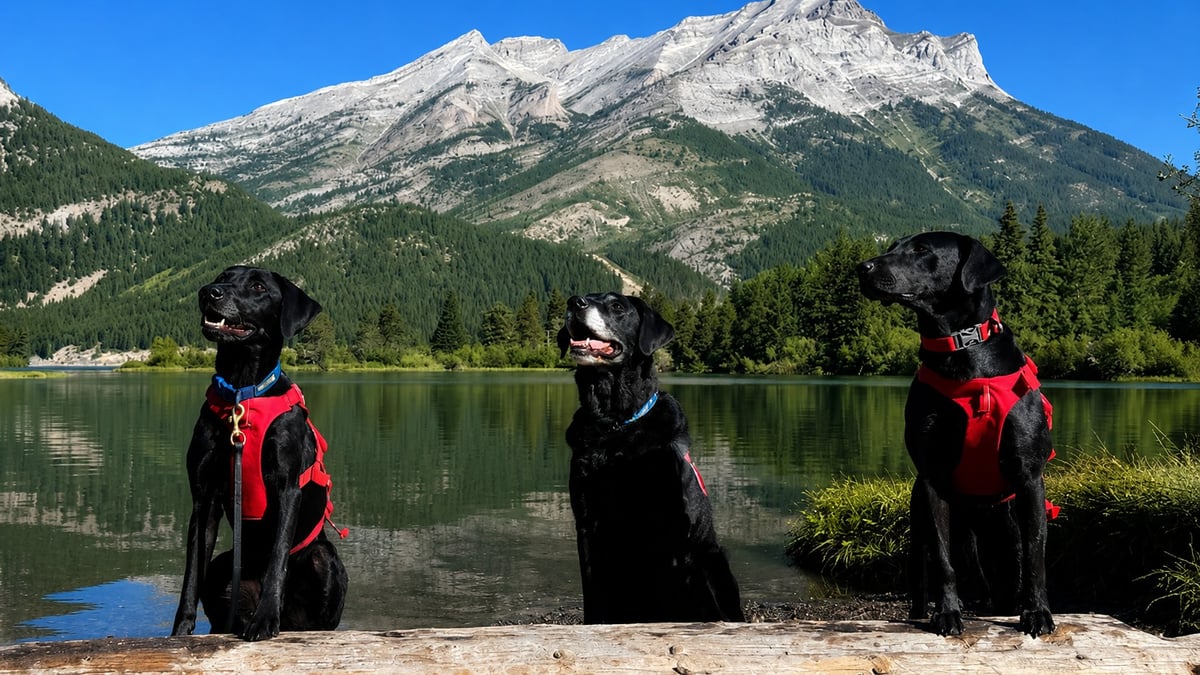
Alberta has two new weapons in the fight to keep its lakes clean, and they have tails.
The provincial government announced Tuesday it's adding two trained detection dogs, Jane and Winnie, to its Conservation K-9 program. They join Hilo, the veteran dog who has spent more than a decade sniffing boats and shorelines for invasive mussels, and their job is simple and serious: find the mussels before they get into Alberta's water.
"Together, we're strengthening Alberta's national leadership in prevention and safeguarding our lakes, rivers and streams for future generations," said Grant Hunter, Minister of Environment and Protected Areas.
Meet the dogs
The three make an unlikely conservation team, and the province leaned into their personalities in introducing them.
Hilo is the veteran, more than ten years on the job, methodical and careful on shift and, by the province's description, joyful and fun-loving off it. He's now mentoring the two newcomers.
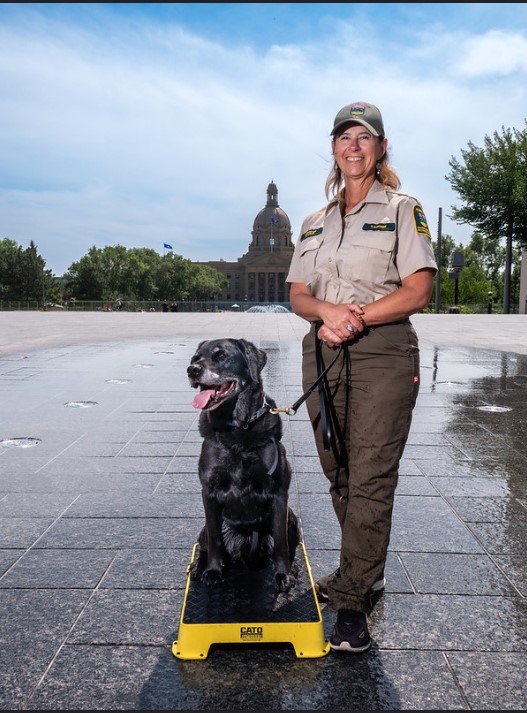
Jane is a black Labrador retriever who works through distractions with total focus and, off the clock, wants nothing more than a squeaky toy and a game of fetch.
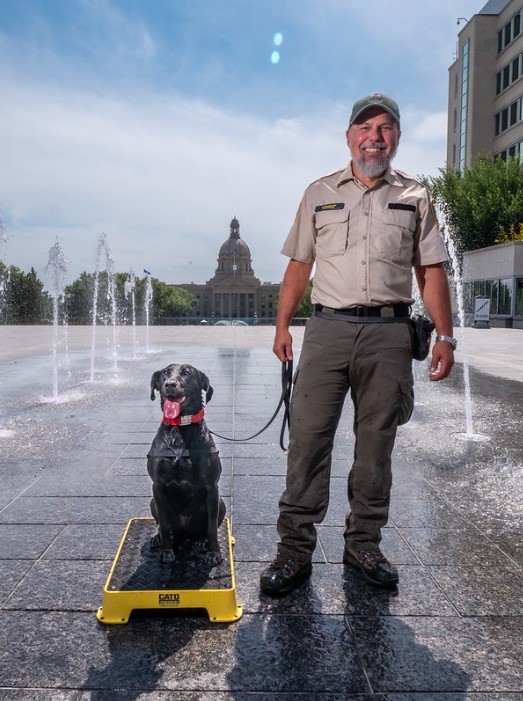
Winnie was found in a Kansas shelter as a puppy, where her charm and work ethic got her recruited as a working dog. She's the friendly, high-energy one, happiest with a toy in her mouth and someone nearby to tell her she's doing a good job.
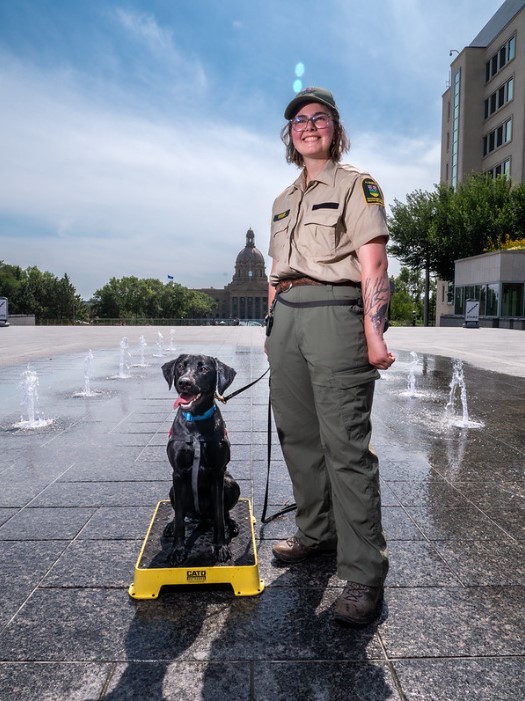
All three trained in the United States over the past several months, learning to identify all three known species of invasive freshwater mussels in North America, zebra, quagga and golden mussels, by scent.
Why a dog's nose is the right tool
This isn't a gimmick. A trained nose can find what a human inspector's eyes can't.
Working alongside watercraft inspectors, the dogs use their sense of smell to detect mussels in the hard-to-reach parts of a boat, inside compartments, in trapped water, in the tucked-away spots where a few microscopic larvae can hide. A single contaminated boat can seed an entire lake, so catching what's hidden is the whole game. As the Alberta Invasive Species Council's Megan Evans put it, the best way to stop invasive mussels is to prevent them from arriving in the first place, before, in her words, irreversible damage occurs.
Why "irreversible" is the right word
The reason Alberta spends so much effort keeping mussels out is that there's essentially no getting them out once they're in.
Invasive mussels reproduce explosively and attach to almost any surface. They clog water pipes, pumps and intake systems, damage power plant and irrigation infrastructure, foul boat engines, and coat lake bottoms and beaches with sharp shells. They filter so much plankton from the water that they starve out native species and can trigger harmful algae blooms. Once a waterbody is infested, the mussels are nearly impossible to eradicate, they resist chemical treatment, and the costs become permanent, an ongoing bill for scraping pipes and maintaining infrastructure that never goes away. That's why the province frames this as protecting not just the environment but the economy: agriculture, water infrastructure, power, and recreation all depend on mussel-free water.
A prevention program other provinces watch
Alberta talks about "national leadership" on this, and the numbers behind the boast are real.
The province runs one of the more aggressive aquatic-invasive-species prevention systems in the country, built on the principle that keeping mussels out is vastly cheaper than living with them. The math is stark: prevention costs a fraction of what a single infested reservoir would cost to manage forever. That's why Alberta has scaled up to a record 12 inspection stations, pairs them with detection dogs, and backs the whole thing with the continent's steepest fines. The dogs are the friendly face of a system that's fundamentally about economics, spending money now on inspections and Labrador retrievers to avoid spending far more later on infrastructure that mussels have permanently colonized.
It's also a system that depends on the public to work. Inspectors and dogs can only check the boats that stop. Every angler, cabin owner and weekend boater towing a watercraft into Alberta is part of the barrier, which is why the province keeps hammering the clean, drain, dry message alongside the enforcement. The dogs get the attention. The boaters who actually stop and get inspected are what keep the province's lakes clean.
Alberta is still winning this fight
The good news underneath all of it: Alberta's waters remain mussel-free, and the prevention system is catching contaminated boats before they launch.
So far in 2026, Alberta has intercepted six watercraft carrying invasive mussels trying to enter the province. In 2025, inspectors checked 21,995 boats, more than 8,495 more than the year before, and stopped 13 mussel-carrying watercraft, every one of them arriving from eastern Canada or the United States. This year the province is running a record 12 watercraft inspection stations, the most it has ever operated.
What this means if you own a boat
If you tow a boat, this affects you directly, and the rules have teeth.
From May 1 to September 30, inspections are mandatory for anyone entering Alberta with watercraft across the eastern and southern provincial borders. If the nearest station is closed when you pass, you're required to get your boat inspected within seven days, and before you put it in the water. Alberta's penalties for skipping this are the highest in North America: $4,200 for failing to stop at an open inspection station, and $600 for failing to remove your drain plug while transporting a boat in the province.
The province also promotes the simple habit that stops the spread: clean, drain, dry. Clean off any plants, mud and debris, drain all the water from your boat and gear, and let everything dry completely before moving between waterbodies. It's the boater's version of what Jane, Winnie and Hilo do with their noses.
Sources:
Government of Alberta, New dogs join Alberta's fight against mussels, July 29, 2026: https://www.alberta.ca/release.cfm?xID=96569D11D7BE3-DD93-E5BA-EC72343444BA08A4
Government of Alberta, Conservation K-9 Program: https://www.alberta.ca/conservation-k-9-program
Government of Alberta, Watercraft Inspections: https://www.alberta.ca/watercraft-inspections







Comments
Conversation