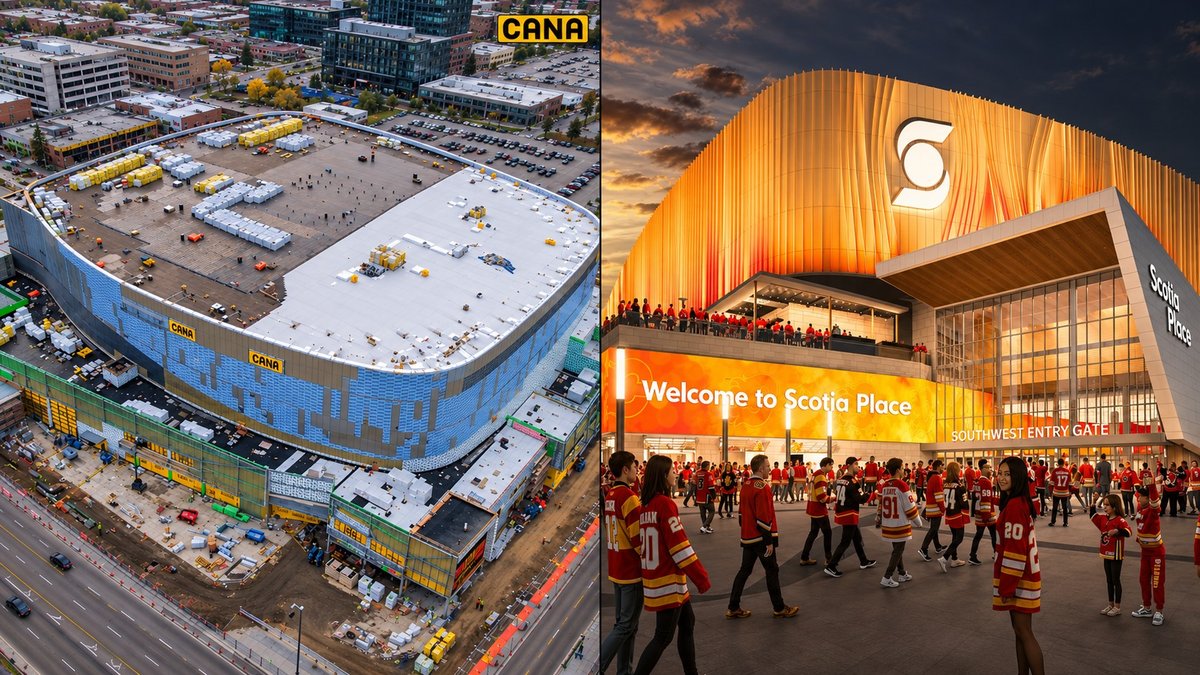
The roof over Calgary’s new arena is now holding itself up.
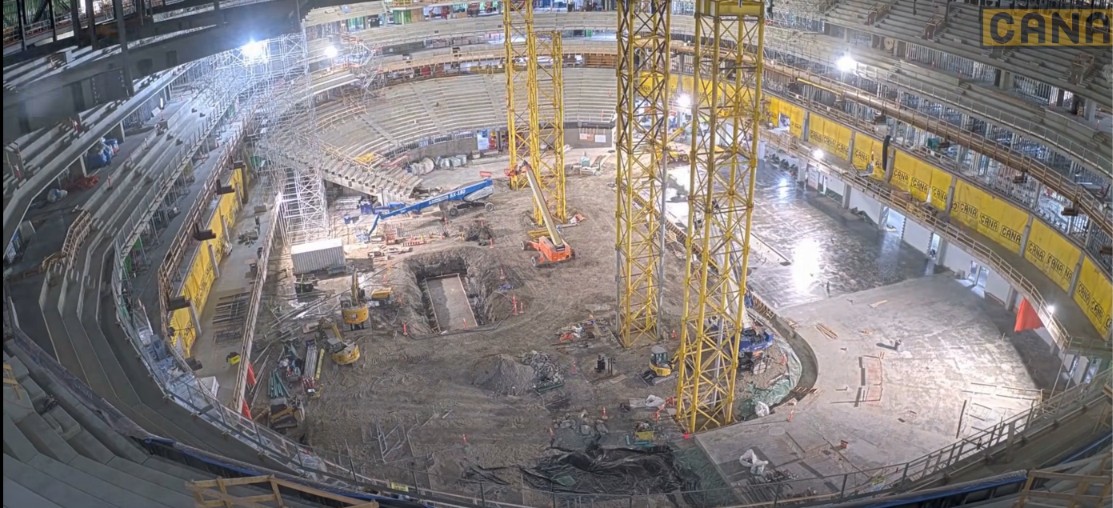
Crews removed all four temporary shoring towers from inside Scotia Place in October, according to the City of Calgary’s latest construction update. For the first time, nothing stands under the middle of the roof above the future arena floor.
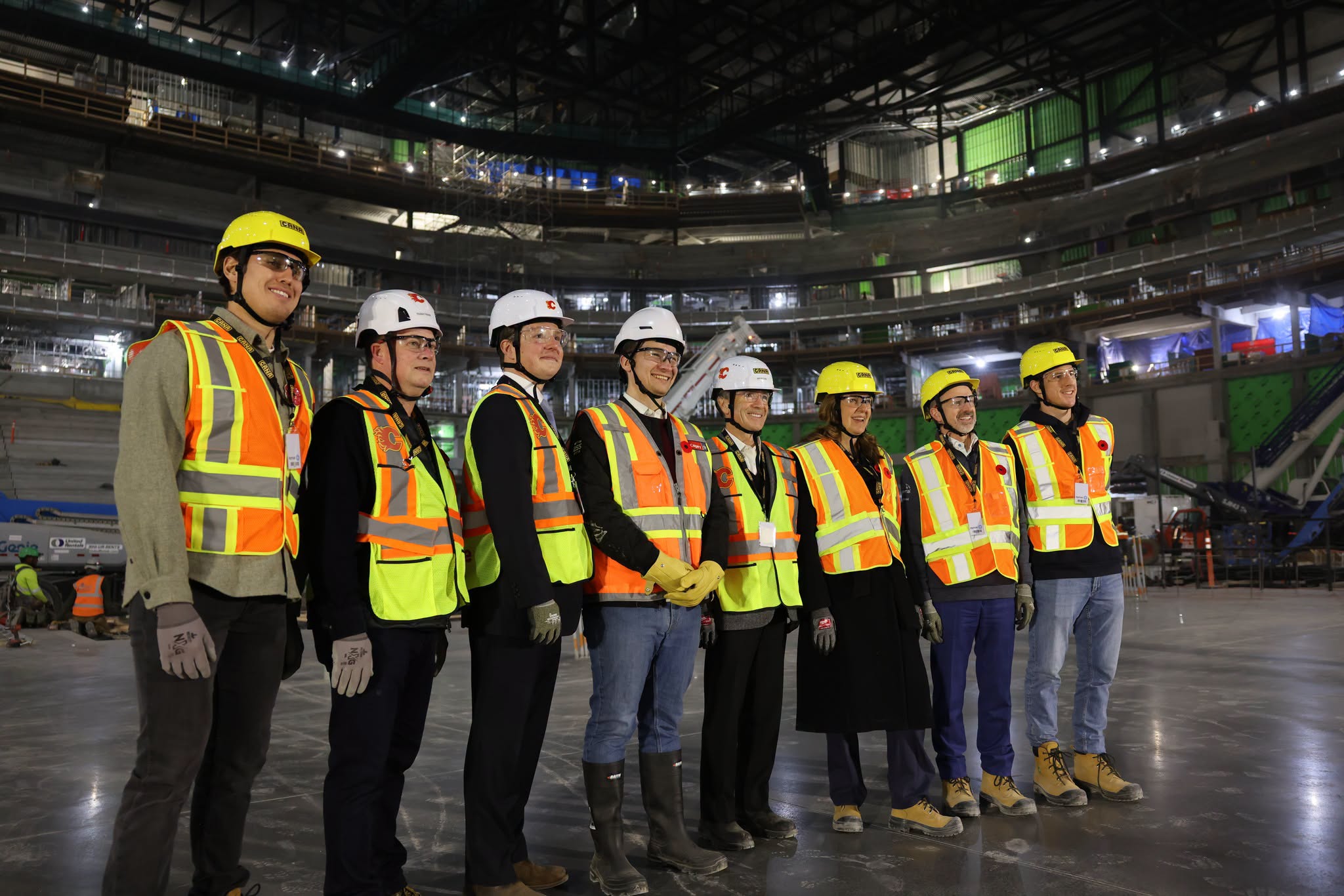
It’s one of the last big structural steps for the future home of the Flames. And it came the same week Premier Danielle Smith, Mayor Jeromy Farkas and Flames players walked through the building.
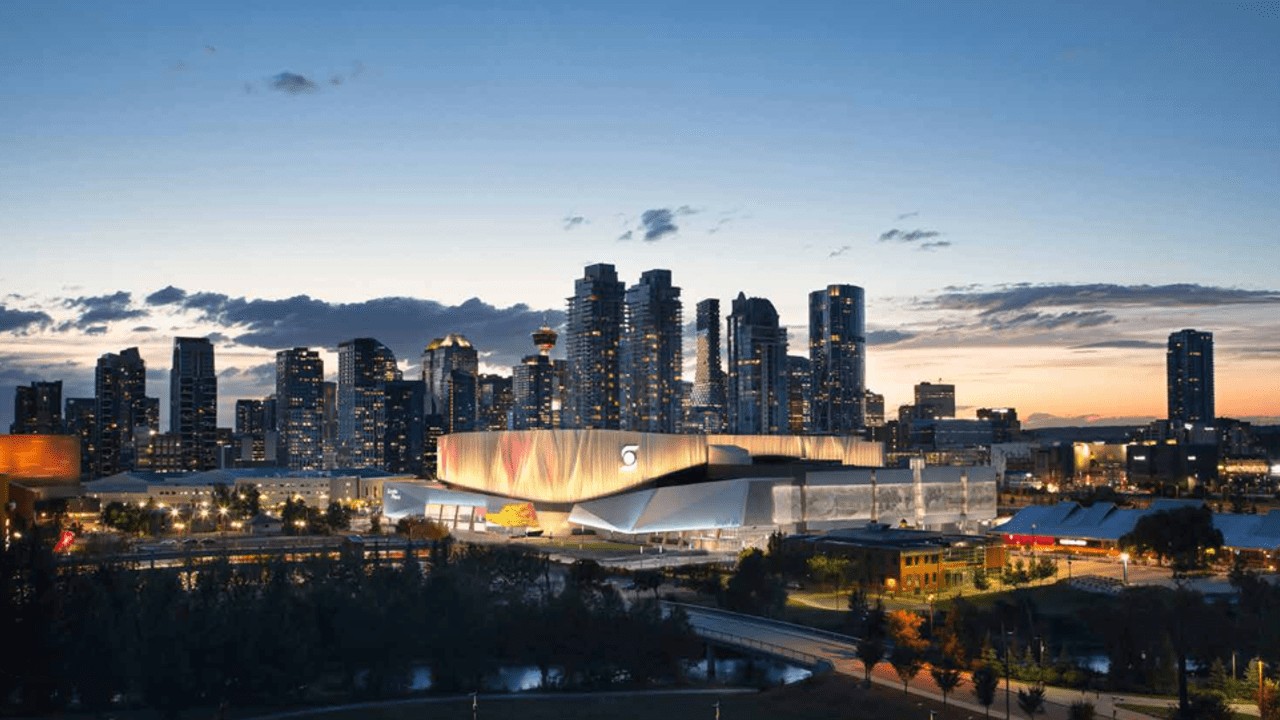
Scotia Place is scheduled to open in fall 2027, with a community rink, restaurants and public plazas around it in the Culture + Entertainment District.
By the numbers
18,400: seats for hockey and other sports
181 tonnes: roof rigging capacity for concert gear
7,760 tonnes: structural steel in the main arena
1,000: seats in the Esso Community Arena
3,000: people the outdoor Red Lot can hold
$800 million: the event centre itself
$1.22 billion: the full project, including the district
From the final steel beam to a self-supporting roof
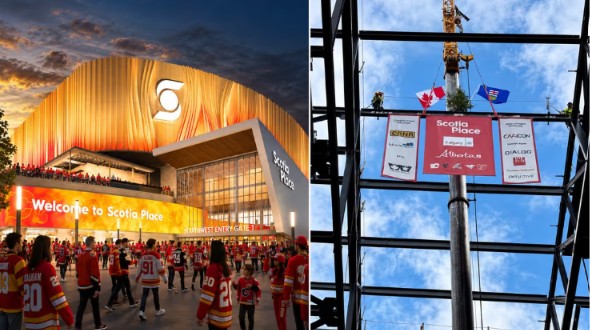
Two months ago, crews lifted the final structural steel beam into the main arena. That finished a frame made of about 7,760 tonnes of steel.
October moved the job indoors. The City says crews:
Removed all four shoring towers, leaving the roof self-supporting
Poured the event-level concrete slab from the north side to the southeast corner
Kept installing stadia, the stepped concrete sections that will hold the seats, on the north side
Started installing the upper concourse LED ribbon board
Put glass into the food hall
Added more fins to the northeast section of the roof’s “cauldron”
Continued work on the lower roofs along the west and north sides
The ice slab itself comes later. It’s one of the most complex pieces of the build, because the piping that makes the ice has to be built into it.
What fans will notice inside
Scotia Place will seat 18,400 for hockey and will be home to the Flames, Wranglers, Hitmen and Roughnecks.
The City says the design includes wider concourses, more food and drink options, better acoustics and “flex” washrooms meant to cut down the lineups at intermission.
For concerts, the biggest change is overhead. The roof can carry 181 tonnes of rigging, about 400,000 pounds. That’s enough for four times as much lighting and sound equipment as the Saddledome can hold.
The centre-hung scoreboard is retractable, so it can be pulled up out of sightlines for shows. For Calgary, that matters. Big touring productions have skipped or scaled down Saddledome dates because the 1983 roof couldn’t carry their gear.
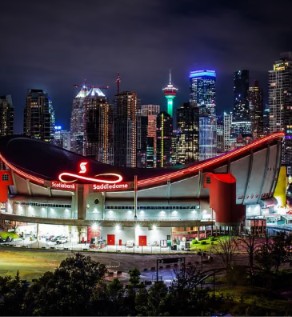
Saddledome vs. Scotia Place
| Saddledome | Scotia Place | |
|---|---|---|
| Opened | 1983 | Fall 2027 (scheduled) |
| Hockey seats | More than 19,000 | 18,400 |
| Roof rigging | Baseline | 4x the Saddledome |
| Centre scoreboard | Fixed | Retractable |
| Community rink | None | 1,000-seat Esso Community Arena |
| Outdoor fan zone | Temporary Red Lot | Permanent plaza for up to 3,000 |
Fewer seats for hockey means tickets won’t get any easier to find. The trade-off is a building designed for the shows the Saddledome couldn’t host.
A community rink below the plaza
October also brought a concrete pour for the roof of the Esso Community Arena, the second rink inside the complex.
The rink sits below the future south plaza, so people will gather on top of an NHL-sized sheet of ice. It will have 1,000 seats and dedicated evening and weekend time for community teams and groups.
Community bookings will be priced 15 per cent below the average rental rate at City of Calgary rinks, the City says. Local players will skate on the same ice the Flames, Wranglers and Hitmen practise on.
It’s also planned with universally accessible change rooms, accessible viewing areas and a design that can be adapted for sledge hockey.
Imperial’s Esso brand signed on as the rink’s partner in January. “Calgary is a hockey city,” Imperial chairman and CEO John Whelan said at the time.
The Red Lot gets a permanent home
Crews also installed structural steel for a large video board in the south outdoor plaza in October.
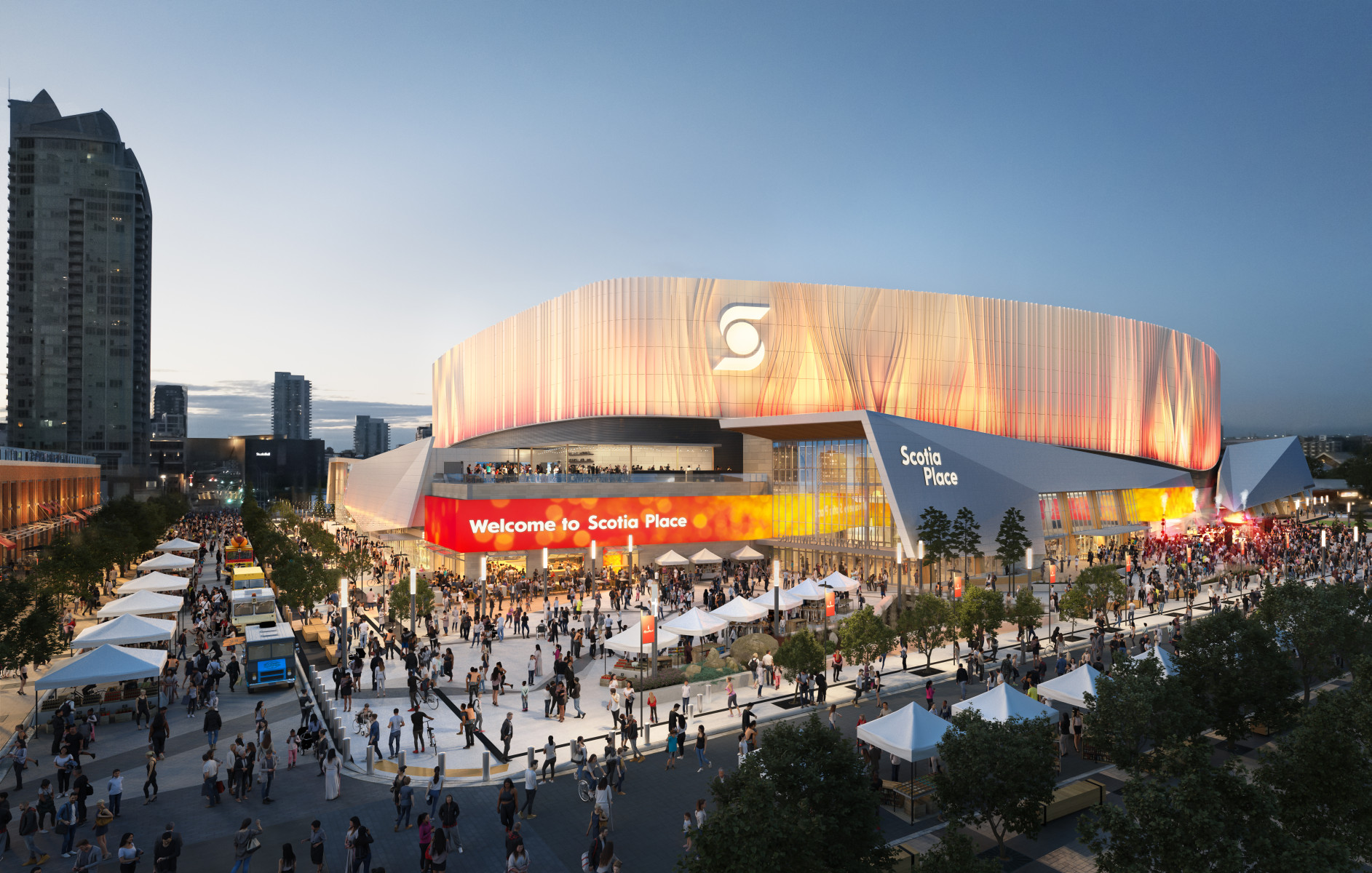
That plaza will be the permanent home of the Flames’ Red Lot. The City says it will hold up to 3,000 people for watch parties and events, and more than 5,000 when the neighbouring streets close to traffic for festivals.
Next to it, an indoor plaza will host markets, exhibits and community events. Outside ticketed and private events, it’s planned to be open to the public all year.
If the Flames make a deep playoff run in 2028, this is where the city will gather.
Why the outside looks like fire and ice
The building’s look is moving off the renderings and onto the walls.
The exterior is designed around four elements tied to Indigenous cultures and the history of the land:
Fire: The roof’s cauldron and its fins
Water and ice: Glacier-like features, with steel and envelope work under way where the first will go on the south side
Land: Alberta limestone, which crews began installing near the southwest entrance in October
Air: Large windows that bring daylight into the indoor plaza and food hall
Along 12 Avenue, crews are rebuilding the historic Stephenson Building into the new facade, piece by piece.
Smith, Farkas and Flames players get a look inside
The tour this week put the progress on display.
Smith thanked Flames players Zach Whitecloud and Ryan Strome for leading the visit, which included Farkas and provincial minister Devin Dreeshen.
“One of the best arenas in the NHL is rising in Calgary,” Smith posted on X. “I’m glad our government could assist getting this amazing arena and entertainment district to the finish line.”
The Flames said Whelan joined ownership, players and management to tour Scotia Place and the Esso Community Arena.

What the $1.22-billion price tag covers
The $1.22-billion figure covers much more than the arena.
The City lists $926.4 million for the Scotia Place block. That includes the $800-million event centre, plus the community rink, parkade and indoor and outdoor plazas. Another $296.9 million goes to transit connections, land, remediation and public spaces across the district.
Calgary Sports and Entertainment Corp., which owns the Flames, is paying $40 million up front. It’s also paying an annual lease that starts at $17 million and rises one per cent a year for 35 years. The City values that contribution at $356 million in today’s dollars.
The province is putting up to $330 million toward infrastructure, including land, roads, bridges and the eventual demolition of the Saddledome. That’s the “assist” Smith referred to.
The City says the project is tracking on schedule and on budget.
When does Scotia Place open?
Fall 2027, in time for the 2027-28 NHL season.
That makes this the Saddledome’s farewell year. The Flames’ last scheduled regular-season game there is April 10, 2027, against the Vancouver Canucks. It sold out in under a minute. A playoff run would buy the old building a few more nights.
The Saddledome opened in 1983. It hosted the 1988 Olympics and the 1989 Stanley Cup champions, and it came back from the 2013 flood. Its replacement is now standing next door, roof and all.
For the full background on the design and the district, see our guide to Scotia Place.
Sources
Calgary Flames and Imperial: Esso named official partner of the Scotia Place Community Arena
Premier Danielle Smith, post on X, Nov. 2026
Calgary Flames, Scotia Place tour post, Nov. 2026







Comments